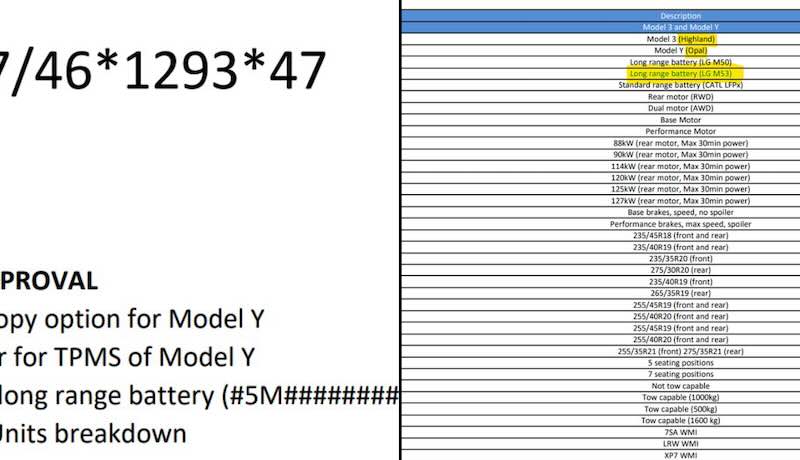
Tesla has updated its type certificate with version VC47, introducing the new “5M” Long Range battery configuration for Model 3/Y vehicles. Brings notable improvements in energy density while maintaining the existing cell architecture framework.
Model Y with 5M battery achieves a 5kg weight reduction compared to the 5L variant, while the Model 3 with 5M battery maintains equal weight to its 5L counterpart. Changes reflect Tesla’s ongoing battery optimization efforts as the company seeks to enhance vehicle efficiency and range performance.
Existing Tesla Model 3 Long Range utilizes LG’s INR21700-M50 cells, which are publicly available products featuring 5 Ah capacity per cell with a nominal voltage of approximately 3.63 V. Battery pack contains 4,416 cells in total configuration.
Setup produces a pack capacity of roughly 80.1 kWh (4,416 cells × 5.0 Ah × 3.63 V), aligning with published specifications. Current Model 3 Long Range RWD achieves an EPA-rated range of 363 miles (584 km) under standard testing conditions.
New 5M battery, also designated as M53, doesn’t correspond to any mass-produced LG cells currently available in the market. Industry reports suggest LG developed a custom version specifically for Tesla’s requirements, with each cell providing 5.3 Ah capacity.
Assuming voltage specifications remain unchanged, new pack would deliver approximately 84.9 kWh capacity (4,416 cells × 5.3 Ah × 3.63 V). Represents a 6% increase in energy density, potentially extending the estimated range to 619 km under EPA standards.
Model 3/Y type certificate update VC47 includes weight optimizations that could benefit overall vehicle efficiency. 5kg reduction in the Model Y variant provides marginal improvements in energy consumption, though the impact remains relatively small in practical driving scenarios.
Peak supercharging performance remains primarily limited by the cell’s C-rate capabilities and the battery management system’s thermal management protocols. Tesla hasn’t indicated major changes to thermal management architecture for this update, suggesting charging improvements will be incremental rather than revolutionary.
New pack may reach the 250 kW peak more quickly and sustain higher charging rates slightly longer, though total charging time won’t differ significantly. Performance remains far from achieving 5C or 10C charge rates that would represent breakthrough charging speeds.
For discharge performance, achieving maximum continuous discharge current comparable to Panasonic’s 2170 cells appears theoretically feasible. Could enable minor acceleration improvements in the Model 3 Performance variant, though gains will likely be modest rather than transformative.
As Tesla continues refining its battery technology through updates like VC47, the company demonstrates that incremental improvements can still deliver meaningful benefits—proving that sometimes the best upgrades are the ones that don’t require customers to completely recharge their expectations.
Related Post
Tesla Nevada LFP Battery Factory Nears Completion, Cuts China Dependence
Tesla 2025.8.3 Update: New Battery Health Test Feature Gives Owners Unprecedented Transparency
Tesla Cybercab: 300-Mile Range from Sub-50kWh Battery Promises Industry-Leading Efficiency