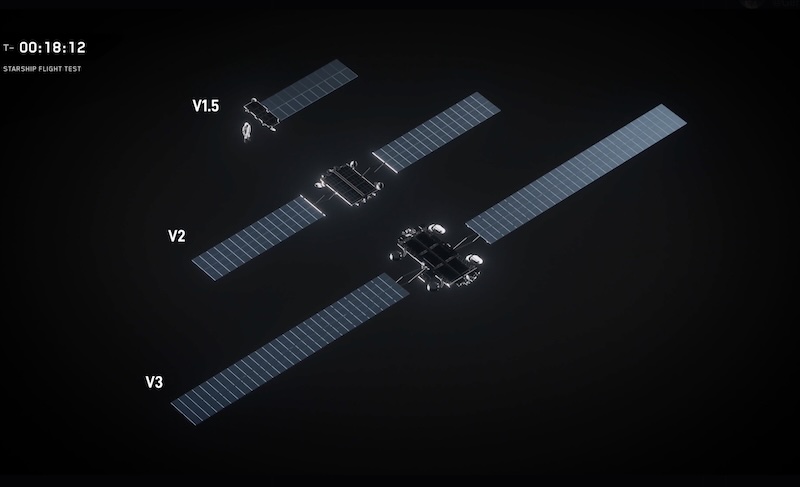
SpaceX rarely undersells its ambitions, but even by that standard, the latest Starlink projection stands out. Elon Musk announced upcoming Starlink V3 satellites, set to launch via Starship, will deliver over 100x the bandwidth of the current V2 system. That’s not a marginal upgrade. It’s the kind of leap that reshapes how analysts think about SpaceX’s communications arm and, by extension, Starlink’s multi-trillion future.
Elon was careful to draw a line between speculation and fact in his post. He noted that some claims about SpaceX carry aspirational weight, while others rest on confirmed engineering. 100x bandwidth figure falls into the latter category, he said, and it changes the revenue math considerably.
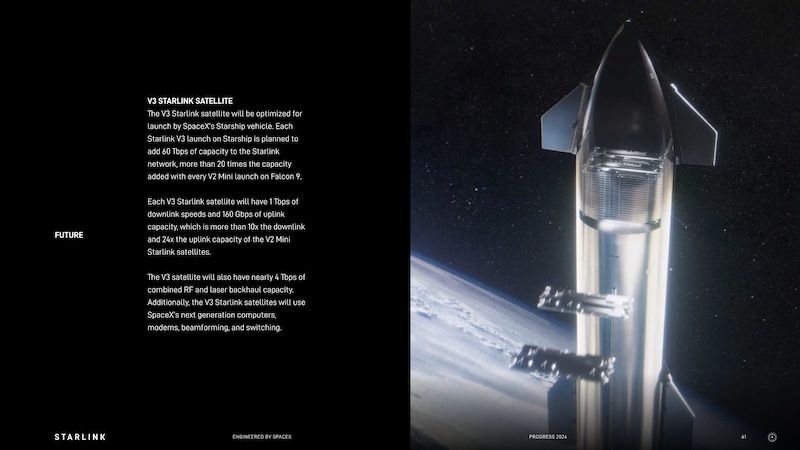
Two factors drive this projection, and neither works in isolation. Multiplier comes from two compounding factors: each V3 satellite carries 10x the bandwidth of a V2 unit, and SpaceX plans to launch more than 10x as many of them, putting the aggregate network capacity leap at over 100x. Multiply those two gains together, and the constellation’s total throughput doesn’t just grow. It compounds.
Elon framed the revenue implications directly. He projected the satellite internet system’s annual recurring revenue will reach $20 billion this year, and even if revenue per gigabyte declines tenfold in the future, SpaceX’s communications business could still generate over $200 billion annually. Even under a conservative pricing scenario, the business case holds up. That’s the part investors are paying attention to.
Cathie Wood’s reaction underscores how far this exceeds prior expectations. The ARK Invest chief noted that the bandwidth leap exceeded industry expectations, saying “we thought the increase in satellite bandwidth from V2 to V3 was 20X. 100X is astonishing.” When a longtime SpaceX bull calls a projection astonishing, it’s worth pausing on why.
Beyond raw bandwidth, the constellation’s physical footprint is expanding too. SpaceX recently applied to the Federal Communications Commission seeking approval to deploy up to 100k low-Earth-orbit satellites for its V3 network, supplementing the approximately 9,600 broadband V2 satellites currently in orbit. That’s roughly a tenfold increase in fleet size alone, before accounting for per-satellite gains.
Altitude changes add another dimension. V3 satellites will operate at a significantly lower orbital altitude of 350km instead of 550km, cutting the physics-limited round-trip latency roughly in half. Lower orbit means faster signal paths, which matters for real-time applications that current satellite internet struggles to support.
None of this happens in a vacuum. SpaceX went public earlier this year, and the company priced its IPO at $135 per share, resulting in a valuation of approximately $1.77 trillion. Starlink was already the centerpiece of that pitch. A hundredfold bandwidth increase only strengthens the argument that satellite internet, not rockets, is where the real money sits, and where Starlink’s multi-trillion future gets its clearest proof point.
The company hasn’t shied away from big claims before, and this one carries more engineering detail than most. Whether the market fully credits it depends on execution, not projection. But if the numbers hold, Starlink won’t just orbit the planet. It’ll orbit past every valuation skeptics assigned it, cementing its multi-trillion fate.
Related Post
SpaceX Q2 2026: $7.81B Revenue, AI Boom, and a Direct Warning to Telecom Giants
SpaceX IPO Filing Reveals $28.5T TAM, Starlink Profits, Retail Access — What You Need to Know
SpaceX Starship Flight 13: V3 Starlink Satellites Take Flight