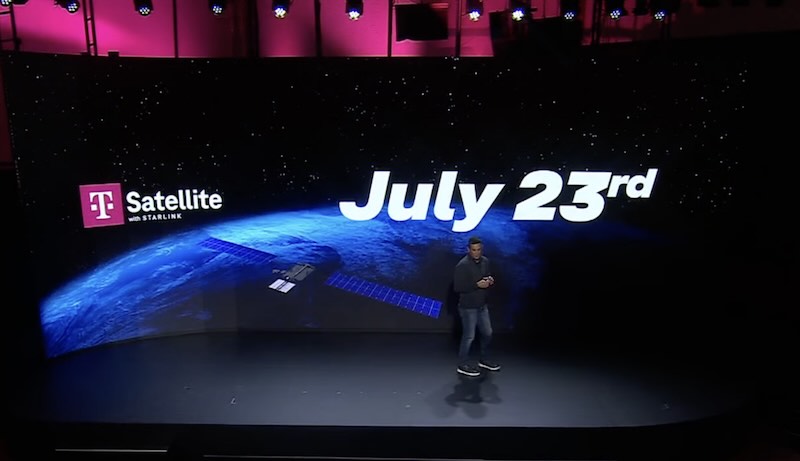
After months of testing through a free beta program that attracted nearly 1.8 million users, T-Mobile’s cellular Starlink service has officially launched today, July 23rd.
T-Mobile’s cellular Starlink service operates differently from SpaceX’s traditional broadband offering. While standard Starlink requires dedicated hardware for homes and businesses, this cellular version works directly with existing smartphones — no additional equipment necessary. Leverages SpaceX’s specialized satellites that function as orbiting cell towers, providing coverage where terrestrial infrastructure falls short.
Service targets users who frequently encounter dead zones, particularly those in rural areas where cell coverage remains spotty. By connecting directly to satellites overhead, subscribers can maintain communication capabilities even in remote locations where traditional carriers struggle to provide reliable service.
Starting today, T-Mobile begins charging for what it calls “T-Satellite” service. Current T-Mobile customers on premium plans — specifically experience beyond and Go5G Next — receive the service as a complimentary add-on. Other T-Mobile subscribers must pay an additional fee for satellite connectivity access.
Non-T-Mobile customers can also subscribe to the service for $10 monthly. However, accessing T-Satellite requires using a secondary eSIM slot on compatible devices, allowing users to maintain their primary carrier while switching to satellite connectivity when needed.
Pricing model reflects T-Mobile’s strategy to attract customers from competing networks while providing value-added services to existing subscribers on higher-tier plans.
Unfortunately, the sign-up process has become more complicated since the beta period ended. While beta participants could register entirely online, new non-T-Mobile customers must now call 877-686-8902 or visit retail locations to gain access. This change represents a deliberate strategy to encourage carrier switching rather than simply providing convenient satellite backup services.
Current beta users on AT&T and Verizon networks should expect automatic enrollment and billing starting today. T-Mobile notified these users on June 23rd about the transition to paid service, with charges beginning July 23rd. Users who participated in the beta but don’t want to continue paying can deactivate the service through their account management portal.
Field testing reveals that T-Mobile’s cellular Starlink works as promised, though with some caveats. Message transmission can experience brief delays when routing through satellite networks, and voice calls may encounter occasional latency issues. However, for users in areas with zero terrestrial coverage, these minor inconveniences pale compared to having no connectivity at all.
Service particularly benefits outdoor enthusiasts, rural residents, and professionals who work in remote locations. Urban users likely won’t find significant value in satellite connectivity, given the extensive cell tower coverage in metropolitan areas.
T-Mobile positions its cellular Starlink service as a solution to persistent rural connectivity challenges. Traditional cell towers require significant infrastructure investments that carriers often can’t justify in sparsely populated areas. By partnering with SpaceX, T-Mobile can provide coverage anywhere with clear sky visibility, potentially revolutionizing rural telecommunications.
The technology represents a fundamental shift in how carriers approach coverage gaps. Instead of building expensive towers in low-population areas, they can leverage existing satellite infrastructure to fill coverage holes cost-effectively.
This approach could pressure other major carriers to develop similar satellite partnerships or risk losing customers who need reliable connectivity in remote areas.
T-Mobile’s cellular Starlink launch puts competitive pressure on AT&T and Verizon to develop their own satellite connectivity solutions. While both carriers have explored satellite partnerships, neither has launched commercial services matching T-Mobile’s current offering.
Related Post
T-Mobile Starlink Direct-to-Cell Satellite Texting: SRG Test Results Reveal Truth
United Airlines Fixes Starlink Wi-Fi After Radio Interference
Starlink V3 Satellites Promise Sub-20ms Latency Launch in 6-9 Months