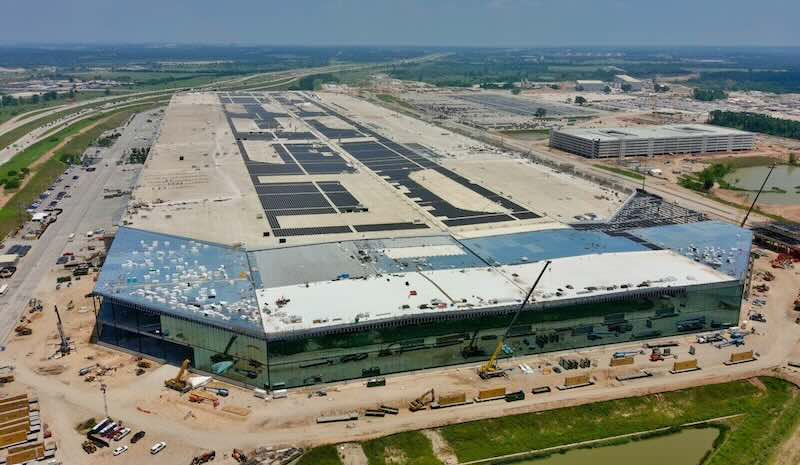
Tesla’s AI infrastructure has achieved a remarkable benchmark, reaching computational power equivalent to 110k H100 GPUs. Development represents 110 EFLOPs of processing capability, positioning the company at the forefront of automotive AI technology. Milestone demonstrates Tesla’s commitment to advancing autonomous driving capabilities through unprecedented computational resources.
Majority of Tesla’s computational strength originates from the Cortex cluster at Giga Texas. Facility houses an estimated 50k+ H100 GPUs alongside 16k H200 units, delivering combined performance equivalent to 67k H100 GPUs. Texas installation serves as the backbone for Tesla’s most demanding AI workloads.
Beyond the primary Texas facility, Tesla maintains additional computational resources through independent GPU clusters and Dojo systems across California and New York. These distributed resources ensure redundancy and provide specialized processing capabilities for different aspects of the company’s AI development.
Tesla’s FSD v13 has reached two significant milestones that validate the company’s AI approach. First, FSD demonstrates robust model generalization across major international markets. Capability indicates that Tesla’s AI can adapt to diverse driving conditions and regulatory environments without requiring extensive regional customization.
Second, FSD v13 has elevated end-to-end driving safety standards beyond traditional rule-based assisted driving systems. Achievement marks a transition from programmed responses to learned behaviors, representing a fundamental shift in autonomous vehicle technology.
Upcoming FSD v14 will dramatically expand model complexity, featuring 10× more parameters than its predecessor. This increase will push Tesla’s AI4 (HW4) platform to its memory bandwidth limits, essentially maximizing the hardware’s initial design specifications.
Remarkably, FSD v14 represents only the second model deployed on the AI4 (HW4) platform. However, the computational demands effectively utilize the platform’s full capacity, demonstrating how rapidly Tesla’s software requirements are advancing.
Current development trajectories suggest that interstate Robotaxi operations and fully unsupervised FSD functionality within the United States are approaching feasibility. Combination of enhanced computational power and improved model performance creates conditions favorable for commercial autonomous vehicle deployment.
However, international expansion remains more challenging. Regulatory frameworks, infrastructure differences, and regional driving patterns create variables that complicate timeline predictions for broader global rollout.
Tesla’s infrastructure milestone positions the company uniquely in the autonomous vehicle sector. With 110k+ H100 GPU equivalent capacity, Tesla’s AI ambitions aren’t just computing – they’re accelerating toward reality.
Related Post
Tesla Q2 Earnings Call Reveals Billion-Mile FSD Milestone and Ambitious Robotaxi Expansion Plans
Tesla Robotaxi Launches in Austin with $4.20 Flat Rate – First Autonomous Rides Begin
Stockholm Denies Tesla FSD Testing Despite European Expansion in Paris, Amsterdam and Rome