It’s not every day a company files for an IPO and casually claims it has identified “the largest actionable total addressable market in human history.” That’s exactly what SpaceX did when its S-1 prospectus went public, and the numbers inside it are, frankly, difficult to process in one sitting. From Starlink’s explosive profitability to asteroid mining listed as a future revenue line, the SpaceX IPO filing reads less like a regulatory document and more like a strategic declaration of intent.
The filing covers everything — voting structures, Bitcoin holdings, AI user counts, and a retail investor offering that’ll let ordinary people buy in through Robinhood or Fidelity at the same price as institutional buyers. There’s a lot to unpack here.
Let’s start with the revenue story, because it’s the clearest signal of where SpaceX’s near-term value actually sits.
The company’s Connectivity segment — driven almost entirely by Starlink — generated $11.38 billion in revenue in 2025, with income from operations of $4.42 billion and Segment Adjusted EBITDA of $7.16 billion. Year-over-year growth came in at 49.8% on revenue, with operating income nearly doubling at 120.4%. That’s not incremental growth — that’s a business scaling rapidly while simultaneously improving its margins.
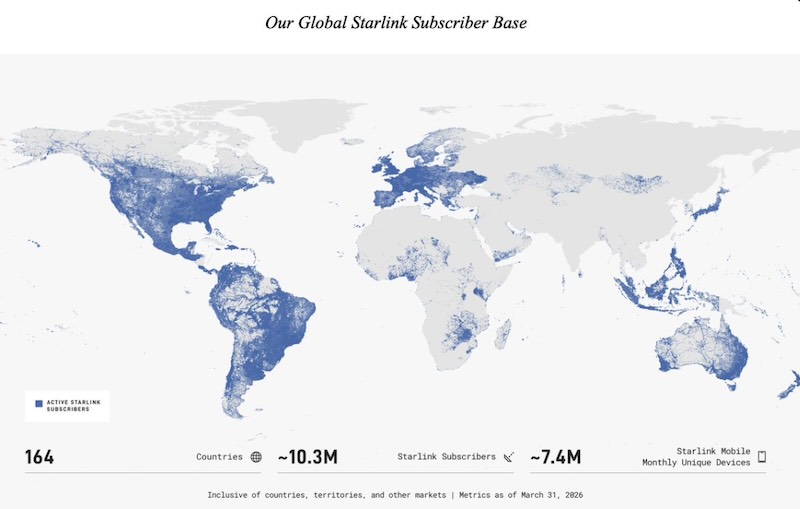
Into Q1 2026, the momentum didn’t slow. Connectivity segment pulled in $3.25 billion in revenue for just the three months ended March 31, 2026, with $1.18 billion in operating income. Subscriber growth, enterprise adoption, and network efficiency improvements were cited as the primary drivers.
SpaceX estimates its total addressable market at $28.5 trillion — a figure that, to be fair, the company arrived at by including AI infrastructure, enterprise software, digital advertising, and consumer subscriptions alongside its core space and broadband businesses. $26.5 trillion AI slice alone accounts for the bulk of it, with $22.7 trillion attributed to enterprise applications.
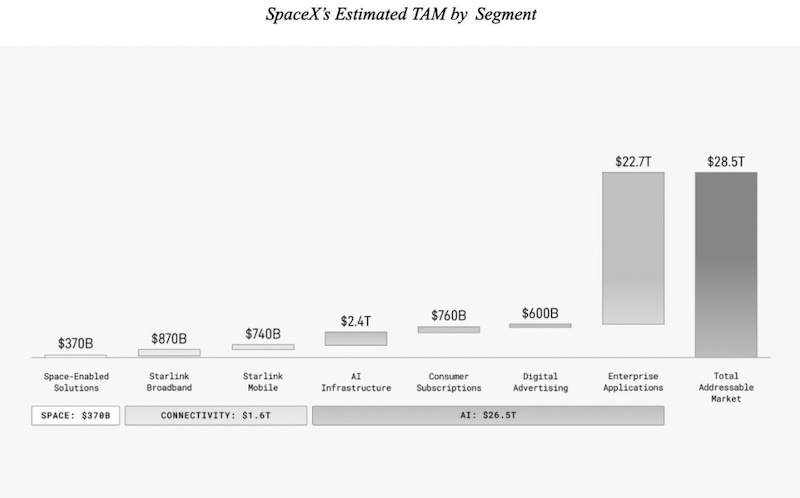
Excluding China and Russia from global estimates is a notable caveat, though it doesn’t meaningfully shrink a number that size.
Elon Musk controls 85.1% of combined voting power through 5.57 billion Class B shares, with an additional 849.5 million Class A shares representing 12.3% economic ownership. That’s an unusual arrangement for a public company, and investors should go in knowing that minority shareholders will have virtually no say in corporate direction.
The lock-up structure is notably more sophisticated than a standard 180-day blackout. Instead, insiders face a staggered release schedule — 20% unlocking after Q2 2026 earnings, followed by tranches tied to stock performance thresholds and calendar milestones. Musk himself is excluded from the early-release provisions entirely, meaning his shares stay locked longer than everyone else’s. Whether that’s a trust signal or simply a legal necessity given his ownership concentration is worth considering.
The SpaceX IPO will be accessible through Charles Schwab, Fidelity, Robinhood, SoFi, and E*Trade — at the same IPO price as institutional buyers. That’s a meaningful commitment. The filing states explicitly that retail purchases “will be at the same IPO price, and at the same time, as any other purchases in this offering.” It removes the typical information and pricing asymmetry that disadvantages individual investors in most large IPOs.
Tesla holds 18,990,195 Class A common shares of SpaceX as of May 1, 2026 — an intriguing cross-ownership detail that ties the two Musk-led companies more formally together on paper.
The filing confirms SpaceX holds 18,712 Bitcoin, currently valued north of $1.45 billion. The company’s AI platform, anchored by Grok, counts 117 million monthly active users as of March 31, 2026, out of approximately 550 million total MAUs across its integrated platforms.
SpaceX also listed asteroid mining among its future market opportunities — alongside in-orbit manufacturing, lunar cargo transport, and Mars operations. The company was careful to note these industries “do not exist today,” but their inclusion signals how broadly leadership defines the company’s eventual scope.
Corporate AI operations are headquartered in Palo Alto, where the teams responsible for Grok’s design and training are based.
When a company files for a public offering and lists asteroid mining as a line item, it’s safe to say this isn’t your average SpaceX IPO — it’s a space for something far larger.
Related Post
SpaceX TeraFab Eyes Grimes County TX for $119B Chip Fab Megaproject
The All-In Podcast: SpaceX IPO, Tesla, The Space Opportunity
SpaceX Starlink Hits 9M Customers With Record Growth, Satellite Internet Expansion