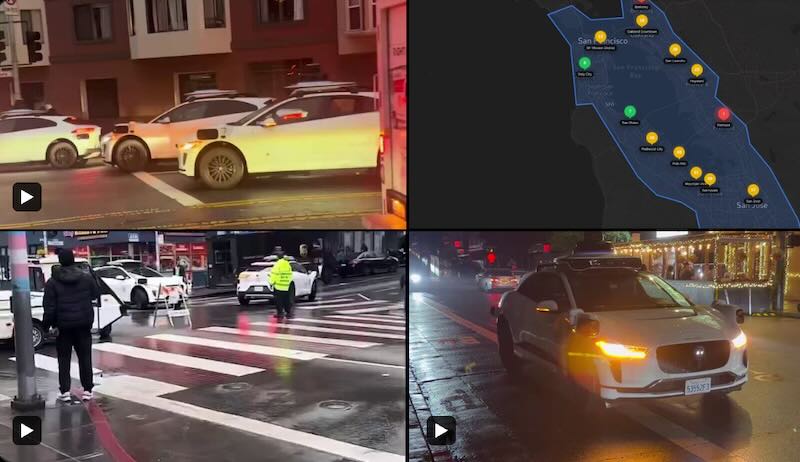
San Francisco experienced an unusual traffic crisis recently when dozens of Waymo autonomous vehicles simultaneously froze at intersections across the city. Incident wasn’t caused by a software glitch or cyber attack—instead, a fire at a Pacific Gas and Electric substation triggered a power outage that disabled traffic signals throughout roughly 30 percent of the city, affecting approximately 130k residents.
Power failure created an immediate challenge for Waymo’s autonomous fleet. As each vehicle approached an intersection where traffic lights were no longer operational, system activated hazard lights and stopped. Critically, these vehicles didn’t just pause momentarily, they remained stationary in the middle of intersections, effectively blocking traffic flow across multiple areas.
San Francisco police were eventually dispatched to manually clear the gridlock, physically moving or directing the immobilized vehicles. Response time and manual intervention required suggest that Waymo’s remote operations team either couldn’t respond quickly enough to the scale of the failure or lacked the technical capability to remotely override and redirect dozens of vehicles simultaneously.
Waymo hasn’t released an official statement addressing the incident, but the underlying issue appears straightforward: the Waymo Driver system lacks programming for scenarios where traffic signals fail completely. Represents a significant gap in operational planning, particularly for a service operating in urban environments where infrastructure failures occur periodically.
Interestingly, a similar situation arose during recent testing of Tesla’s FSD system in Los Angeles. When encountering non-functional traffic lights, FSD v13 reportedly applied alternating right-of-way protocols, analyzing oncoming and cross traffic patterns to navigate through the intersection without disrupting flow or requiring manual intervention.
Contrast highlights a fundamental difference in autonomous vehicle philosophy. Waymo’s approach has successfully earned regulatory approval and consumer confidence through controlled deployment and extensive mapping, achievements that enabled the first commercial Robotaxi operations. However, San Francisco incident raises questions about scalability.
True generalization requires systems that can reason through unprecedented scenarios in real time. Edge cases can’t be exhaustively cataloged and programmed in advance. Without foundational AI models capable of dynamic inference, autonomous systems will continue encountering situations they simply weren’t designed to handle, no matter how many miles they’ve driven or how detailed their maps become.
Tesla CEO Elon Musk responded to news of the incident on X, stating that “Tesla Robotaxis were unaffected by the SF power outage.” Whether that claim reflects actual operational capability or opportunistic marketing remains to be verified, but Waymo traffic light failure certainly didn’t illuminate the company’s readiness for widespread deployment.
Related Post
Elon on Waymo: “Never really had a chance against Tesla” Waymo Details AI Safety Strategy
Waymo Partners With DoorDash for Autonomous Food Delivery in Phoenix – What You Need to Know
Tesla vs Waymo: Kyle Vogt Explains the Real Robotaxi Divide That Matters Most