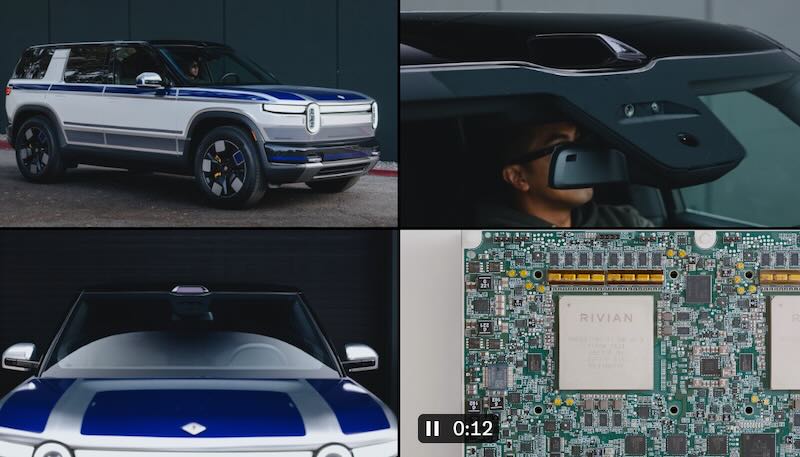
Rivian has taken the wraps off its most significant technological leap yet, a complete autonomy platform built around custom silicon and machine learning infrastructure. Rivian announced its Gen 3 autonomy hardware, anchored by RAP1, an in-house designed chip fabricated on TSMC’s 5nm process node. Positions Rivian alongside Tesla in the exclusive club of automakers developing proprietary silicon for autonomous driving applications.
Announcement signals Rivian’s commitment to vertical integration across its technology stack, from sensor fusion to inference processing. Unlike competitors relying on third-party suppliers, the company has chosen to design critical components internally, betting that specialized hardware will unlock performance advantages in real-time processing workloads.
Rivian Autonomy Platform represents a substantial upgrade from previous generations. Sensor suite includes 11 cameras capturing 65 total megapixels, 5 radars, a new front-facing LiDAR unit. Multi-modal approach provides redundant sensing capabilities, essential for handling edge cases that confound single-sensor systems.
RAP1 itself delivers over 800 TOPS through a multi-chip module design featuring a custom neural engine. Compute module 3 achieves 1,600 sparse INT8 TOPS with processing capacity reaching five billion pixels per second. That’s serious computational firepower for vehicles operating in dynamic environments.
The RAP1 architecture includes RivLink, a low-latency interconnect technology enabling multiple chips to work in parallel. Design choice means Rivian can scale processing power by connecting additional modules, critical for future iterations requiring greater computational resources. Also developed proprietary AI compiler tools and platform software optimized for RAP1’s architecture.
Rivian’s approach centers on an end-to-end AI system trained using techniques borrowed from large language models. The company’s large driving model employs group-relative policy optimization to extract superior driving strategies from massive datasets. Foundational model continuously improves through data collected from the fleet, each mile driven contributes to system-wide learning.
Closed-loop training pipeline represents Rivian’s philosophical departure from rule-based systems. Rather than programming specific responses to predetermined scenarios, the neural networks learn generalizable behaviors from real-world driving data.
Current second-generation R1 vehicles will receive Universal Hands-Free functionality in early 2026 through over-the-air updates. This feature enables hands-free assisted driving across 3.5 million miles of roads throughout the USA and Canada, operating on highways and clearly marked off-highway routes.
Rivian Autonomy+ subscription service launches alongside UHF updates, priced at $2,500 as a one-time purchase or $50 monthly. The company projects a clear development trajectory: point-to-point navigation, eyes-off capability, and eventually personal L4 autonomy.
Full Gen 3 autonomy hardware integration—including ACM3 and LiDAR, is currently undergoing validation testing. Rivian expects this technology to ship on R2 models beginning late 2026, giving the company roughly two years to refine algorithms and validate safety performance.
R2 platform represents Rivian’s volume play, with more accessible pricing targeting mainstream buyers. Bundling advanced autonomy capabilities from launch could differentiate R2 in an increasingly crowded EV market.
Rivian’s betting its autonomous future rides on RAP1’s processing capabilities and software expertise, a calculated risk that could accelerate the company’s evolution beyond pure hardware manufacturing.
Related Post
Rivian 2026 Quad-Motor Launch Edition: 1,025 HP, Tank Turn & 400 Mile Range
Rivian R2 Platform Becomes Backbone for All Future Volkswagen EVs
Rivian Launches Also Inc: Spin-Off Venture Focused on Electric Micromobility Solutions