SpaceX has officially confirmed plans to go public in 2026, marking a turning point for the aerospace company that’s resisted outside investors for years. Elon Musk announced the decision with a clear justification: building and deploying satellites designed to function as data centers in orbit requires substantial capital. “It will take a lot of cash to design and build the satellites and launch the rockets to deploy data centers in space,” Elon stated, signaling that SpaceX will use the IPO proceeds to accelerate development of what could become the next frontier in AI infrastructure.
Timing isn’t coincidental. Former SpaceX employee Abhi Tripathi, who spent over a decade at the company starting in 2010, explained that Musk’s commitment to an IPO became inevitable once SpaceX recognized Starlink satellites could be architected into a distributed network of orbital data centers. “That is the moment an IPO suddenly came into play after being unlikely for so long,” Tripathi noted, adding that the move reflects Musk’s pattern of fully committing once he identifies a strategic direction.
Advantages of operating data centers in orbit aren’t just theoretical, they’re grounded in physics. Gavin Baker, Managing Partner and CIO, outlined the fundamental benefits that make orbital facilities superior to terrestrial alternatives. Satellites positioned in orbit can maintain constant sun exposure, receiving solar irradiance that’s 30% more intense than on Earth. Translates to 6 times more available energy without requiring battery storage systems that add weight and complexity.
Cooling presents another area where space offers distinct advantages. Traditional data centers on Earth require elaborate cooling infrastructure that consumes significant energy. In orbit, thermal management becomes straightforward—radiators mounted on the satellite’s dark side provide passive cooling at zero operational cost. Network latency also improves because lasers traveling through vacuum move faster than light passing through fiber optic cables, creating a more responsive network architecture.
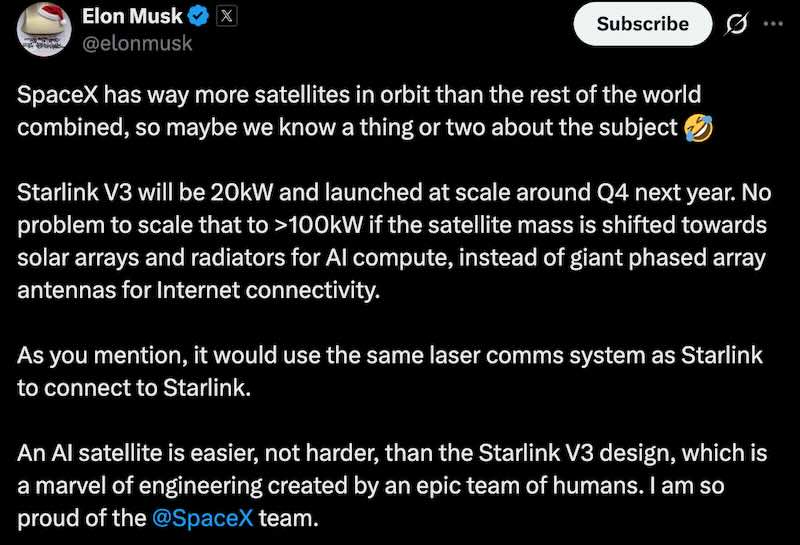
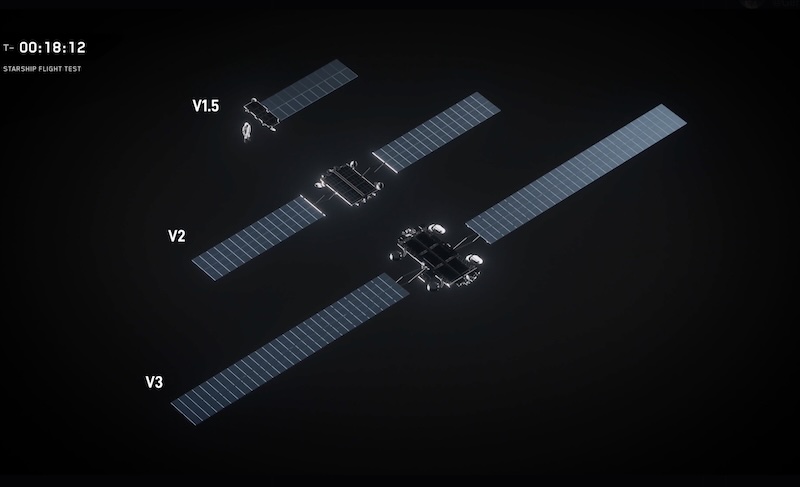
SpaceX already operates more satellites than the rest of the world combined, giving the company unmatched experience in orbital operations. Elon pointed to this track record when addressing skepticism about the technical feasibility of space-based AI compute. The company’s Starlink V3 satellites, scheduled for scaled deployment in Q4 2025, will operate at 20 kilowatts, promise sub-20ms latency. Scaling that design to over 100 kilowatts for AI-focused satellites would require shifting mass allocation from communications hardware toward solar arrays and radiators, a modification Elon described as easier than the current Starlink design.
Satellites would leverage existing Starlink laser communication systems for inter-satellite links, building on proven technology rather than requiring entirely new development. Elon emphasized that designing AI satellites would actually prove simpler than creating the “marvel of engineering” represented by Starlink V3.
Operating data centers in orbit raises obvious questions about maintenance and repairs. Initial deployments will likely treat satellites as disposable units—entire satellites get replaced when internal failures accumulate beyond acceptable thresholds. Approach avoids the complexity of orbital servicing missions while SpaceX refines the architecture.
Over time, the design could evolve toward modular construction where individual units connect physically and can be swapped as needed. Eventually, robotic systems might enable component-level repairs, though that capability remains years away. Progression mirrors how terrestrial data centers evolved from monolithic designs to modular, hot-swappable infrastructure.
Tripathi characterized the IPO strategy as part of the broader AI race, where success depends on deploying assets faster than competitors. Capital raised through going public would give SpaceX a “large war chest” that creates competitive advantages while putting rivals at a disadvantage. Financial firepower matters because establishing orbital data center networks requires massive upfront investment before generating revenue.
For investors, SpaceX presents an unusual opportunity, a company with demonstrated technical capabilities, existing infrastructure, and a clear vision for expansion entering public markets. Whether orbital data centers become the standard for AI computation remains to be seen, but SpaceX has certainly positioned itself to find out if the sky’s no longer the limit.
Related Post
SpaceX Doubles Valuation to $800B with 2026 IPO Plans as Starlink Drives Growth
SpaceX Raptor 3 Engine to Beat Merlin by 4X on Cost Efficiency | Elon Musk Confirms