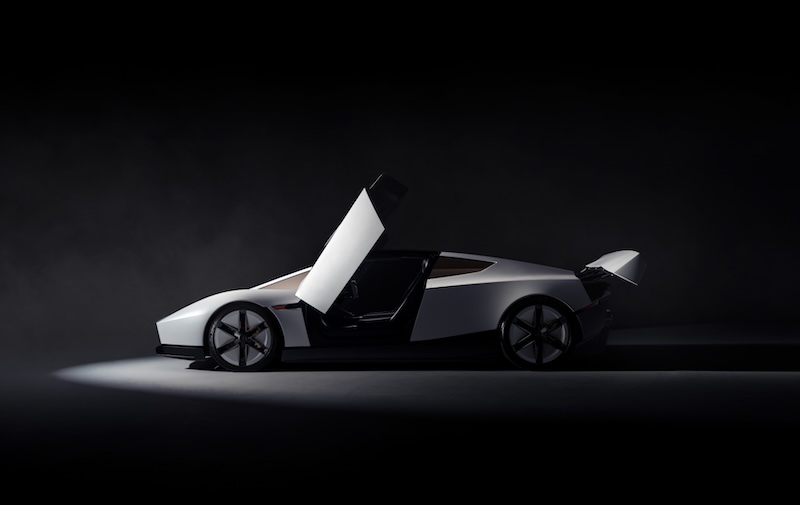
Tesla has never lacked ambition, but the newly unveiled next-generation Roadster signals something different, a convergence of automotive engineering and aerospace technology that’s genuinely difficult to categorize. Positioned as “The last best driver’s car,” this isn’t just a performance EV. It’s a provocation. And with three distinct configurations targeting different buyer profiles, Tesla is essentially arguing that the future of the automobile isn’t one thing. It’s three.
The lineup breaks into Performance, Thrust, and Rocket — each with a clearly defined purpose.
Performance is the version most buyers will actually consider. It seats two, incorporates active aerodynamics, and features a multi-mode suction system designed to maximize grip at speed. It’s still a Tesla Roadster, which means specifications that would’ve seemed implausible five years ago are now listed as baseline targets.
Thrust escalates considerably. Rear-mounted cold-gas thrusters become part of the powertrain equation, with Tesla targeting a 0–60 mph time of under 0.9 seconds. To put that in context, that figure sits well below anything currently road-legal. Thrust requires a $250k deposit, a signal of who this configuration is built for.
Then there’s Rocket, which frankly operates in its own category. Cold-gas thrusters are mounted around the entire vehicle, enabling acceleration in every direction — including, Tesla claims, brief periods of hovering or flight. Sub-0.59-second 0–60 times, a top speed exceeding 230 mph, and a 300-plus-mile range are among the stated targets. It’s non-road-legal, available only by invitation, and priced in a range Tesla hasn’t announced yet. Honestly, that might be the most revealing detail of all.
Headline engineering story behind the Tesla Roadster isn’t the numbers, it’s where the technology originates.
COPVs, or composite overwrapped pressure vessels, store the compressed gas powering the thruster systems. These are directly derived from SpaceX rocketry applications. Active aerodynamic wings are driven by Optimus actuators, with claimed downforce levels approaching F1 specifications. The suction system, meanwhile, is designed to generate enough ground-sealing force to theoretically hold the vehicle inverted.
Lightweight construction relies on magnesium, titanium, and carbon fiber throughout. Aviation-grade surface treatments further distinguish the Roadster’s build philosophy from conventional automotive production. This isn’t incremental improvement, it’s a transfer of aerospace manufacturing discipline into a consumer vehicle context.
Elon post — simply “Tesla x SpaceX” — landed the same evening SpaceX launched the USSF-481 mission from SLC-4E in California, with the Falcon 9 booster landing on the drone ship Of Course I Still Love You. SpaceX posted “Go for launch.” The timing wasn’t subtle.
Speculation around a potential Tesla–SpaceX merger has been building for months, and this unveiling did nothing to quiet it. Whether that’s intentional narrative construction or genuine operational convergence, the visual overlap between the two companies’ technology has never been more obvious.
Production is scheduled to begin in 2028. Deposits for Performance start at $50k; Thrust requires $250k. Final pricing remains unannounced.
If Tesla’s goal was to make the last best driver’s car, then they’ve certainly set the road — literally — for everyone else to follow.
Related Post
Tesla Next-Gen Roadster Reveal: October 1, 2026 Waco Event Details
Sam Altman Can’t Cancel His 2018 Tesla Roadster Order
Tesla Posts Roadster Battery Engineer Job, Signaling Production Progress for Delayed Supercar