
SpaceX’s Starlink has reached a significant milestone with 2 million active customers in the United States, while delivering impressive peak-hour speeds approaching 200 Mbps as of July 2025, check out Starlink post. Starlink satellite internet service has transformed from an experimental venture into a mainstream broadband provider.
The Starlink performance improvements demonstrate how rapidly satellite internet technology has evolved. With over 6 million active customers globally, the network now serves exponentially more users than during its initial deployment phases. Service connects not only households but also schools, healthcare centers, and businesses across diverse sectors.
Starlink performance metrics now rival traditional broadband providers in many markets. Service delivers median peak-hour latency of 25.7 milliseconds across all U.S. customers, with fewer than 1% of measurements exceeding 55 milliseconds. This performance surpasses several terrestrial operators, particularly in rural areas where fiber infrastructure remains limited.
Network’s capacity expansion has been substantial. SpaceX currently deploys over 5 Tbps (5,000 Gbps) of capacity per week to the constellation using second-generation satellites. Newer satellites provide four times the capacity of original Starlink versions, enabling weekly capacity deployments that exceed the total capacity of existing GEO or full LEO constellations.
SpaceX has launched more than 2,300 Starlink satellites in the past year alone, adding nearly 450 Tbps of cumulative capacity. Aggressive deployment schedule has enabled consistent service improvements across all coverage areas.
The company plans to launch over 400 additional satellites to polar inclination by the end of 2025, which will more than double capacity for Alaskan customers and other high-latitude locations. Initial deployments have already begun serving Alaskan users, nearly doubling median peak-hour download speeds over the past month.
SpaceX will begin launching V3 Starlink satellites in the first half of 2026, bringing massive performance enhancements. Each new satellite will provide over one terabit per second of downlink capacity and over 200 Gbps of uplink capacity to ground users, and promise sub-20ms latency.
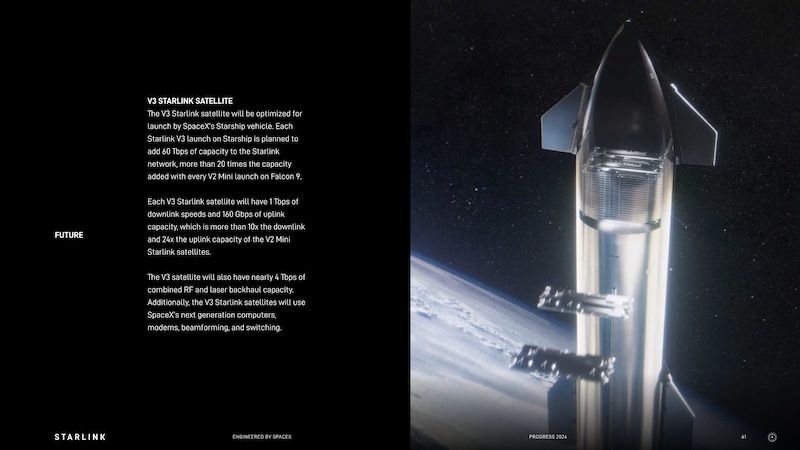
These specifications represent more than 10x the downlink and 24x the uplink capacity compared to second-generation satellites. Each Starship launch carrying third-generation satellites will add 60 Tbps of capacity to the network—more than 20 times the capacity added with current launches.
V3 satellites will incorporate next-generation computers, modems, beamforming, and switching technologies while operating at low altitude to further improve network latency. Technological leap positions Starlink for sustained competitive advantage in the satellite internet market.
Major cruise lines and several commercial airlines now provide Starlink high-speed internet to tens of millions of passengers annually. Service has proven particularly valuable for connecting remote locations where traditional broadband infrastructure remains economically unfeasible.
In the United States, where the average household contains approximately 2.5 people, Starlink serves both residential and commercial customers with consistent reliability. Network’s ability to serve schools and healthcare centers has proven especially important for rural communities previously underserved by terrestrial providers.
Starlink performance continues reaching new heights—literally and figuratively—as the constellation prepares for its next orbital evolution.
Related Post
Elon Mars Presentation: Starship V3 Launch 2025, Tesla Optimus Robots to Mars 2027
SpaceX Launches Ruggedized Starlink Performance Terminal for $1,999
Starlink Router Mini: SpaceX New Solution for Enhanced Wi-Fi Coverage