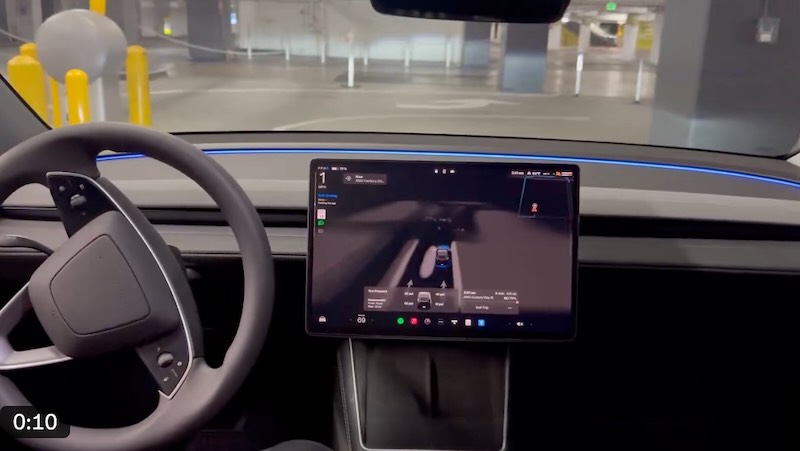
There’s a line Elon Musk dropped on Tesla’s Q2 2026 earnings call that deserves more attention than it’s getting. “People are actually buying Tesla FSD with a car attached rather than the other way around,” he said. That’s not a boast — it’s a market signal. Numbers backing it up are genuinely hard to argue with.
Tesla FSD subscriptions reached 1.48 million in Q2 2026, a 56% jump from Q1 and the single largest quarterly subscriber gain in Tesla’s history. That’s roughly 200k new subscribers added in one quarter, averaging 2,200 sign-ups per day. At this rate, Tesla’s autonomous driving software isn’t a feature anymore — it’s becoming the product.
When Tesla first rolled out FSD as a paid add-on, the reception was skeptical, to put it generously. Critics questioned the price point. Regulators raised safety flags. Drivers complained about limited functionality in complex environments. Yet here we are in mid-2026, watching Tesla generate approximately $775 million annually from FSD subscriptions alone.
That revenue figure matters because it’s becoming structurally significant. Tesla’s Q2 attach rate — meaning the percentage of new North American deliveries that included an FSD subscription, exceeded 55%. More than half of buyers in Tesla’s home market are now opting into Tesla FSD subscriptions at the point of purchase, not after months of deliberation.
Reaching a 55%+ attach rate in North America isn’t just a win for Tesla’s bottom line, it signals a behavioral shift among buyers. Consumers who once viewed FSD as an expensive experiment are now treating it as a baseline expectation, comparable to how navigation or premium audio entered the standard options psychology years ago.
This change didn’t happen overnight. Tesla has spent years iterating on its neural net-based driving stack, deploying over-the-air updates, and — critically — accumulating real-world data at a scale no competitor has matched. That data flywheel is now producing measurable results, and the safety figures Tesla released alongside Q2 earnings make for genuinely striking reading.
Tesla’s newly released FSD (Supervised) safety report covers North America across all road classes, reflecting a rolling 12-month aggregation. Here’s what the numbers show:
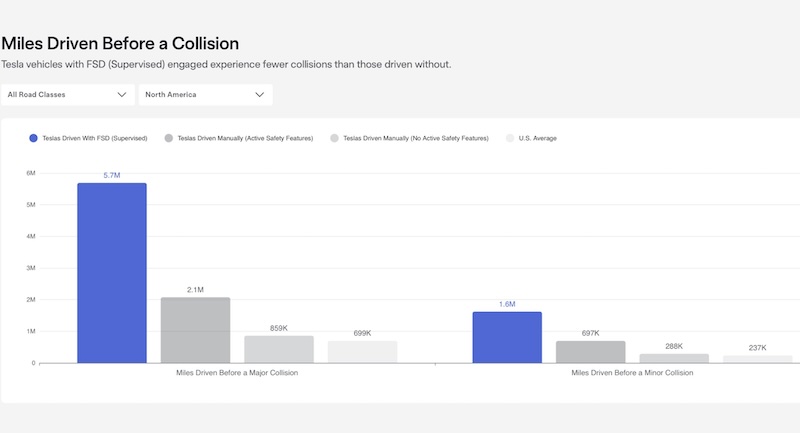
- Miles per major collision with FSD (Supervised) engaged: 5,690,675
- Miles per major collision, manually driven with active safety features: 2,076,014
- Miles per major collision, manually driven without active safety features: 859,465
- U.S. national average: 698,781
To put that in plain terms: Teslas operating with FSD engaged experienced approximately 7x fewer major collisions than those driven manually without active safety features, and nearly 3x fewer than Teslas driven manually with those features on.
Total mileage logged in this dataset is substantial. Teslas with FSD engaged accounted for over 7.1 billion miles. Manually driven Teslas with active safety added another 36 billion. The U.S. driver population overall logged more than 3.2 trillion miles — providing a credible national baseline for comparison.
What makes this dataset more defensible than prior iterations is the sheer volume of FSD-engaged miles. A year ago, critics could reasonably argue the sample size was too thin for statistical confidence. At 7.1 billion miles, that argument gets harder to sustain.
Tesla owners are now collectively driving on FSD subscriptions at an annualized rate of 13.7 billion miles per year — a 241% increase year over year. For reference, that’s the equivalent of driving to the Moon and back 28,652 times.
Tesla updated its FSD miles tracker during Q2 to reflect both a larger vehicle fleet and significantly increased adoption. Fleet is now averaging 37.5 million FSD miles per day, up from 28.8 million a few months prior and 14.4 million at the start of 2026.
That’s 1k miles logged every 2.3 seconds. That kind of throughput doesn’t just improve the product — it creates a compounding advantage. Every mile driven generates training data, edge cases get surfaced faster, and the model improves in ways that a manually curated dataset can’t match at equivalent speed.
Beyond the passenger vehicle numbers, Elon addressed two forward-looking questions that have significant implications for Tesla’s FSD trajectory.
On the Tesla Semi, Elon said the company expects to have self-driving capability operational on the Semi “probably around the end of this year or early next year,” adding a firm commitment that it “will definitely be working next year.” He was careful to note that Semi FSD shouldn’t distract from the continued safety iteration on the Model 3/Y, and Cybercab.
On hardware, Elon signaled a broader upgrade cycle is coming for older vehicles. Any Tesla with cameras and less than HW4 is a candidate. Next-gen AI board is expected around mid-2027, followed by the AI5 chip, initially destined for Optimus, also targeting volume production by mid-next year. AI6, Elon said, will be “the best edge computing in the world.” These aren’t footnotes. They determine how capable FSD subscriptions can ultimately become.
$775 million in annualized FSD subscription revenue is meaningful not just in dollar terms but in structural terms. Recurring software revenue carries higher margins than vehicle sales, scales without proportional production cost increases, and — perhaps most importantly, creates a financial incentive for Tesla to keep improving the software long after a vehicle is delivered.
That recurring revenue dynamic is what Elon’s “car is now the bonus” line was really pointing at. Software businesses trade at higher multiples than hardware businesses. If Tesla’s FSD subscription base continues growing at anywhere near its Q2 pace, the financial character of the company starts shifting in ways that equity markets will need to reprice.
1.48 million subscriber milestone isn’t the ceiling — it might not even be the halfway point. With attach rates above 55% on new deliveries and a global fleet still in early-stage FSD adoption, the numerator has a long way to run.
When a software subscription makes the car the afterthought, it’s fair to say Tesla’s finally driving the point home — FSD has fully sold itself.
Related Post
Tesla HW3 Can’t Achieve Unsupervised FSD – Upgrade Program Announced, Q1 2026 Earnings
Tesla FSD V14 Lite Rolls Out to HW3 Owners After 14-Month Wait
Tesla Semi FSD: What the New Ground-Truth LiDAR Sightings Actually Mean