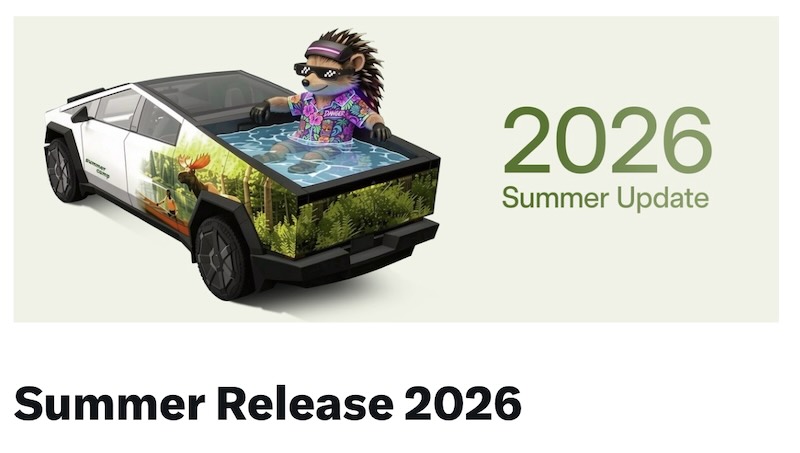
Tesla’s Summer 2026 update has officially landed, and it’s not a minor patch. It’s a signal. Across navigation, entertainment, autonomous driving, and in-cabin AI, the company has pushed what might be its most operationally significant update in recent memory, one that quietly assembles pieces that, together, point toward a future where drivers don’t interact with a car’s interface at all. They just talk to it.
Update spans over a dozen distinct features, but the one that commands the most attention is Grok Agent’s expanding footprint inside Tesla’s vehicle ecosystem. What started as an in-car assistant capable of answering general queries has now grown into something that can make phone calls, adjust climate settings, search and play music, open the glovebox, and pull context from Tesla’s owner’s manual on demand. That’s not an incremental improvement — it’s a shift in what in-car AI is expected to do.
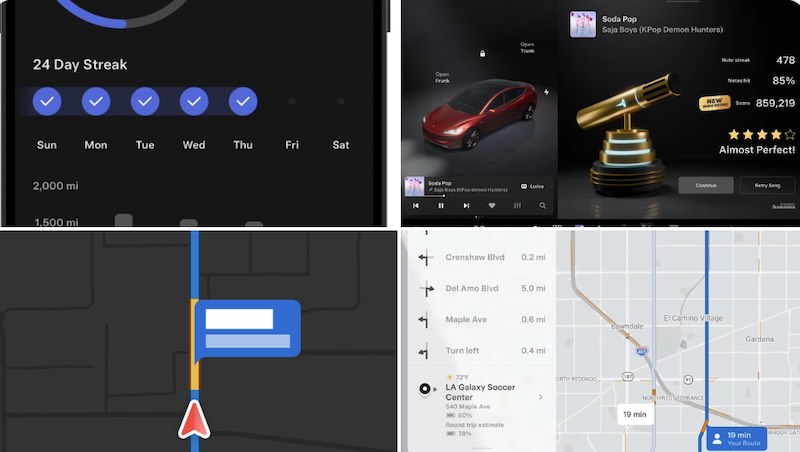
Tesla’s Summer 2026 update brings one of the most practically useful navigation changes in years: system now prioritizes routes the driver has previously taken. No pop-up notifications, no prompts to confirm — the vehicle simply learns from behavior and surfaces the familiar path first.
Automatic Navigation also adapts to routine in a way that goes beyond Home and Work. Update adds support for recurring stops — a school drop-off on the way to work, a gym visit on the way home — and begins suggesting and routing to these locations based on travel patterns. That kind of passive, behavioral learning is exactly the type of feature that doesn’t demo well but earns loyalty over weeks of use.
For Supercharger planning, drivers can now search for charging stations by name when looking up a destination. It’s a small addition, yet for frequent road-trippers who’ve memorized their preferred Supercharger stops, it removes real friction from the process.
Here’s where Tesla’s Summer 2026 update gets genuinely interesting. Grok Agent has now gained access to vehicle controls, and it’s not a limited preview. Phone calls, music playback, climate adjustments, the glovebox: these are core, everyday functions that drivers previously handled through the touchscreen or voice commands that required precise phrasing. Grok changes that dynamic by accepting natural language.
According to statements from Elon and Tesla’s senior engineering team, the company is actively working to connect Grok Agent with the FSD agent. If that integration materializes, implications are significant. A driver could tell Grok which route to take, ask it to adjust speed, or request a specific stop — all through conversation, not menus.
That experience isn’t entirely theoretical anymore. It’s the closest analog to communicating with a human driver, where the instructions are verbal, contextual, and flexible. Traditional touchscreen interfaces don’t offer that kind of fluidity. Grok increasingly does.
Worth noting: Grok is now available across all of Europe as well, extending the assistant’s geographic reach meaningfully beyond its initial rollout.
One of the most practical additions coming to Full Self-Driving is the ability to select a specific parking spot during an FSD maneuver. Previously, drivers had to disengage the system to manually choose their preferred space. That friction is going away.
Better yet, the vehicle will remember a driver’s preferred spot — at the grocery store, the office, wherever routines take them. It’s the kind of feature that reduces the gap between autonomous driving’s promise and its day-to-day utility.
Tesla’s Summer 2026 update also addresses the in-cabin entertainment experience with several targeted additions. Caraoke now scores singing while the car is in Park, an addition that’s genuinely fun and gives the feature more replay value. Apple Music integration now allows users to add songs to the queue directly from search and artist pages, which should satisfy listeners who’ve found the current Apple Music experience inside Tesla’s interface limited.
Rear display gets a notable parental control: Rear Display Lock allows kids to watch content on the back screen while restricting control of that screen to the front row. It’s a thoughtful addition for family vehicles, and it reflects how Tesla’s thinking about in-car experience has matured beyond the driver-only perspective.
On the personalization front, drivers can now upload a custom vehicle wrap directly from the mobile app — a visual customization option that appeals to owners who want their digital vehicle representation to reflect their real-world modifications. Preferred zoom level for Self-Driving visualization is now also adjustable, giving drivers more control over how they monitor the car’s autonomous decision-making.
From the app side, drivers can now set desired Arrival Energy directly from their phones and view or share self-driving stats without needing to be inside the vehicle. That last one is a feature owners have requested for a long time, and its arrival is welcome.
Browser also gains camera and microphone support in this update, and new intro animations roll out for the Model 3 and Model Y — smaller additions, but they reflect continued attention to the onboarding and software-feel experience.
What makes Tesla’s summer update worth paying attention to beyond any single feature is what it suggests about trajectory. The company has a pattern that’s become recognizable over the years: extended periods of quiet development, followed by rapid integration once the underlying technology stack reaches a critical threshold.
Grok Agent story is a useful lens here. Following xAI’s restructuring — which saw co-founders depart, xAI being acquired by SpaceX, and SpaceX’s subsequent acquisition of Cursor — there were genuine questions about whether Grok’s integration inside Tesla’s vehicles would slow down or stall. Concerns weren’t unreasonable; major organizational changes typically disrupt product velocity.
And yet, Grok now controls vehicle functions. FSD-Grok connection is in active development. Ecosystem that once looked fragmented is beginning to cohere.
That’s the pattern. Long stretches where individual components exist in isolation, followed by a convergence moment where everything connects. Tesla’s Summer 2026 update isn’t necessarily that final convergence moment — but it’s credibly the prelude to one.
When the FSD agent and Grok Agent fully integrate, and when parking intelligence, route learning, and natural-language vehicle control all operate in concert, the resulting experience won’t resemble current car software at all. It’ll resemble something closer to a personal driver who knows the owner’s habits, anticipates needs, and takes instruction without friction.
For now, Summer 2026 update delivers tangible improvements across navigation, entertainment, personalization, and in-cabin AI. Some of those improvements are immediately useful. Others are foundational. Real question isn’t what this update does today, it’s what Tesla’s been driving toward all along.
Related Post
Tesla 2026 Spring Update: New Features, Visuals and Grok Integration Explained
Tesla Grok Navigation Commands: Natural Voice Control for FSD Drivers