Tesla’s FSD continues its rapid evolution, with CEO Elon Musk making bold claims about the upcoming v14 release. V14 will not merely match human capabilities but exceed them by a substantial margin. These developments follow an already impressive trajectory established by the current v13 system, which Tesla reports is already demonstrating safety metrics superior to the average human driver.
During Tesla’s Q3 2024 earnings call, VP of Tesla AI Ashok Elluswamy highlighted the extraordinary pace of improvement in the company’s autonomous driving system. “Like you mentioned, Elon, we already made a 100x improvement with 12.5 from starting of this year and then with v13 release we expect to be 1000x from the beginning from January this year,” Ashok stated.
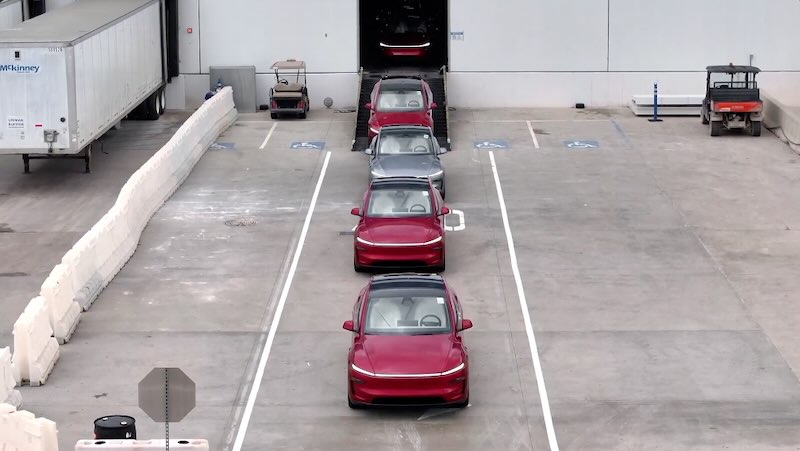
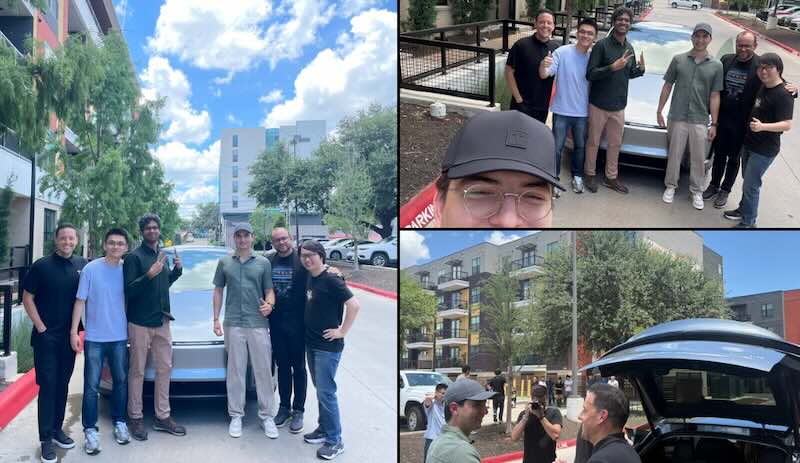
June, Tesla has reached a significant milestone in autonomous vehicle technology, completing what appears to be the first fully autonomous delivery of a production vehicle from factory to customer. Model Y traveled across Austin, Texas, navigating highways without any human intervention or remote operation.
This acceleration in capability correlates with predictions made earlier in the year when both Elon and Ashok anticipated that FSD would exceed human driver performance by Q2 or Q3 of 2025. Based on recent metrics, those predictions appear to be tracking accurately or potentially even conservatively, as Tesla’s FSD v13 has already demonstrated safety performance exceeding human benchmarks.
Data behind Tesla’s FSD v13 indicates a system that is 54% safer than human drivers, effectively crossing a critical threshold in autonomous driving development. Milestone likely influenced Tesla’s decision to select v13 as the foundation for its Robotaxi pilot program, providing a safety margin that regulators and the public could find compelling.
Elon has tempered expectations regarding the upcoming v14 release, stating: “V14 will be better than human for sure, but I don’t know if it will be 10X. Maybe 2X to 3X. V15 has a shot at 10X.” Even with this more conservative estimate, a twofold to threefold improvement over human safety performance would represent a significant advancement in autonomous driving capability.
A primary factor in the anticipated performance jump for FSD v14 is its dramatically expanded neural network. System reportedly features ten times as many parameters as its v13 predecessor, enabling more sophisticated decision-making and environmental understanding. Expanded computational capacity allows the system to process edge cases and unusual driving scenarios with greater nuance.
Early evaluations of v14 builds have reportedly shown “a noticeable step up” compared to the current v13 system, according to statements from Elon. If these preliminary assessments translate to real-world performance, the implications for autonomous driving adoption could be substantial.
Timing of FSD v14’s arrival next month aligns strategically with Tesla’s autonomous driving roadmap. As the company pushes forward with its Robotaxi ambitions, demonstrating safety performance that consistently exceeds human capabilities provides both technical validation and regulatory ammunition.
AI researcher James Douma speculated that if early evaluations of v14 are accurate, mature versions of the system will move FSD into the realm where even “diligent and careful” human drivers cannot match its safety performance. James suggested that data collected over the next 6 months should provide compelling evidence of this capability gap.
With FSD v14 scheduled for release next month, the autonomous driving community won’t have to wait long to evaluate these claims against real-world performance. System’s ability to navigate complex urban environments, handle unexpected obstacles, and maintain safety under adverse conditions will be closely scrutinized.
Looking further ahead, Elon has suggested that FSD v15 could potentially achieve the 10x safety improvement benchmark, which would represent an extraordinary leap forward in autonomous driving capability. For now, Tesla’s focus remains on successfully launching v14 and gathering performance data to validate its safety claims.
As Tesla continues its FSD development drive, the competition to create truly autonomous vehicles accelerates alongside it. Question is no longer whether self-driving systems can match human performance, but by how much they’ll eventually surpass it.
Related Post
Tesla Hits 110 EFLOPS AI Milestone for Autonomous Driving
LiDAR Weather Performance: Rain and Fog Challenges for Autonomous Vehicles
Tesla Raw Vision Gambit: Vision-Only Active Safety, Pure Vision and Sensor Fusion