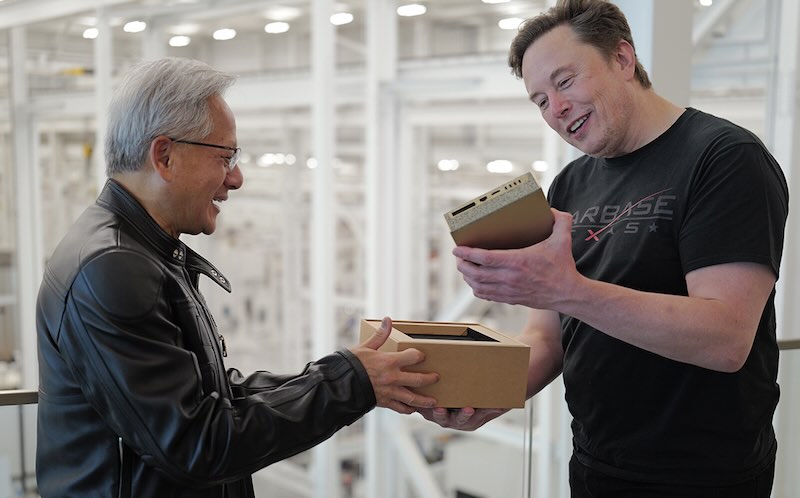
NVIDIA CEO Jensen Huang delivered the company’s latest hardware achievement directly to SpaceX’s Starbase facility in Texas — a desktop AI supercomputer that packs enterprise-grade performance into a footprint smaller than most gaming rigs. DGX Spark represents a shift in how organizations approach local AI deployment, bringing petaflop-level compute to individual workstations.
Jensen’s appearance at Starbase wasn’t just about logistics. Handoff deliberately echoed his 2016 donation of the DGX-1 to OpenAI, when Musk was part of that organization’s founding team. This time, Jensen inscribed the chassis with “From A Single Spark, A world of Intelligent,” while Elon responded with “Ad astra!” Timing aligned with SpaceX’s 11th Starship test flight preparations.
DGX Spark fits 128GB of unified memory into a 1.2 kg package roughly the size of an origami sheet. NVIDIA’s GB10 Grace Blackwell Superchip delivers up to one petaflop of AI performance at FP4 precision — sufficient for running models with 200 billion parameters without cloud dependencies. ConnectX networking enables clustering configurations, while NVLink-C2C provides bandwidth five times faster than PCIe standards. System includes NVMe storage and HDMI output alongside NVIDIA’s complete AI software stack.
DGX Spark targets researchers and developers who need immediate access to inference and fine-tuning capabilities. Form factor eliminates the traditional choice between remote data center access and local prototyping. Organizations can now deploy AI workloads at the desk level rather than maintaining separate infrastructure for development and production environments.
Will desktop supercomputers reshape enterprise AI strategies? NVIDIA clearly believes the DGX Spark ignites that conversation.
Related Post
NVIDIA DRIVE AGX Thor Developer Kit: Pre-Orders Open for September Shipping
Nvidia Partners with GM on Self-Driving Tech, Unveils Groundbreaking Cosmos System
Nvidia Cosmos AI Model Promises to Revolutionize Autonomous Vehicle Training | CES 2025