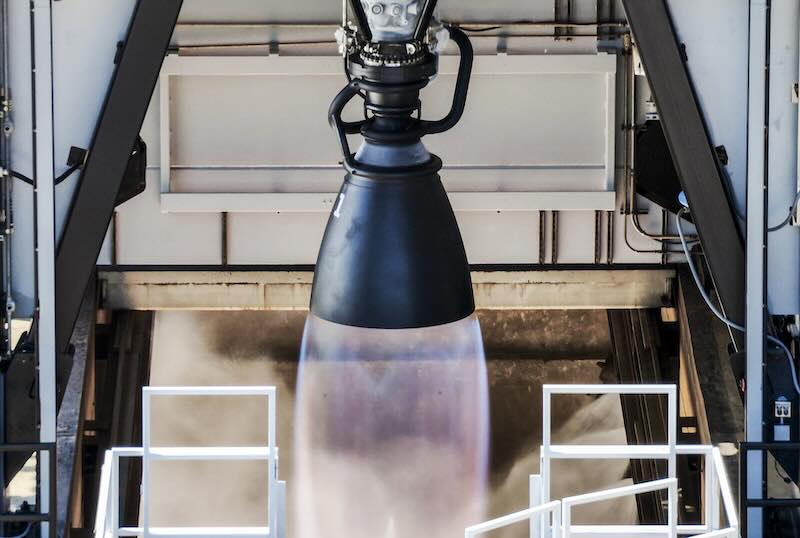
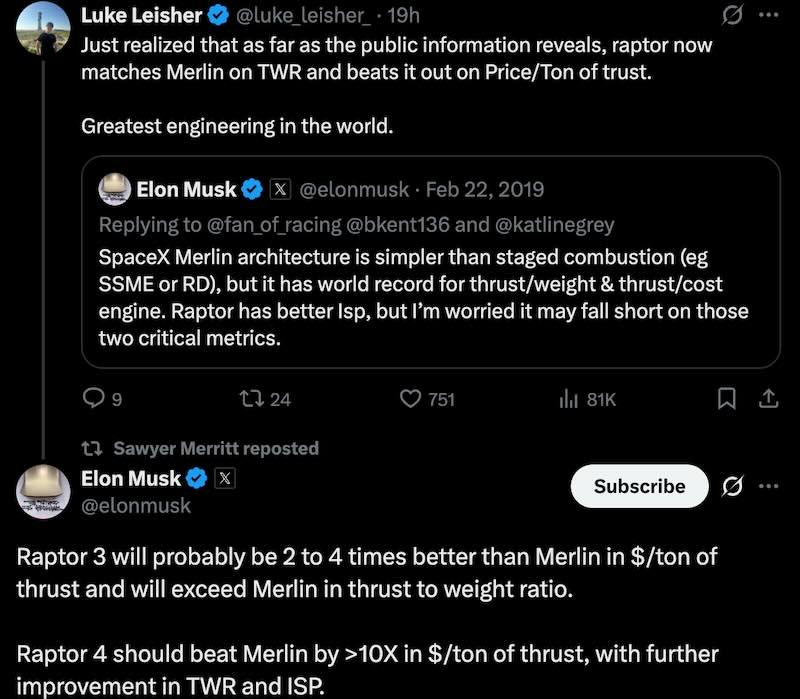
SpaceX’s Raptor engine has reached a milestone that rocket engineers didn’t anticipate this quickly. According to recent analysis, Raptor now matches the Merlin engine’s thrust-to-weight ratio while delivering superior cost per ton of thrust. Not just incremental progress — it represents a shift in how SpaceX approaches propulsion economics.
Elon responded to the performance comparison with projections that sound almost absurd. He claims Raptor 3 will achieve 2 to 4 times better economics than Merlin in terms of cost per ton of thrust, while simultaneously exceeding Merlin’s thrust-to-weight ratio. If accurate, these numbers would fundamentally change launch economics.
Raptor 3 improvements aren’t theoretical anymore. SpaceX has been testing iterations at its Starbase facility, refining manufacturing processes and optimizing performance parameters. Each version brings tangible cost reductions through simplified production techniques and increased performance output.
Looking further ahead, Elon outlined Raptor 4 specifications that border on revolutionary. Next-gen engine should beat Merlin by more than 10X in cost per ton of thrust, with continued improvements in thrust-to-weight ratio and specific impulse. That level of advancement would make current rocket engines look primitive by comparison.
What makes these claims credible? SpaceX has consistently delivered on engine development promises, though timelines often slip. The company’s vertical integration allows rapid iteration cycles that traditional aerospace contractors can’t match. Manufacturing costs decrease as production volume increases, and SpaceX is producing Raptor engines at a pace no other company approaches.
Competitors watching Raptor 3 development face an uncomfortable reality. If SpaceX achieves even half the projected improvements, the cost gap between SpaceX launches and alternatives will widen significantly. Traditional rocket manufacturers relying on legacy engine designs won’t be able to compete on economics alone.
For the space industry, these Raptor advancements mean cheaper access to orbit, more ambitious missions, and faster development cycles. The engine that once seemed like a risky bet now appears poised to capture the entire market.
Related Post
SpaceX Raptor 3: A Triumph of Simplicity in Rocket Engineering
Elon Mars Presentation: Starship V3 Launch 2025, Tesla Optimus Robots to Mars 2027
SpaceX Installs Massive Fuel Transfer Tube in Next Generation V3 Super Heavy Booster