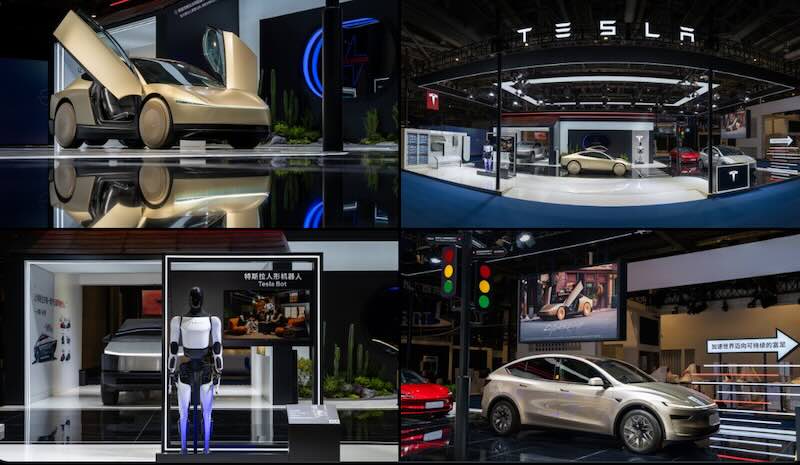
Tesla’s making its most ambitious pitch yet for an AI-driven future. The electric vehicle manufacturer will showcase its driverless Cybercab for the first time in the Asia-Pacific region at the 8th China International Import Expo, which opens November 5 at Shanghai’s National Exhibition and Convention Center.
Tesla’s designed its booth as a working prototype of tomorrow’s neighborhoods—one where Tesla’s vision of “sustainable abundance” from Master Plan Part 4 becomes tangible reality.
What does sustainable abundance actually look like? Tesla’s CIIE installation answers that question with a fully integrated district model. Solar Roof tiles generate power for homes, storing excess energy in Powerwall batteries that subsequently charge vehicles parked in garages. A Megapack unit delivers clean electricity to the entire neighborhood.
Scene includes a Cybertruck in a driveway, Model 3 and Model Y L vehicles navigating streets, and humanoid robots performing household tasks like walking dogs. At the center sits a gold-finished Cybercab with butterfly doors, ready for passenger service.
Tesla believes AI-driven efficiency gains across transportation, energy, and robotics sectors will unlock sustainable abundance. Tesla projects Robotaxi services could undercut public transit pricing. Solar generation paired with AI-based energy management systems promises low-carbon, affordable electricity. Humanoid robots could handle dangerous or repetitive labor while expanding access to specialized services, including surgical procedures.
“Tesla has everything required for real-world AI—cutting-edge AI research, world-class electromechanical engineering, and the ability to scale manufacturing,” Elon stated.
Cybercab represents pure autonomous operation—no steering wheel, no pedals. It relies on Tesla Vision and end-to-end neural networks rather than expensive lidar sensors. Configured as a two-seater with substantial rear cargo capacity, it’s built for ride-hailing and light urban deliveries. Gold finish comes from metal treatment instead of paint, improving sustainability and manufacturing efficiency. Vehicle achieves approximately 5.5 Miles/kWh.
Designed for fleet operation, Cybercab supports wireless charging and robotic cleaning. Mass production’s scheduled for Q2 2026, with prototypes already testing near Tesla’s California engineering headquarters, Spotted at In-N-Out Burger.
Two Tesla Bots join the Cybercab at the booth, sharing cameras, powertrain components, and Tesla’s AI architecture. Exhibition also features Solar Roof, Powerwall, V4 Superchargers, Cybervault home chargers, and Megapack demonstrations—a closed-loop system for generating, storing, and distributing clean electricity.
Related Post
Tesla Robotaxi CyberCab Wireless Charging Speed of 25kW: The Future of Urban Mobility
Tesla True Unboxed Process Patent Could Transform EV Manufacturing for CyberCab Production