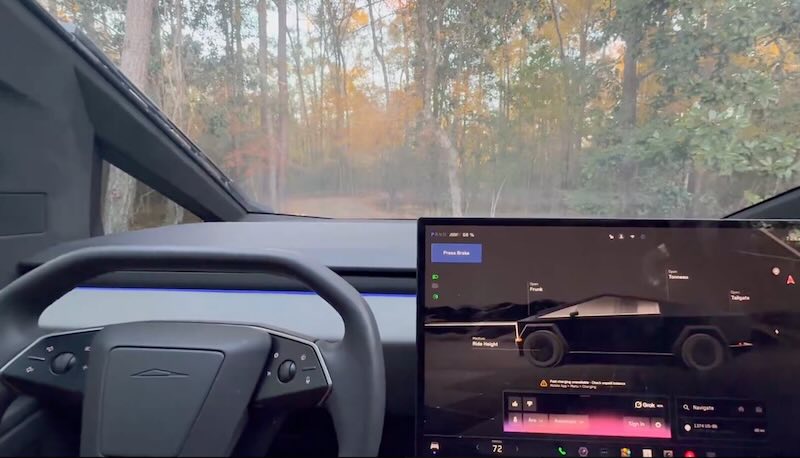
Tesla’s latest annual update landed with a surprise lead feature: Grok with Navigation Commands (Beta). At first glance, addition seems underwhelming, just another voice assistant handling navigation requests. But beneath that modest “(Beta)” label lies something more significant. xAI and Tesla have built a system that demonstrates genuine semantic understanding of location data, powered by what xAI employees confirm is Grok 4.1-Fast running directly inside Tesla OS.
The implementation suggests a relatively low technical barrier on the model side, yet the practical applications reveal a shift in how drivers might interact with their vehicles. Rather than tapping through menus or issuing rigid voice commands, Tesla owners can now speak naturally to their cars.
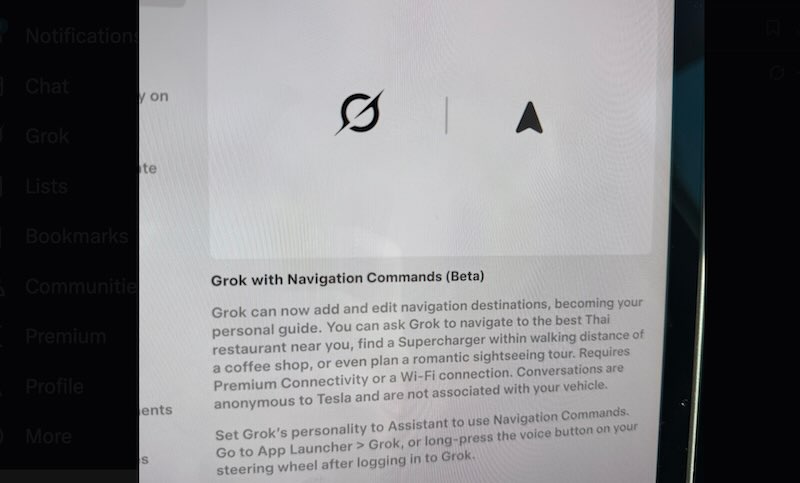
Feature allows drivers to add, edit, and modify navigation destinations through conversational requests. Unlike traditional voice assistants that require specific phrasing, Grok processes fuzzy semantic queries and executes multi-step reasoning. A driver can say, “Find Superchargers on my way home, choose the closest one, add it as a waypoint, and don’t take a detour.” System parses that compound request and acts accordingly.
Capability addresses a real gap in existing voice technology. Most assistants fail at chained commands requiring contextual awareness and geographic reasoning. Tesla’s Grok integration handles these scenarios without forcing users into predetermined command structures.
Early Tesla FSD users report mixed experiences. One Model 3 owner described requesting navigation to a chain restaurant on a specific street. Grok identified two locations, then routed to the closest when asked, exactly like instructing a cab driver. No touchscreen interaction required.
Another user requested routing through three separate destinations. Grok added all waypoints automatically in proper sequence. “This exactly why I use FSD 100% of the time,” they noted. “The ability to talk to have a regular conversation and make reroutes or stops on the fly is game changing.”
However, the system isn’t perfect. Multiple users encountered failures when requesting specific route modifications to avoid busy streets. Grok acknowledged the requests and claimed changes were made, but the navigation system didn’t update accordingly. In one case, Grok stopped responding entirely despite active premium connectivity. In another, three reroute attempts failed to modify the displayed path.
These failures point to integration issues between Grok’s language understanding and the underlying navigation system, not the AI model itself.
What comes after navigation commands? Broader opportunity extends beyond routing. Tesla could fine-tune Tesla’s Grok integration for complex, chained in-car tasks, essentially rebuilding products like Apple Shortcuts without requiring users to think in if-else logic. Instead of predefining scenarios, drivers would simply speak to their vehicle as they would to a personal assistant, letting the system remember and execute requests naturally.
Whether Tesla’s Grok integration reaches that potential depends on resolving current navigation system limitations. But the foundation is there, that’s what makes this beta feature worth watching.
Related Post
Tesla FSD V14.2.1 Lets You Text and Drive Depending on the Context of Surrounding Traffic
Tesla FSD V14.2.1 Now Recognizes Human Hand Gestures, Autonomous Driving Update
Tesla Cybertruck Drives 1,200 Miles FSD 14.2 Autonomously, Full Self-Driving Milestone Achieved