
The Federal Communications Commission has doubled down on its bet with SpaceX, authorizing the company to deploy up to 15k next-generation satellites for its expanding Starlink constellation. The decision, announced in a 34-page order released Friday, represents a substantial increase from the previous 7,500-satellite cap established in December 2022. While SpaceX initially sought approval for more than 22k satellites, the partial grant still positions the company to operate a total of 19,400 satellites when combined with its first-gen constellation clearance.
Authorization arrives at a critical juncture for SpaceX’s satellite internet ambitions. Network capacity has reached its limits in certain parts of the United States, where subscriber growth has outpaced infrastructure deployment. With an estimated subscriber base approaching 3 million users, the company now has regulatory clearance to address congestion issues that have plagued high-demand areas.
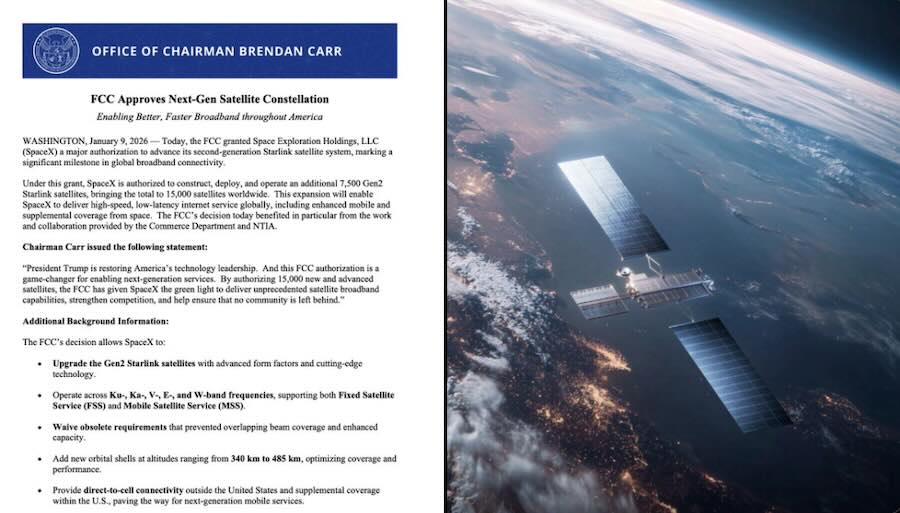
FCC’s approval extends beyond simple satellite quantity. SpaceX has received permission to operate most of its next-generation spacecraft approximately 200 kilometers closer to Earth than originally planned. New orbital configuration includes up to 144 satellites across 72 planes at altitudes ranging from 340 to 365 kilometers, with an additional 120 satellites distributed across 56 planes at 480 and 485 kilometers.
This orbital adjustment should deliver measurable latency improvements for end users. Closer proximity to Earth’s surface reduces the distance signals must travel, translating to faster response times for applications requiring real-time data exchange. SpaceX retains the option to continue operating second-generation satellites at the higher 500-kilometer range, providing operational flexibility as the constellation scales.
Perhaps the most significant aspect of the FCC’s decision involves a time-limited waiver allowing SpaceX to exceed equivalent power-flux density limits. Commission acknowledged that increasing power levels would benefit American consumers while an ongoing rulemaking process examines permanent changes to EPFD regulations.
The waiver comes with strings attached. SpaceX must ensure operations don’t interfere with rival geostationary satellite constellations, and the authorization applies exclusively to United States operations. Peak capacity in high-demand areas could increase by as much as five times current levels, though realizing those gains requires deploying sufficient satellites to support the enhanced throughput.
FCC granted SpaceX access to multiple radio frequency bands, including Ku-, Ka-, V-, E-, and W-band frequencies. Bands will support both fixed satellite service and mobile satellite service applications, enabling SpaceX to deliver traditional broadband alongside direct-to-cell connectivity.
SpaceX’s cellular Starlink system stands to benefit from 2GHz spectrum acquired from EchoStar, (SpaceX $17B EchoStar licenses deal). However, the commission approved this radio frequency use only for operations outside the United States. FCC continues reviewing the spectrum transfer and SpaceX’s proposed satellite constellation designed to leverage these frequencies for domestic mobile services.
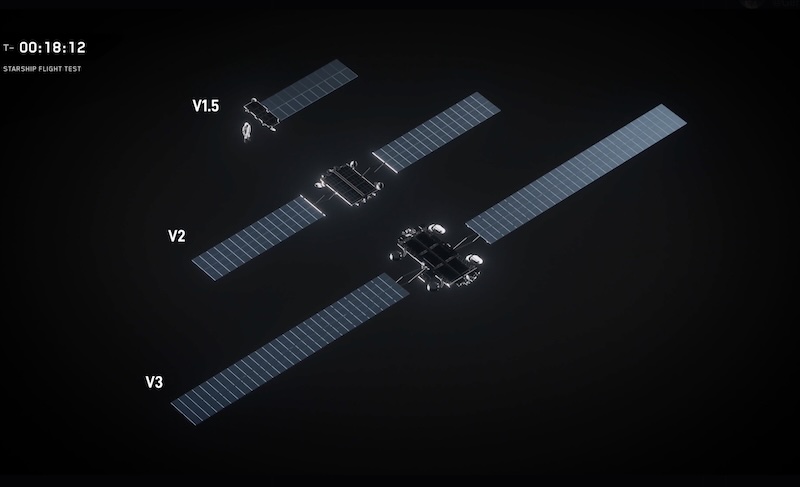
FCC also eliminated obsolete requirements that previously prevented overlapping beam coverage, a change that should enhance network capacity. Current Starlink download speeds typically hover around 200Mbps, but the commission expects the next-gen satellites v3 to deliver symmetrical gigabit speeds.
Rival satellite operators have expressed concerns that SpaceX’s expanding constellation could generate radio interference and restrict access to lower orbital altitudes. FCC imposed conditions requiring SpaceX to immediately cease any harmful interference should it occur.
Commission found SpaceX’s ongoing efforts to minimize light reflection from satellites and coordinate with astronomers sufficient to address concerns about night sky observations. Scientists had urged the FCC to investigate whether retired satellites burning up in the atmosphere pose risks to the ozone layer, but the commission determined the evidence remains insufficient to warrant additional environmental review under the National Environmental Protection Act.
SpaceX plans to leverage this authorization to launch V3 Starlink satellites, which feature larger form factors and increased capacity compared to current models. The company intends to deploy these spacecraft using its Starship vehicle, though that launch system remains in the testing phase. SpaceX has forecasted the first V3 satellite launches will occur sometime in 2026.
Approval positions SpaceX to provide direct-to-cell connectivity outside the United States and supplemental coverage within American borders. T-Mobile currently offers cellular Starlink service to its customers in the United States, and the expanded authorization should enable service improvements for this partnership.
FCC’s decision marks a turning point for SpaceX’s satellite internet operations, providing the regulatory foundation needed to address current network constraints while building toward gigabit-speed service. For millions of users in areas underserved by traditional broadband infrastructure, the expanded Starlink constellation promises to deliver high-speed, low-latency internet access that was previously unavailable. Stars have aligned for SpaceX to take its satellite internet service to the next level.
Related Post
SpaceX Secures FCC Approval to Boost Starlink Dish Power for Enhanced Internet Speeds
SpaceX Pitches Starlink as GPS Alternative to FCC | The Next Evolution in Satellite Navigation
FCC Votes to Review Satellite Power Limits That Could Supercharge Starlink Internet Speeds