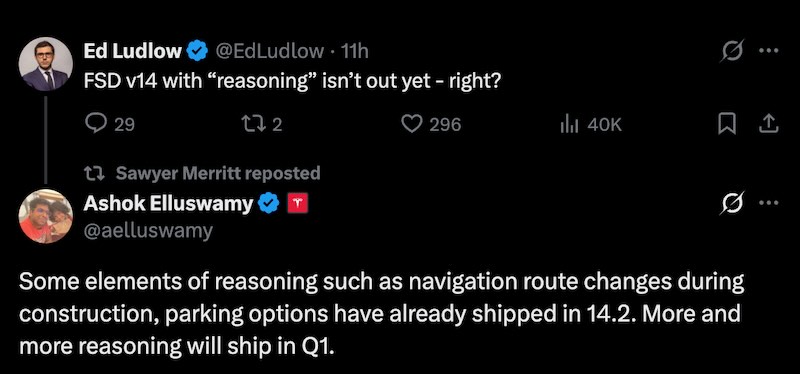
Tesla’s FSD Supervised v14.2 rolled out widely by late 2025, and according to VP of AI Ashok Elluswamy, reasoning features are already live. Responding to questions about when reasoning capabilities would arrive, Ashok clarified that “some elements of reasoning such as navigation route changes during construction, parking options have already shipped in 14.2.” More advanced reasoning features will arrive throughout Q1 2026, but the core capability isn’t coming—it’s here.
The industry conversation around reasoning in autonomous vehicles has created significant confusion. NVIDIA CEO Jensen Huang’s CES 2026 comments about the Alpamayo platform suggested that reasoning functions as a solution to the long tail of driving scenarios. “Alpamayo brings reasoning to autonomous vehicles, allowing them to think through rare scenarios, drive safely in complex environments, and explain their driving decisions,” Jensen said.

That framing implies current systems lack the ability to handle edge cases until reasoning gets added as a separate component. However, that perspective misunderstands how Tesla FSD v14 operates.
Tesla FSD v14 doesn’t need a new reasoning layer bolted on—it already is a reasoning engine. System’s reasoning capability isn’t symbolic logic or chain-of-thought processing layered over perception modules. Instead, it’s the learned ability to select safe, legal, and contextually appropriate trajectories in real-world conditions.
Reasoning emerges from billions of real driving scenarios encoded into Tesla’s neural network. System doesn’t follow programmed rules for handling construction zones or parking selection. It learns these behaviors through imitation and reinforcement, internalizing how actions lead to outcomes across countless situations.
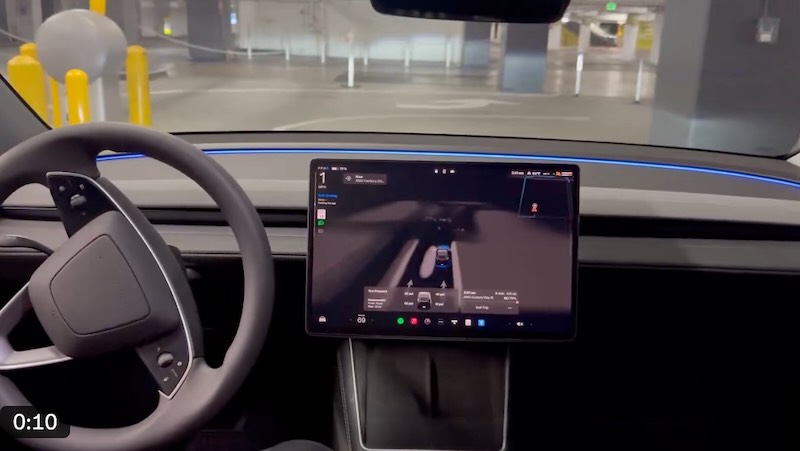
Owners have shared footage of hands-off drives through tunnels and precise parking maneuvers, demonstrating the system’s capability in practice. “Thinking” happens within the model’s weights rather than through explicit reasoning steps that users can trace.
There’s a persistent notion that Tesla’s advantage comes primarily from fleet data collection while competitors can achieve parity by incorporating stronger reasoning models. That view suggests Tesla has data, others have reasoning, and the two approaches will converge.
Analysis misses the core point. Driving isn’t governed solely by physics—it’s shaped by conventions, unwritten social rules, and context-dependent edge cases. You can’t reason effectively about that domain without first learning it at scale. Data isn’t merely additive to the reasoning process—it’s foundational.
Tesla FSD v14 already functions as general-purpose driving intelligence. It handles rare scenarios not because someone programmed specific responses but because the reasoning capability generalizes across situations based on learned patterns from real-world driving.
Users praise FSD v14’s performance in rain and heavy traffic, noting improved poise compared to earlier versions. System’s ability to reroute around construction or select optimal parking spots demonstrates reasoning in action, even though it remains in supervised mode.
Skeptics point to delays in the unsupervised rollout, questioning when Tesla will remove the supervision requirement, (embeds hidden “unsupervised” FSD geofence in Bay Area). Yet the technical capability already shows reasoning at work, timeline for removing human oversight is a regulatory and risk management question rather than a technical limitation of the reasoning itself.
Widespread misunderstanding about when reasoning would arrive in Tesla FSD v14 reveals how the industry talks past itself on autonomy fundamentals. Reasoning isn’t coming in some future update—it’s already driving, and it’s been rea-zoning its way through edge cases all along.
Related Post
NVIDIA Alpamayo vs Tesla FSD: Development Kit Can’t Challenge Production Leader
Tesla FSD Drives Coast-to-Coast Without Human Intervention, Full Story
Tesla Model Y Robotaxi Drives Empty on Austin Roads, No Safety Driver