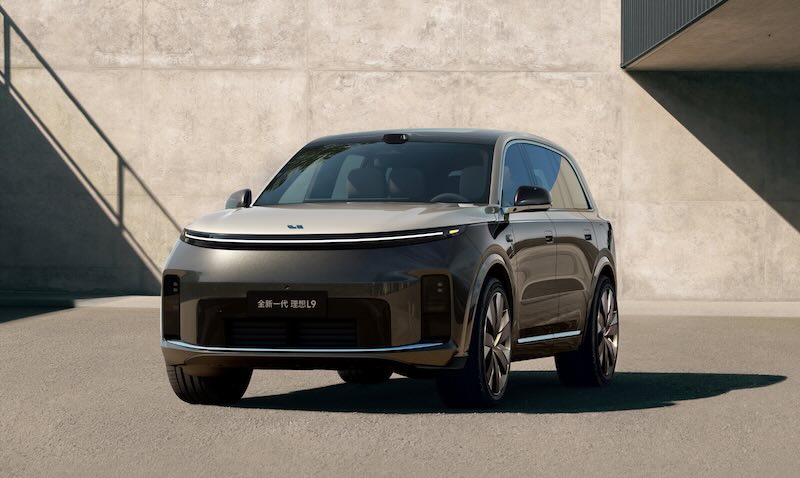
Li Auto redrew the competitive landscape for premium electric SUVs. The company’s refreshed L9, top specs branded as the L9 Livis, arrives with a specification sheet that reads more like a robotics platform than a family hauler, ipriced at RMB 559,800, roughly $77k. Positioning matters because Li Auto has effectively become the first manufacturer to push a fully drive-by-wire chassis below the RMB 600k threshold, forcing competitors to either match the hardware or explain why they can’t.
Updated Li Auto L9 runs on dual “Mach 100” chips, Li Auto’s in-house 5 nm silicon—delivering a combined 2,560 TOPS of compute power. That’s a substantial jump from the outgoing model and positions the vehicle for more demanding AI workloads. Forward LiDAR unit appears physically smaller, but the system adds a fourth compact LiDAR unit similar to Huawei’s implementation. What’s missing is just as notable: ultrasonic sensors seem to have been eliminated entirely.
Li Auto has been aggressive with sensor pruning before, original 2022 L9 was among the first vehicles to drop millimeter-wave radar beyond a single forward-facing unit. Now the company appears ready to lean fully into vision-based perception. Whether this gamble pays off depends entirely on software execution, but a well-tuned occupancy network can theoretically outperform ultrasonics in tight parking scenarios.
Chassis tells the real story here. Steer-by-wire combines with rear-wheel steering, an 800V active suspension capable of single-wheel lifting forces exceeding 10,000 N, and brake-by-wire using electromechanical brakes. These aren’t experimental technologies anymore, they’re becoming table stakes in the Chinese EV market’s relentless specification race.
Li Xiang, the company’s founder, framed the Li Auto L9 as an “embodied intelligence robot” during yesterday’s presentation. That’s marketing language, but the hardware supports the premise. Drive-by-wire architecture compresses the perception-to-actuation pipeline to roughly 350 milliseconds, compared to 550 milliseconds for conventional autonomous systems and 450 milliseconds for human drivers, according to Li Xiang’s previous earnings call disclosures.
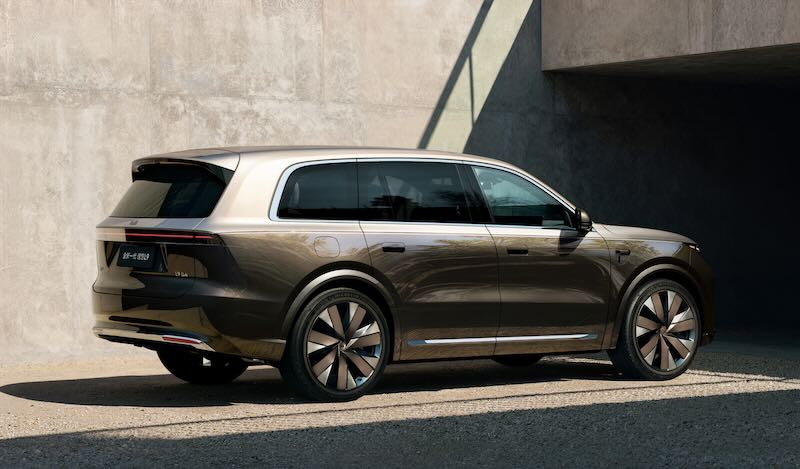
ADB headlights finally make an appearance. Door handles are no longer flush, a regulatory compliance move. Tire size increases to 285/40 R22. Electric side steps aren’t visible in released images but will likely be included, though pricing tier remains unclear. Exterior silhouette stays largely familiar, with the rear seeing the most significant redesign work. A two-tone paint option arrives with seamless hand-polished transitions, and the front “star-ring” lighting now illuminates in blue and yellow, apparently tied to driving modes and external interaction features.
Li Auto L9 Livis designation suggests a standard variant is coming at a lower price point, Li Xiang’s wording positioned this as the “ultimate version,” which implies stratification below it.
RMB 559,800 for a fully drive-by-wire platform isn’t just aggressive pricing, it’s a challenge to every manufacturer working above that threshold. Hardware superiority means nothing if competitors can’t justify their premium positioning. And for Li Auto, the real test starts now: whether software can extract meaningful differentiation from all that silicon and all those actuators. The company just raised the specification floor, now it needs to prove it can actually auto-mate the L9’s capabilities into something consumers will use.
Related Post
Li Auto MEGA Recall Costs 97.5k RMB Per Vehicle, Q3 2025 Earnings Analysis
Li Auto Unveils New Refresh MEGA Models with Smart Driving and Family-Focused Features
Li Auto i8 Electric SUV Unveiled: Discover the Future of Family EVs