
It’s a number that’s hard to wrap your head around. SpaceX is targeting a constellation of over 100k Starlink satellites, a tenfold jump from the roughly 10k currently circling Earth. That’s not a typo, and it’s not a stretch goal buried in a footnote — it came directly from the company’s roadshow pitch to investors, framed as a core part of SpaceX’s next growth chapter.
Announcement carries real weight. Starlink already accounts for 60% of SpaceX’s $18.7 billion in 2025 revenue, and the company’s upcoming IPO will demand the kind of financial performance that justifies that valuation. Expanding the constellation isn’t just an engineering ambition — it’s a business strategy.
Before unpacking the scale of 100k satellites, it’s worth understanding why that number is even viable. Answer is Starlink’s next-gen V3 satellites, expected to begin launching later this year aboard the Starship heavy-lift rocket.
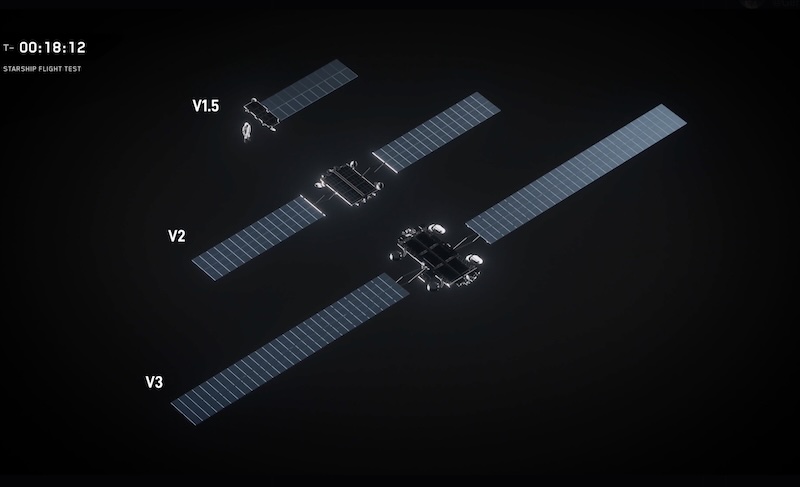
Compared to the current V2 generation, V3 offers 10X to 20X the capacity per satellite, gigabit internet speeds, and three onboard chips described as “far beyond state of the art.” Combine that hardware jump with a planned orbital altitude drop from 550km to 350km, and the math becomes striking: more than 100X the total network bandwidth, with minimum latency potentially cut in half to under 5ms.
To put that in context, 300km per millisecond is roughly how fast light travels through space. At 350km altitude, the physics of signal travel alone enables round-trip latency that approaches what fiber delivers on the ground in dense urban environments.
“I think it will actually be the highest bandwidth, lowest latency means of communicating,” Elon said at the JP Morgan investor event.
SpaceX’s roadshow materials project a total addressable market of $1.6 trillion for Starlink’s services, split between broadband ($870 billion) and Starlink Mobile ($740 billion). That’s an aggressive figure, though the customer trajectory gives it some credibility.
Active Starlink customers crossed 12M as of this week — up from 10.2M in March 2026 and 9M last December. That’s roughly 27,700 new subscribers added per day, a record pace. Whether that momentum holds as the service expands into emerging markets and lower-income regions will determine how much of that $1.6 trillion is actually within reach.

Starlink Mobile, the company’s direct-to-cell offering, adds another dimension entirely. SpaceX already has an FCC application pending for 15k satellites focused specifically on phone connectivity, with the current direct-to-cell fleet sitting at about 650 satellites. A 100k-satellite constellation would almost certainly absorb and expand that program.
Tucked into the investor pitch was something even more forward-looking than expanded broadband: orbiting data centers. SpaceX has floated the concept of deploying compute infrastructure in space, with constellations potentially scaling to 1 million satellites — dwarfing everything currently in orbit, which numbers just over 15k active spacecraft.
That’s a longer-horizon bet, tied to the company’s view that AI and robotics will require bandwidth levels that today’s infrastructure simply can’t support. It’s a legitimate technical argument — training and inference workloads are already stressing terrestrial data center capacity — but the economics of orbital computing remain unproven at scale.
Still, it signals that SpaceX isn’t thinking of Starlink purely as an internet service provider. Infrastructure ambitions here are closer to a utility play, one where the satellite network becomes the foundation for a much broader digital economy.
Related Post
Starlink V3 Satellites Promise Sub-20ms Latency Launch in 6-9 Months
SpaceX IPO Filing Reveals $28.5T TAM, Starlink Profits, Retail Access — What You Need to Know
The All-In Podcast: SpaceX IPO, Tesla, The Space Opportunity