
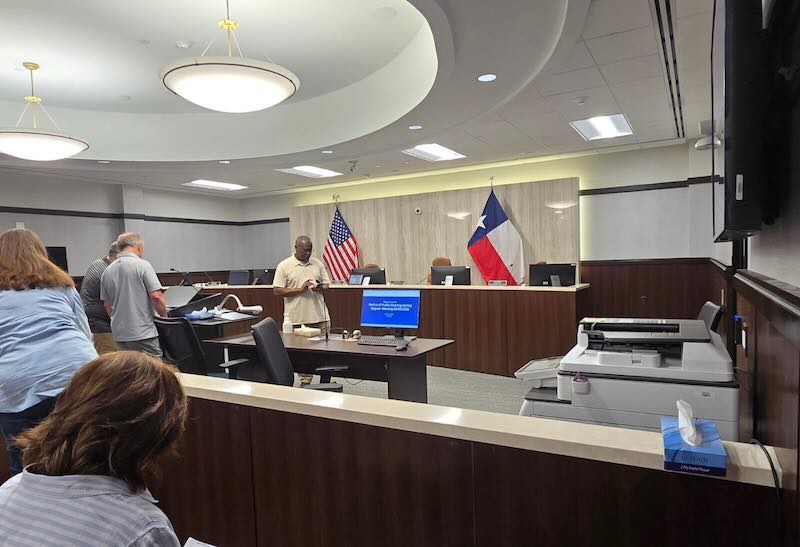
It wasn’t a unanimous standing ovation. But it was enough. On June 3, 2026, Grimes County commissioners voted 4-1 to hand SpaceX a full property tax exemption for Terafab, its proposed semiconductor manufacturing facility near the Gibbons Creek Reservoir in northwest Texas — a project that could balloon to $119 billion across all planned phases. In exchange, SpaceX commits to paying Grimes County $10 million upfront and $20 million annually for 35 years, a deal that county leaders argue will redefine what the region’s tax base looks like for decades to come.
County Judge Joe Fauth called it a “generational change.” Not everyone agrees.
The scale of the Terafab project is difficult to overstate. SpaceX filed a property tax abatement application describing the facility as a “multi-phase, next-generation, vertically integrated semiconductor manufacturing and advanced computing fabrication facility.” Initial investment is pegged at $55 billion, but if all expansion phases proceed, the total figure reaches $119 billion — a number that places Terafab in the same conversation as TSMC’s Arizona expansion or Intel’s Ohio fab projects.
Terafab isn’t a SpaceX-only play, either. Facility is structured as a joint venture between SpaceX, Tesla, and xAI, and it’s designed to produce chips for Tesla’s vehicles, Optimus humanoid robots, Starlink satellites, and xAI’s AI infrastructure. Intel has also joined the consortium. Musk has said current global chip output covers just 3% of his companies’ projected demand — which, if accurate, makes this build-out a supply-chain necessity rather than a speculative moonshot.
Site itself spans more than 6,000 acres near the Gibbons Creek Reservoir, about 90 miles northeast of Austin. A firm tied to SpaceX has already entered contracts to acquire parcels across that footprint, converting what was once a coal-fired power site into a candidate for one of the largest domestic semiconductor campuses in the country.
The agreement waives all property taxes on the project within the county in exchange for those guaranteed payments over 35 years. It also establishes SpaceX Reinvestment Zone No. 1, which channels revenue generated from rising property values within the zone’s boundaries back into improvements inside it.
Commissioner David Tullos cast the lone dissenting vote — and his objections were pointed. He argued that SpaceX hadn’t been transparent enough throughout the process, noting that site maps outlining the project’s boundaries were only provided two weeks before the vote, giving commissioners and residents limited time to review them. He described the reinvestment zone as a “green blob” on those maps and questioned why the project had expanded well beyond the original Gibbons Creek area without explanation. He asked the court to delay the vote. The court moved forward anyway.
“We’re being asked to establish a tax increment reinvestment zone that comprises this entire area, which the court and the county had to piece together through our county engineering and county attorney’s office,” Tullos said, adding that he could “write a novel” about the unanswered questions.
Responding to criticism of the tax arrangement, Elon addressed the deal’s optics directly. He argued that even with the property tax exemption, SpaceX will still pay an annual amount that grows Grimes County’s tax revenue by roughly 25%, and that when taxes from SpaceX employees and contractors are included, Terafab will far exceed all revenue the county currently earns. His reasoning: semiconductor fabs run on extraordinarily expensive equipment, and property taxes on those machines would create a structural cost disadvantage relative to chip fabs operating in other countries.
John Federspiel, senior director of SpaceX subsidiary Starlink Product Engineering, echoed that framing before commissioners. He told the court that America’s position in space, AI, and advanced manufacturing would depend on building critical technologies domestically — and that Grimes County had an opportunity to be part of that effort. He also offered environmental assurances: wastewater treatment facilities designed around water reuse, hazardous materials management in compliance with — and aiming to exceed — applicable regulations.
More than 100 residents packed the Grimes County courthouse for the public hearing. Most who spoke either opposed the project outright or expressed frustration over how the approval process had been handled. Speakers raised concerns about water and power strain, wildlife disruption, and the permanent industrialization of what is currently a rural county of roughly 34,000 people known for ranches, dark skies, and agricultural land.
Timing is also notable. Terafab’s regulatory progress comes just ahead of what could be SpaceX’s record-breaking IPO — and investors will be watching whether the company can convert its space and satellite dominance into a credible position in advanced domestic chip production.
For a county of 34,000 people, $20 million a year is transformative revenue.
Related Post
Terafab: Intel Joins SpaceX & Tesla to Build a U.S. Chip Factory in Texas
Tesla Launches Terafab: Inside the Company In-House Chip Manufacturing Ambition
The All-In Podcast: SpaceX IPO, Tesla, The Space Opportunity