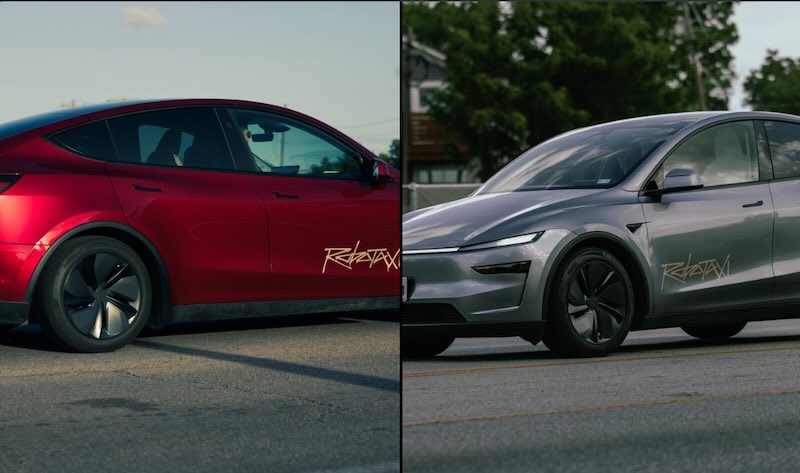
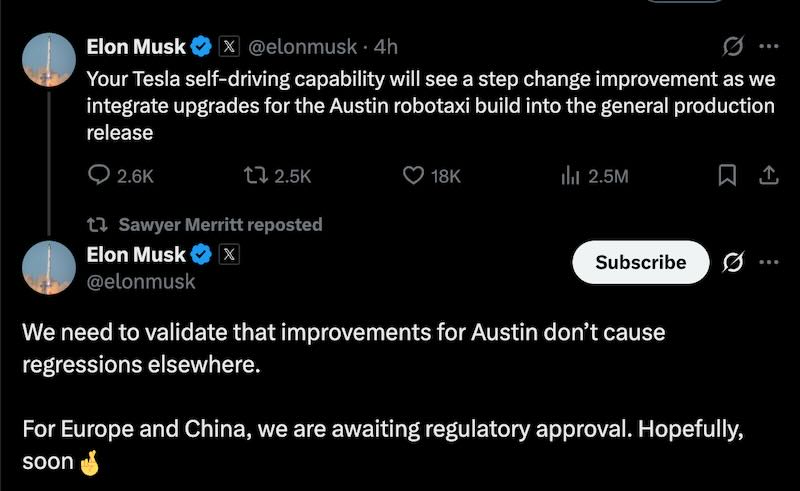
Tesla will integrate technologies developed for its Austin-based Robotaxi program into the general version of FSD, according to confirmation from Elon. Integration aims to boost performance across all supported markets while addressing concerns about potential regressions that often occur when AI systems undergo localized retraining.
This represents Tesla’s most significant FSD system-wide upgrade since the rollout of v13.2.8 in November 2024. While v13.2.9 brought minor refinements, upcoming release promises substantial improvements rooted in real-world validation conducted in Austin.
Austin Tesla Robotaxi project has generated scenario-specific optimizations that will benefit the broader FSD ecosystem. Improvements include enhanced complex intersection handling, refined extreme weather response strategies, and real-time validation of high-definition maps.
Adaptations will be deployed in the FSD global stack to improve Tesla’s overall hardware-software coordination. Modules underwent extensive closed-loop validation in Austin’s challenging driving environment before being considered for wider deployment.
Tesla’s latest FSD iteration will fully leverage HW4 capabilities, which support 4K visual processing and multimodal inference. Represents a significant upgrade from previous hardware generations, offering enhanced computational power for complex driving scenarios.
However, owners of HW3-equipped vehicles will face notable limitations. HW3 operates at 72 TOPS (trillion operations per second) compared to HW4’s 240 TOPS capacity, creating a substantial performance gap between hardware generations.
Internal estimates suggest the functional reduction for HW3 vehicles could reach 40%, particularly in areas requiring advanced ray tracing algorithms. Limitation highlights the growing divide between Tesla’s hardware generations as the company pushes the boundaries of autonomous driving technology.
Tesla must still navigate regulatory hurdles in Europe and China, where FSD enhancement rollouts remain contingent on government approval. These markets represent significant opportunities for Tesla Robotaxi tech deployment, yet regulatory frameworks haven’t kept pace with technological advancement.
Tesla’s ability to demonstrate safety improvements through Austin’s validation program may help accelerate approval processes in these markets. However, each region maintains distinct requirements that could delay or modify the integration timeline.
As the mass-market version of Tesla Robotaxi software edges closer to public testing, expectations continue building for what many consider a transformative moment in autonomous driving development. For Tesla, successfully integrating robotaxi innovations into FSD could prove that dedicated testing programs can taxi the entire autonomous vehicle industry forward.
Related Post
Tesla Robotaxi Review: FSD v13+ with Remote Intervention – Real Test Results
Tesla Model Y Completes First Fully Autonomous Vehicle Delivery from Factory to Customer Home
Tesla vs Waymo: Kyle Vogt Explains the Real Robotaxi Divide That Matters Most