
SpaceX secured a significant regulatory win that could mean faster internet speeds for Starlink users. The Federal Communications Commission on Monday approved the company’s year-old request to increase the radiated power on two Starlink dish models, potentially enhancing performance across its growing satellite internet service.
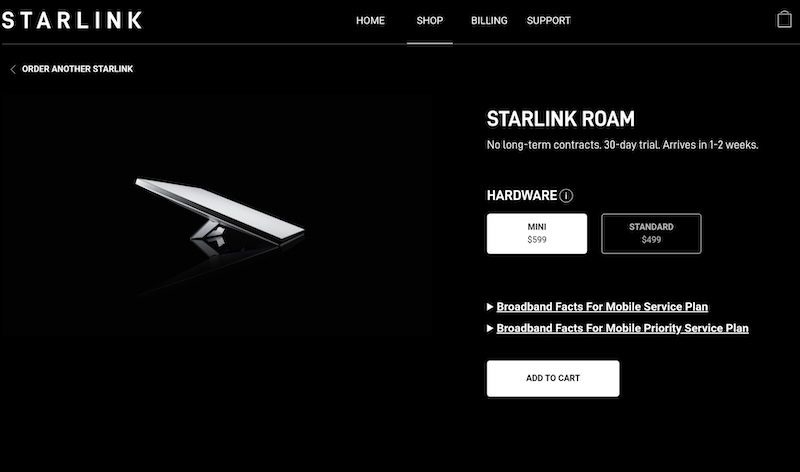
Approval specifically allows SpaceX to increase the Equivalent Isotropic Radiated Power (EIRP) – essentially how much signal the Starlink hardware effectively transmits in a given direction. For the standard dish model (UT3-V1), EIRP can now increase from 42.1 to 43.4 decibel watts, while the Mini dish (UT3-V2) sees a more substantial jump from 33.2 to 39.2 dBW.
According to the FCC filing, SpaceX requested these changes “to offer faster and/or more reliable service for users of these devices.” The company submitted multiple reports demonstrating that the power increase wouldn’t create radiation hazards or cause radio interference issues – key concerns the FCC needed addressed before granting approval.
The regulatory green light covers both stationary and in-motion use cases, expanding the potential applications for Starlink’s increasingly versatile satellite internet service. Currently, Starlink connections in the US typically deliver download speeds ranging from 100Mbps to upwards of 300Mbps.
What remains unclear is how SpaceX will implement these newly approved power increases. The company hasn’t publicly responded to requests for comment about whether existing Starlink dish models will receive the enhancement or if it will be reserved for upcoming hardware.
Earlier this year, SpaceX indicated it was developing new Starlink products: a Mini dish successor, a gigabit dish, and an updated high-performance dish. In June, the company released a next-gen $1,999 “performance” dish designed to eventually deliver gigabit speeds once SpaceX deploys its V3 Starlink satellites using Starship launches.

Interestingly, SpaceX hasn’t filed applications with the FCC for entirely new dish models, suggesting the company may be iterating on its existing hardware designs rather than creating completely new form factors. Approved power increase could be part of this evolutionary approach to hardware development.
Timing of this FCC approval aligns with growing speculation about a smaller Starlink Mini dish, especially as SpaceX continues exploring ways to bring Starlink service to phones in some capacity. Power boost approval might just be the link to making those connections faster.
Related Post
T-Mobile Starlink Satellite Cellular Apps Supported: Real-World Test Results Before October Launch
Starlink V3 Satellites Promise Sub-20ms Latency Launch in 6-9 Months
FCC Votes to Review Satellite Power Limits That Could Supercharge Starlink Internet Speeds