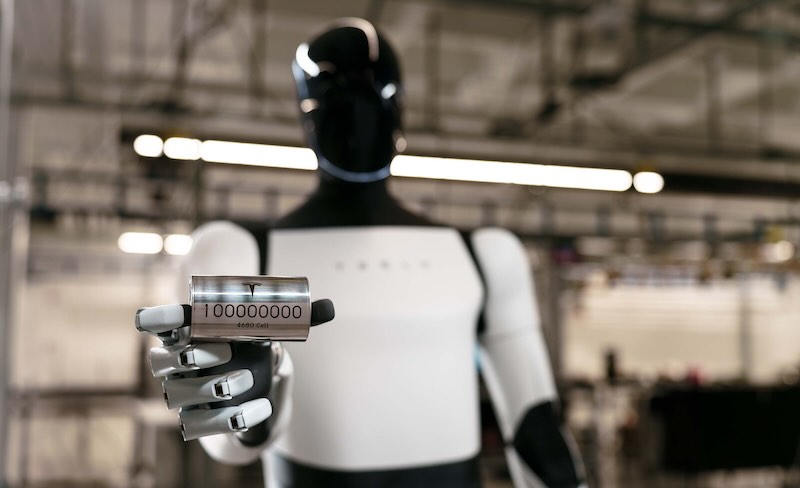
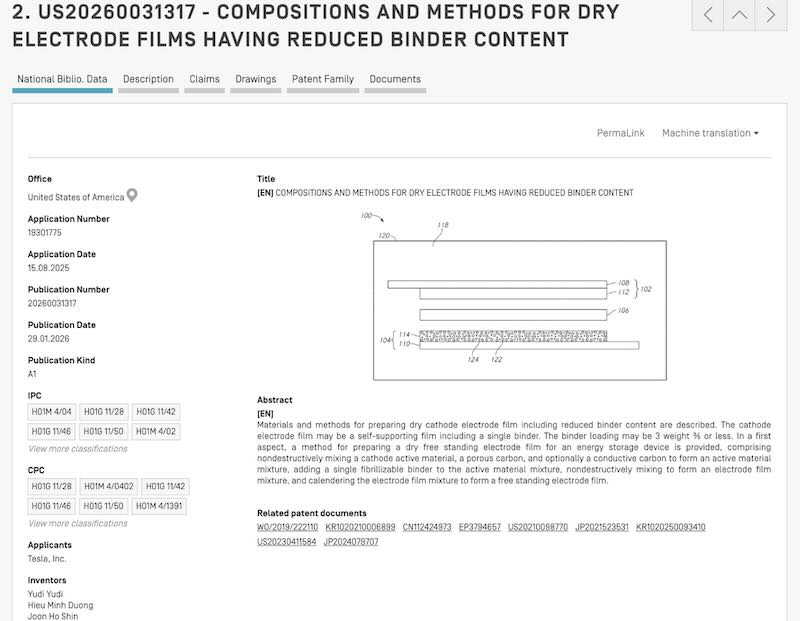
Tesla has reached a milestone that’s been five years in the making. The company confirmed large-scale deployment of dry electrode manufacturing for both the anode and cathode of its 4680 battery, a process first teased at Battery Day in 2020. What’s more, Tesla has now secured intellectual property protection through patent application US20260031317A1, published January 29, 2026, which could reshape competitive dynamics across the battery manufacturing sector.
The filing details a specific dry electrode manufacturing method that non-destructively mixes active materials, particles larger than 10 microns, with porous carbon before adding a single PTFE binder at less than 2% weight. Crucially, process limits conductive carbon to 8% or less by weight, enabling energy density improvements while maintaining production efficiency. Self-supporting films can be achieved in three or fewer calender passes, and active material content can reach up to 98%.
This isn’t just incremental progress. Tesla’s approach addresses fundamental manufacturing challenges that have held back dry electrode technology for years. By securing patent protection around this process, the company has created barriers that prevent competitors from easily replicating the efficiency gains.
According to data Tesla released, the dry electrode approach slashes both equipment capital expenditure and energy consumption by roughly 90% compared with conventional wet electrode processes. These aren’t marginal improvements, they represent a fundamental restructuring of battery production economics.
When combined with other vertically integrated optimizations spanning materials and cell design, Tesla is targeting a 54% increase in driving range from the 4680 battery. Cost reduction goals sit at 56%, while capital investment per unit could drop 69%. Those figures explain why the company persevered through years of production challenges.
Yet the 5-year development timeline hasn’t been without consequence. Beyond pack-level integrations such as cell-to-chassis architecture, Tesla’s battery breakthroughs have been sparse during this period. Meanwhile, Chinese manufacturers, led by CATL and supported by domestic market scale, have pursued alternative battery technologies. Their progress on cost control, ultra-fast charging capabilities, and performance has been substantial, even as they’ve avoided the large cylindrical cell route.
Elon acknowledged the difficulty in a comment: “Making the dry electrode process work at scale, which is a major breakthrough in lithium battery production technology, was incredibly difficult.”
Now that Tesla dry electrode technology has reached production scale with patent protection in place, the question becomes whether competitors can find workarounds, or whether Tesla’s manufacturing moat just got significantly deeper.
Related Post
Tesla 4680 Battery Cell Production Soars: 100 Million Milestone Reached
Tesla Nevada LFP Battery Factory Nears Completion, Cuts China Dependence
Tesla Dry Cathode 4680 Cells Cybertruck: Revolutionary EV Technology