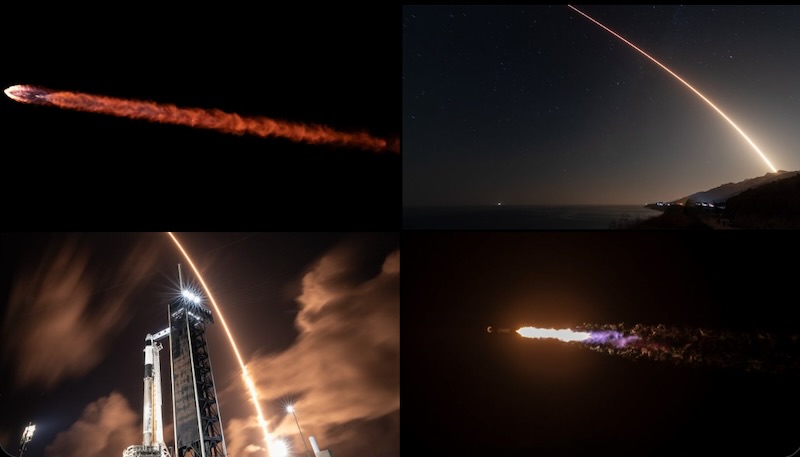
SpaceX has submitted a request to the Federal Communications Commission that redefines ambitious. The company wants permission to launch and operate up to one million satellites functioning as orbital data centers, designed to power artificial intelligence applications for users worldwide. Filed late Friday, application outlines a vision that extends far beyond the existing Starlink network, which currently operates over 9,600 satellites in low Earth orbit.
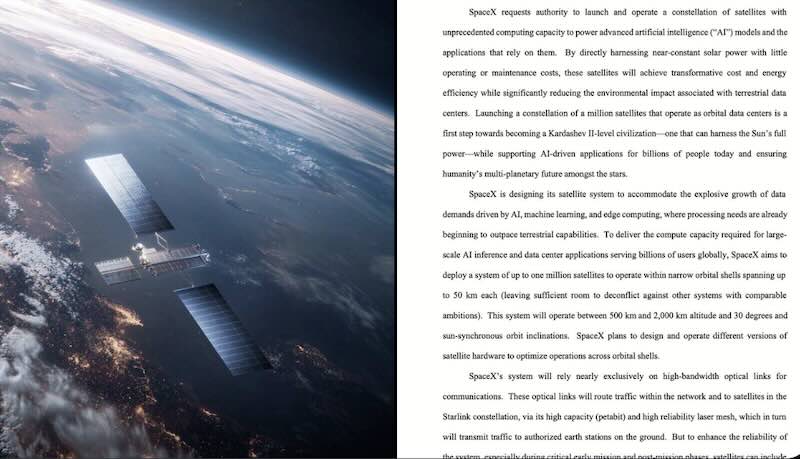
The filing describes these spacecraft as solar-powered computing platforms that would operate between 500 and 2,000 kilometers above Earth’s surface. According to SpaceX, this constellation represents “a first step towards becoming a Kardashev II-level civilization, one that can harness the Sun’s full power—while supporting AI-driven applications for billions of people today and ensuring humanity’s multi-planetary future amongst the stars.”
The company’s rationale centers on addressing what it identifies as a critical infrastructure challenge. Traditional data centers consume massive amounts of electricity and require substantial cooling systems. SpaceX argues that orbital facilities powered entirely by solar energy offer a more efficient alternative.
“With Starship’s ability to deliver unprecedented tonnage to orbit for AI compute, the capacity for intelligence processing in space could surpass the electricity consumption of the entire U.S. economy, without the immense cost and disruption of rebuilding Earth’s strained electrical grid to support the explosive demand for data centers,” the filing states.
The company projects it could add 100 gigawatts of AI computing capacity annually by launching one million tonnes of satellites per year, with each tonne generating 100 kilowatts of compute power. Elon commented on the proposal, noting that “100GW/year of solar-powered AI satellites requires 100GW/year of AI computers.”
SpaceX plans to distribute the satellites across narrow orbital shells, each spanning up to 50 kilometers. Configuration aims to prevent conflicts with other satellite systems that might have similar deployment goals. Orbital shells would range from 500 to 2,000 kilometers in altitude, operating at inclinations between 30 degrees and sun-synchronous orbits.
System would rely almost exclusively on high-bandwidth optical links for communications. Laser-based connections would route traffic within the network and connect to the existing Starlink constellation, which would then transmit data to authorized ground stations. Approach leverages Starlink’s petabit-capacity laser mesh network, essentially using the current satellite internet system as a backbone for the orbital data centers.
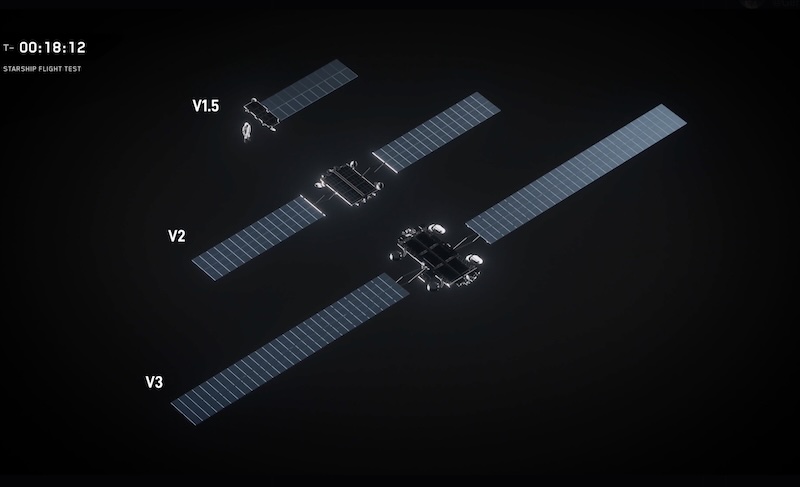
SpaceX indicates it will design multiple versions of satellite hardware optimized for different orbital shells, though specific details about satellite mass and exact configurations remain undisclosed in the filing.
Central to this proposal is SpaceX’s Starship launch vehicle, which the company positions as the key enabler for rapid deployment. Fully reusable rocket system can deliver significantly more payload to orbit than any existing launch vehicle, making the economics of launching hundreds of thousands of satellites theoretically feasible.
The company emphasizes that decreasing launch costs through Starship development will allow it to scale the constellation as demand increases and computing technology advances. Same vehicle is also crucial for deploying next-generation Starlink v3 satellites.
FCC will likely subject this request to intense scrutiny. Earlier this month, the Commission approved SpaceX’s request to operate an additional 7,500 satellites for its second-gen Starlink constellation, including at lower altitudes. However, regulators stopped short of granting permission for the full 22,488 satellites SpaceX had requested.
A constellation of one million satellites would dwarf any previous space-based system. Critics will probably raise concerns about orbital debris, collision risks, astronomical observation interference, and spectrum allocation. Application arrives as SpaceX reportedly prepares an initial public offering, Elon officially confirmed SpaceX 2026 IPO, which could help finance the orbital data center initiative.
SpaceX’s 8-page filing describes the project as necessary to “deliver the compute capacity required for large scale AI inference and data center applications serving billions of users globally.” The company maintains that orbital facilities represent “the most cost-effective, energy-efficient, and environmentally sound way to build infrastructure to meet accelerating demand for AI-enabled goods and services.”
Whether regulators will approve even a fraction of the requested satellites remains uncertain. What’s clear is that SpaceX wants to launch a million satellites into an entirely new frontier for cloud computing.
Related Post
SpaceX Plans 2027 Launch for Second-Gen Cellular Starlink, 100x Faster Connectivity
FCC Approves SpaceX to Launch 15,000 Next-Gen Starlink Satellites, Gigabit Speeds Coming
SpaceX Starlink Hits 9M Customers With Record Growth, Satellite Internet Expansion