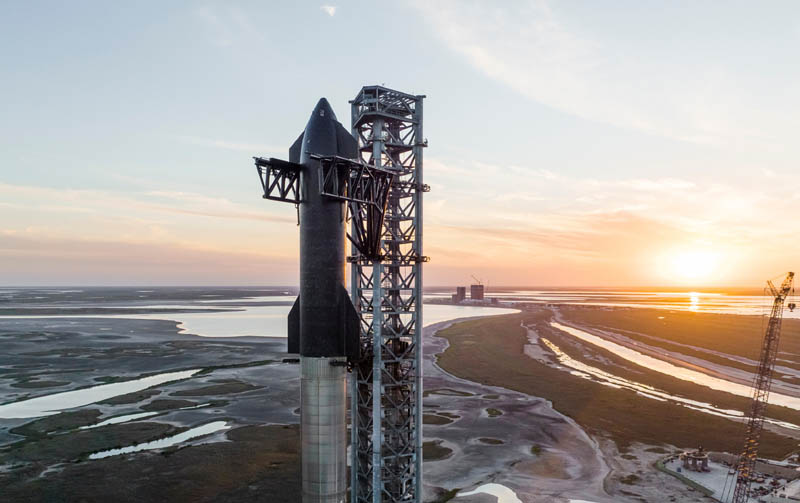
Elon Musk announced Tuesday that SpaceX has acquired xAI, marking one of the most significant corporate consolidations in the commercial space sector. Merger unites rocket manufacturing, satellite internet infrastructure, and artificial intelligence development under a single corporate structure. SpaceX is now valued at $1.25 trillion following the acquisition, making it the 11th most valuable company globally and overtaking Berkshire Hathaway in market capitalization.
Elon’s statement outlined plans to deploy orbital data centers powered by solar energy, addressing what he characterizes as unsustainable terrestrial power demands for AI computation.
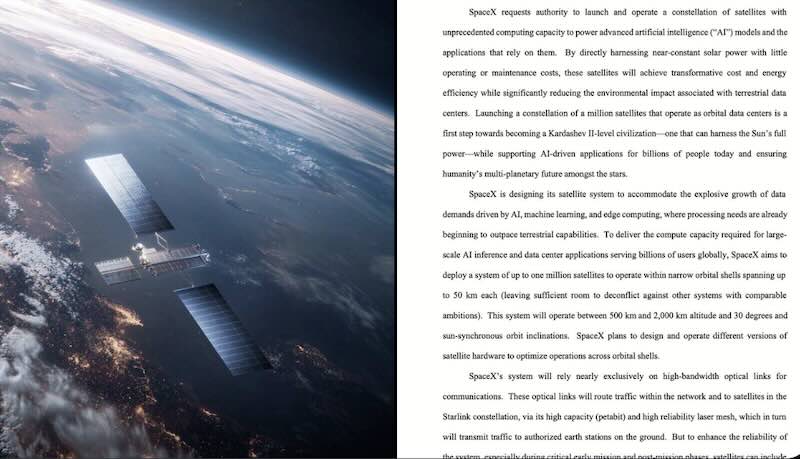
Acquisition targets a specific technical challenge: AI training requires massive electricity consumption that current grid infrastructure cannot support without environmental consequences. SpaceX and xAI propose launching satellite-based data centers that operate in constant sunlight, eliminating cooling costs and grid dependency. According to Elon’s projections, orbital facilities could generate 100 gigawatts of compute capacity annually by launching satellites that produce 100 kilowatts per ton.
Timeline suggests SpaceX and xAI expect space-based computation to become cost-competitive with ground facilities within two to three years. Calculation depends on Starship’s projected capability to launch 200 tons per flight at hourly intervals, delivering millions of tons to orbit yearly.
Starship’s development trajectory now includes AI satellite deployment alongside existing commitments to Starlink V3 satellites and direct-to-mobile communications. The company launched approximately 3,000 tons to orbit in 2025, primarily Starlink units via Falcon rockets. Starship’s payload capacity exceeds current launch vehicles by substantial margins, Starlink satellites launch on Starship, enabling the satellite constellation scale required for orbital data centers.
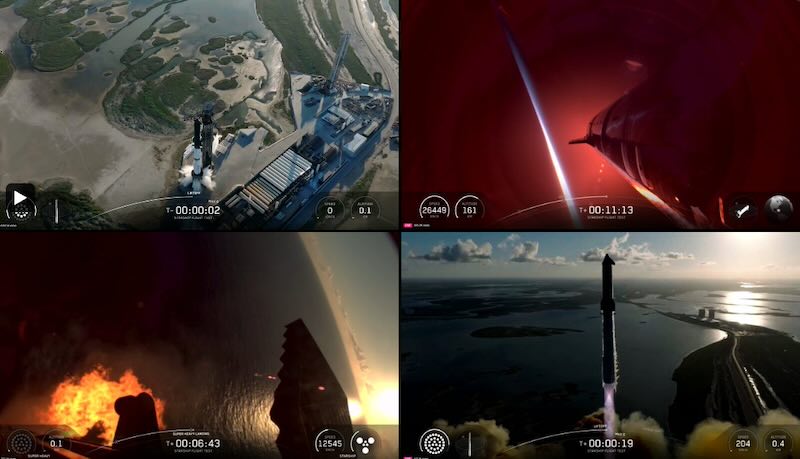
Elon referenced the forcing function concept, how Starlink’s satellite requirements drove Falcon program improvements. SpaceX and xAI anticipate similar developmental pressure will accelerate Starship’s capabilities and launch cadence.
Statement extends beyond near-Earth operations to lunar manufacturing facilities. Elon outlined plans for electromagnetic mass drivers and Moon-based factories producing satellites from lunar materials, potentially deploying 500 to 1,000 terawatts annually of AI computing infrastructure into deep space. This represents movement toward Kardashev Type II civilization status, defined by a society’s ability to harness stellar-scale energy.
Elon stated that “the capabilities we unlock by making space-based data centers a reality will fund and enable self-growing bases on the Moon, an entire civilization on Mars and ultimately expansion to the Universe.” Revenue from orbital data centers would theoretically fund expanded lunar operations and Martian settlement infrastructure. The company maintains that existing space sustainability protocols, including end-of-life satellite disposal procedures, will apply to the new constellation.
Whether SpaceX and xAI can execute these technical and financial projections remains an open question, though the merger consolidates resources and establishes the financial foundation for attempting the transformation.
Related Post
xAI Colossus 2 1GW Supercomputer is Now Online, Scaling to 1.5GW by April
xAI Buys 5 Natural Gas Turbines to Power 600K+ GPU Cluster
xAI Colossus 2 Supercomputer Targets Million-GPU Milestone with $20B Investment