
Battery technology doesn’t wait for anyone — CATL proved it. The world’s largest battery manufacturer has unveiled its third-gen Shenxing LFP battery, a landmark release that pushes EV charging into territory that would’ve seemed implausible just three years ago. Charging from 10% to 98% in 6.27 minutes isn’t a concept. It’s a product. And it’s arriving at a moment when CATL already powers one out of every two EVs sold in China.
“We always deliver what we promise,” CTO Gao Huan told reporters at a Beijing event — a statement that carries real weight when the data backs it up this convincingly.
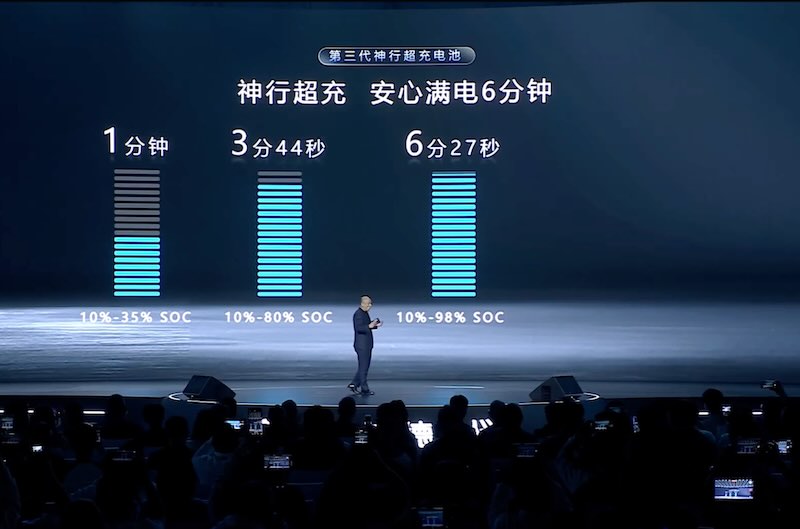
Headline numbers are striking. Third-gen Shenxing LFP battery moves from 10% to 35% in just 1 minute. From 10% to 80% takes 3.44 minutes. And from 10% to 90%? 6.5 minutes. That’s not a trickle charge with caveats — that’s consistent, repeatable performance under real-world conditions.
Cold-weather charging has long been the Achilles’ heel of fast-charging systems. CATL’s answer here is its new self-heating pulse technology, which keeps performance intact even at -30°C (-22°F). At that temperature, battery charges from 20% to 98% in just 9 minutes, a result that’s genuinely difficult to contextualize without stopping to reconsider what “fast charging” used to mean.
Durability is addressed just as seriously. CATL claims third-gen Shenxing LFP battery retains over 90% of its original health after 1,000 ultra-fast charging cycles. That’s a significant commercial commitment, not just a lab figure. Battery also achieves a world-record internal resistance of 0.25 milliohms — roughly 50% lower than the industry average, and meaningfully improved over the 0.3 milliohms recorded in the first-generation Qilin battery used in the Li Auto MEGA. Complementing this, new Cell Shoulder Cooling Technology improves thermal efficiency by 20%, keeping charge cycles stable under sustained load.
Not every problem in EVs is a charging problem. Range and weight matter just as much — and that’s where CATL’s third-generation Qilin battery enters the picture.
CATL has been vocal in pushing back against the industry trend of oversized LFP packs. A 125 kWh pack weighing 880 kg, the company argues, directly conflicts with automotive lightweighting principles. Simply stacking capacity to chase range figures beyond 750kg is, in their view, an inefficient allocation of engineering resources. Using LFP chemistry in vehicles priced above 250k RMB, Gao Huan added, is effectively a step backward.
Third-gen Qilin battery answers that critique directly. With a cell energy density of 280 Wh/kg and volumetric energy density of 600 Wh/L, a 125 kWh pack now weighs just 625kg — enabling over 1,000km of range. Equivalent charging rate has jumped from 4C to 10C, and peak power has more than doubled, from 1,330 kW to 3,000 kW.
CATL has also introduced a Qilin semi-solid-state battery at 350 Wh/kg — enough to deliver over 1,500km of range in executive sedans and more than 1,000km in full-size SUVs, with pack weight staying under 650 kg.
For extended-range hybrids, the second-generation Xiaoyao battery completes the portfolio. Range improves from 400km to 500km, charging rate scales from 4C to 10C, and the ternary version delivers an energy density of 230 Wh/kg with up to 600km of pure electric range. Discharge power reaches 1,500 kW at full charge and 1,200 kW at 20% — with additional reinforcements for off-road durability, including enhanced impact resistance and water sealing.
Whatever the competition has planned next, CATL’s latest generation of batteries makes one thing unmistakably clear: when it comes to EV energy, they’re not just charging ahead — they’re recharging the entire industry.
Related Post
CATL Invests RMB 2.5B in NIO Energy: Battery Swap Partnership Set to Transform EV Charging
CATL New EV ‘Shenxing’ Battery with 700km Range and 400km just 10 Minute Charging
Sunwoda Joins Tesla Battery Supply Chain — What It Means for the Global EV Market