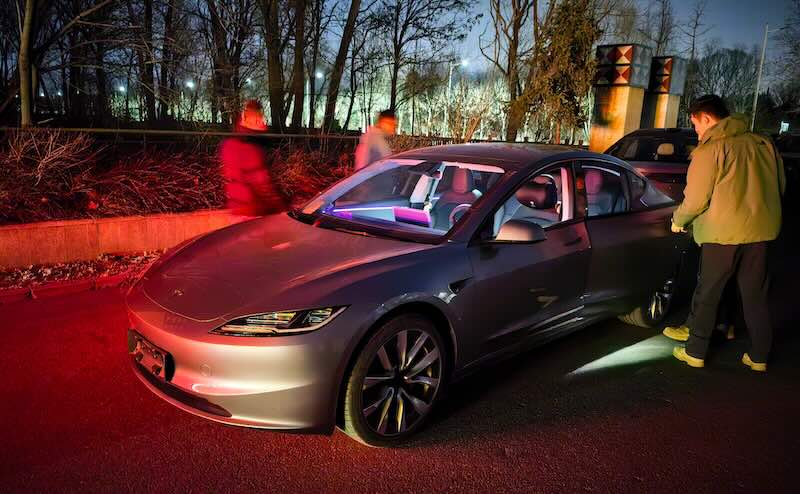
Tesla’s FSD ambitions in China have been building for over a year, and the latest signals suggest the company is finally closing in on a broader deployment. But between regulatory timelines and Elon Musk’s historically optimistic forecasts, there’s still reason to pump the brakes before declaring victory.
Tesla’s official account recently outlined rollout plans for Supervised FSD, explicitly noting the system’s intent for the Chinese market. That framing, however, overstates the novelty of the situation. FSD had already entered China in a limited capacity back in March of last year, with Tesla officially confirming its China plans by June. Regulators, though, capped that initial phase at roughly 5,000 vehicles — barely a proof-of-concept at Tesla’s scale.
More consequential update came during Tesla’s Q1 earnings call, where the company’s CFO confirmed active engagement with Chinese regulators and targeted a full approval timeline in Q3 of this year. That’s a meaningful signal, but it shouldn’t be treated as a guarantee.
Here’s the thing: Elon has floated optimistic FSD China approval dates before. At last year’s World Economic Forum Annual Meeting, and again at this year’s Tesla shareholder meeting, he suggested broader approval could arrive as early as February or March of this year. It’s now May, and full approval hasn’t materialized. Regulatory process, it’s clear, doesn’t move on Elon time.
That said, there’s concrete operational evidence that Tesla is pushing hard. Recruitment listings show openings for Autopilot real-world testing technicians across nine Chinese cities — Beijing, Shanghai, Guangzhou, and Shenzhen among them. The roles, sitting under Tesla’s Autopilot R&D division, involve vehicle validation on public roads, proving grounds, and dedicated test facilities. You don’t hire at that scale without a deployment in mind.
Equally important is what Tesla has put in place behind the scenes. To comply with China’s Data Security Law and cross-border automotive data regulations, Tesla launched a local AI training facility in Shanghai Lingang in February 2026. Center is equipped with high-performance compute clusters and enables a fully localized pipeline — covering data collection, storage, model training, and in-vehicle deployment — without routing road data overseas.
That’s a significant operational commitment, not a footnote. It means Tesla can iterate FSD models within China entirely on local infrastructure. Combined with the shift to a monthly subscription model globally since February 2026, Tesla’s commercial framework for FSD is increasingly locked in.
Groundwork is there. The regulatory green light isn’t — yet. One might say Tesla’s FSD China story is fully supervised, just waiting on final approval.
Related Post
Tesla FSD HW 3.0/HW 4.0 in China: First Impressions of New FSD Update on HW 3.0 Vehicles
Tesla FSD V14.3.3 Update: 8 MPH Summon & Intervention Tracking
Tesla Ships First 3,000+ New Model Y Vehicles from Giga Shanghai to Australia