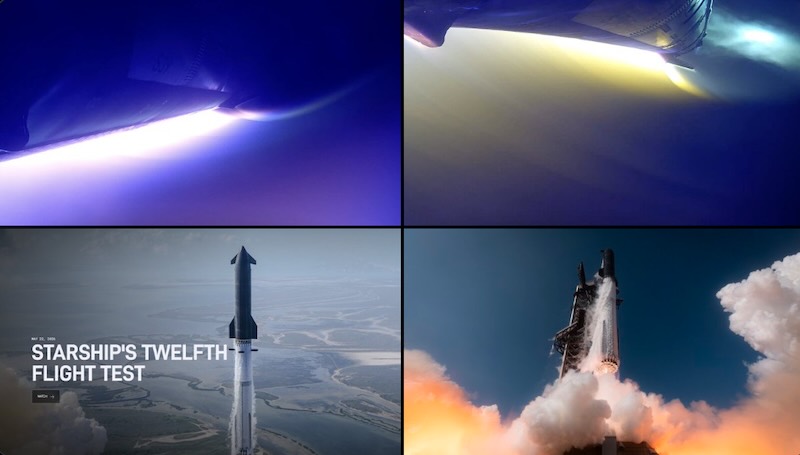
SpaceX’s twelfth Starship test flight didn’t go perfectly — but it didn’t need to. Debut of Starship V3 from Starbase marked a significant milestone in commercial spaceflight, validating core mission objectives despite a booster mishap and an early engine shutdown. For a program that measures progress in data points rather than flawless landings, this flight delivered.
Standing 124.4 meters tall and tipping the scales at 5,533 tons at liftoff, Starship V3 is, without qualification, the most powerful rocket ever flown. Its 33 Raptor 3 engines generate a combined 9,240 metric tons of thrust — a figure that renders every previous launch vehicle obsolete by comparison.
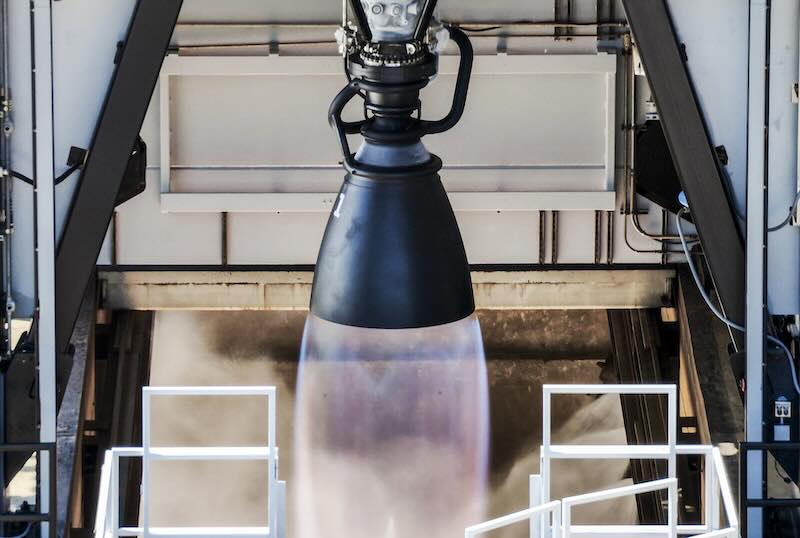
Mission launched cleanly, with all 33 Raptor v3 engines igniting over the Gulf of America. One engine shut down during ascent, though the vehicle continued on trajectory without issue — a direct demonstration of its engine-out redundancy capability.
Hot-stage separation proceeded as planned, with the upper-stage ship (S39) igniting its six Raptor engines to continue into space. What followed, however, was a rough sequence for the Super Heavy booster (B19). Unable to light all engines for its boostback burn, B19 executed only a partial burn before losing control and splashing down hard in the Gulf of America. Recovery operations were called off.
Meanwhile, S39 pushed through its own challenge. After losing one vacuum-optimized Raptor engine during ascent, the ship extended its burn — nearly depleting its propellant reserves — to reach the planned trajectory. That decision forced SpaceX to cancel a scheduled reentry test, though the vehicle still completed a controlled splashdown in the Indian Ocean.
Beyond the flight dynamics, the structural improvements in Starship V3 deserve attention. Engineers trimmed the total vehicle mass by 80 tons — a substantial reduction that directly improves payload efficiency. Grid fins were reduced from four to three and repositioned lower on the booster for better thermal and aerodynamic management.
The revised hot-stage separation system performed as designed, and a newly integrated orbital refueling interface opens the door for future lunar and Mars missions requiring in-space propellant transfer. With more than 100 tons of payload capacity to low Earth orbit, the commercial implications are difficult to overstate.
On this flight, S39 successfully deployed 20 Starlink simulators alongside two modified Starlink satellites that captured imagery of the vehicle in orbit — a quiet but telling validation of the platform’s operational potential.
Critically, Starship gathered heat shield and structural performance data during reentry, executing deliberate stress maneuvers on its rear flaps before guiding itself to the pre-planned splashdown zone.
For all its setbacks, Starship V3 showed exactly what SpaceX needed it to show: that even when things go wrong, this rocket finds a way to stay on course — and that’s not a small thing to launch.
Related Post
SpaceX Installs Massive Fuel Transfer Tube in Next Generation V3 Super Heavy Booster
SpaceX Starship Rocket Aces 11th Test Flight, Setting Stage for Version 3
The All-In Podcast: SpaceX IPO, Tesla, The Space Opportunity