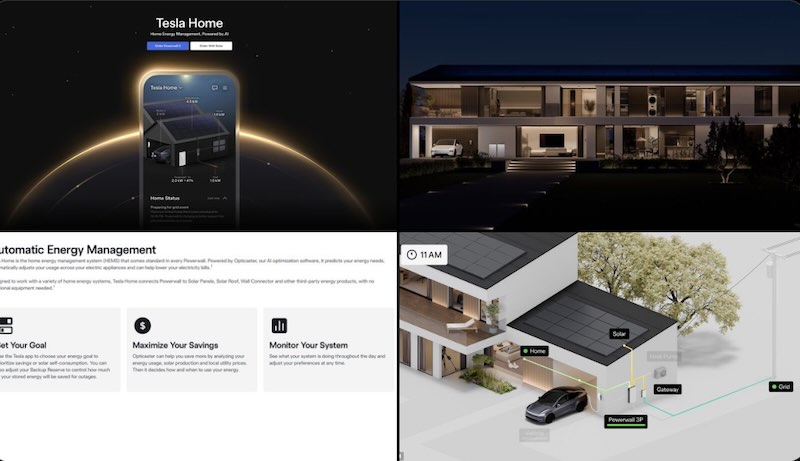
Tesla has launched Tesla Home, a home energy management system built to simplify how households produce, store, and use electricity, check out. Rather than a standalone device, Tesla Home is a software layer that ships standard with every Powerwall. It coordinates solar panels, battery storage, EV charging, and compatible third-party equipment under one system. The company positions Tesla Home as a way to cut electricity costs without requiring homeowners to manage each device separately.
At the center of Tesla Home sits Opticaster, Tesla’s AI optimization engine. Opticaster forecasts solar production and home loads, then creates a personalized strategy to optimize energy usage and meet your goals. In practice, that means the system anticipates conditions before they happen instead of reacting after the fact.
Forecasting model draws on more than weather data. According to Tesla, Opticaster looks at three things at once: how much solar your panels are likely to produce, how much energy your home is likely to use, and the details of your electricity tariff and your energy goal. Consequently, the system can weigh multiple variables simultaneously rather than optimizing for a single factor.
Once Opticaster has its forecast, it builds a usage plan. During periods when utility prices climb, home draws on solar or stored battery power instead of pulling from the grid. Conversely, when utility rates drop, the Powerwall and connected EV chargers refill using solar generation or lower-cost grid electricity. Either way, the objective stays the same: keep costs down without asking the homeowner to track pricing manually.
This isn’t a one-time calculation, either. Opticaster continuously benchmarked and upgraded based on the latest improvements and updates to energy consumption patterns, which allows the system to adjust as circumstances shift throughout the day.
Tesla Home doesn’t stay static after installation. System receives regular updates delivered over the air, meaning performance can improve without any hands-on intervention from the homeowner. Given that Opticaster has already logged over a hundred million hours of operational experience across Tesla’s broader energy business, the software isn’t starting from scratch — it’s applying lessons learned at scale to individual homes.
Perhaps the most practical detail is what Tesla Home doesn’t require: extra hardware. System connects Powerwall to solar, Wall Connector and other energy products without a separate control box. For homeowners who’ve already invested in Tesla’s ecosystem, or who run compatible third-party devices, that translates into fewer components to install and fewer things that can go wrong.
Is Tesla Home a dramatic shift for energy management? Maybe not on paper. But by consolidating forecasting, cost control, and equipment coordination into one automatic layer, Tesla Home makes the case that the smartest way to manage electricity is to stop managing it manually — and let the home take charge.
Related Post
Tesla Accelerates Energy Storage Play with $194M Build 1.6M Sqft New Texas Megapack Factory
Tesla Q2 2026: 480K Deliveries Stun Wall Street Forecasts
Tesla Semi Charging for Businesses: Pricing, Hardware & Network Fees Explained