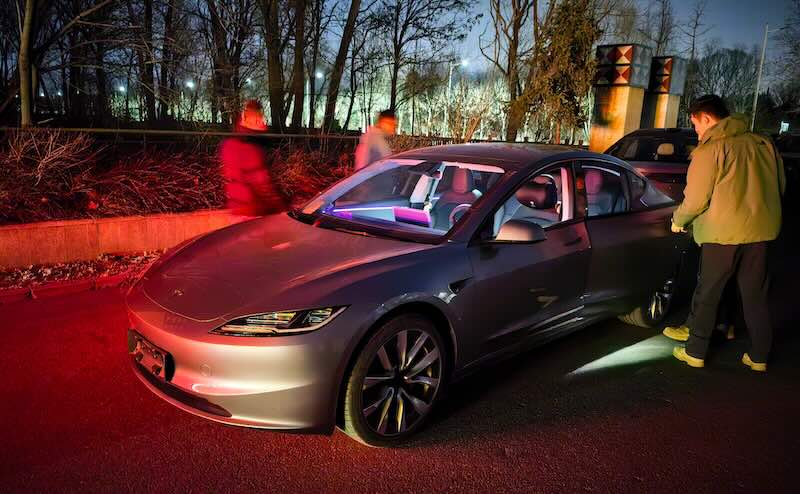
Tesla’s FSD has always been a tale of two camps. HW4 owners have been living in a different world — one where Reinforcement Learning improvements, smoother handling, and smarter navigation have stacked up quietly over more than a year. HW3 owners, meanwhile, have been watching from the sideline. That wait is officially over. FSD V14 Lite is now rolling out, and it’s arguably the most consequential update this hardware segment has seen.
Ashok Elluswamy, Tesla’s VP of AI, confirmed the rollout is live for early-access customers, with a broader release expected over the coming weeks. Announcement was direct: this build distills the driving behavior from AI4’s V14 series into the camera configuration and compute profile of AI3. Translation? HW3 hardware is now learning from HW4’s neural playbook — and the gap is closing.
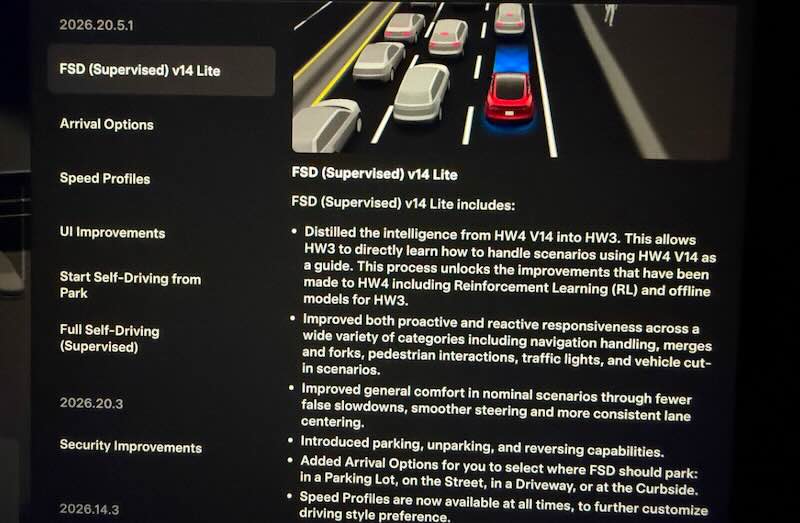
Headline capability is knowledge transfer. FSD V14 Lite takes the intelligence developed on HW4 hardware and compresses it into a format HW3 can run. Includes reinforcement learning improvements and offline model refinements — techniques that weren’t previously accessible to older hardware due to compute constraints.
Practically, the update targets several friction points that have frustrated HW3 users:
Responsiveness across merges, forks, pedestrian interactions, traffic lights, and cut-in scenarios has been improved, covering both proactive anticipation and reactive recovery. Nominal driving comfort sees a meaningful uplift too — fewer false slowdowns, smoother steering inputs, and more consistent lane centering are all cited in the official release notes.
Addition of parking, unparking, and reversing is a notable feature addition. Alongside it comes Arrival Options, which let drivers select where FSD should deposit the vehicle: a parking lot, street spot, driveway, or curbside. Speed Profiles are also now available at all times, extending driver customization to city road scenarios — a feature HW4 users have had access to for some time.
Here’s the context that makes FSD V14 Lite more than a routine update: this is the first FSD release HW3 owners have received in over 14 months. That’s not a small gap in software terms — that’s more than a year during which the HW4 experience evolved substantially while the existing fleet went untouched.
Question everyone is asking is whether this changes the FSD subscriber calculus. A significant portion of Tesla’s installed base is still running HW3 hardware. If V14 Lite delivers even a fraction of the capability improvement that HW4 users experienced with V14, that could translate into material subscription growth. Ashok’s phrasing was notably careful — “significantly improved safety” was his primary claim, not just feature parity. That framing matters. Safety is the metric regulators, investors, and buyers actually care about.
Rollout strategy is conservative for now: early-access customers first, broader distribution in the coming weeks based on feedback. That’s a reasonable approach for a release that has to perform correctly across a wide range of vehicle configurations.
After 14 months of silence, (December, 2024, FSD v12.6 for HW3 owner) , HW3 owners aren’t just getting an update. They’re getting a whole new drive. You could say Tesla just gave FSD V14 Lite the green light to prove that good things really do come to those who wait — and this one’s fully self-driven.
Related Post
Tesla HW3 Can’t Achieve Unsupervised FSD – Upgrade Program Announced, Q1 2026 Earnings
Tesla Promises Free HW3 Upgrades for Early FSD Buyers, Elon Confirms Commitment
Tesla FSD Hits 10 Billion Miles: What’s Driving the Subscriber Surge in 2026