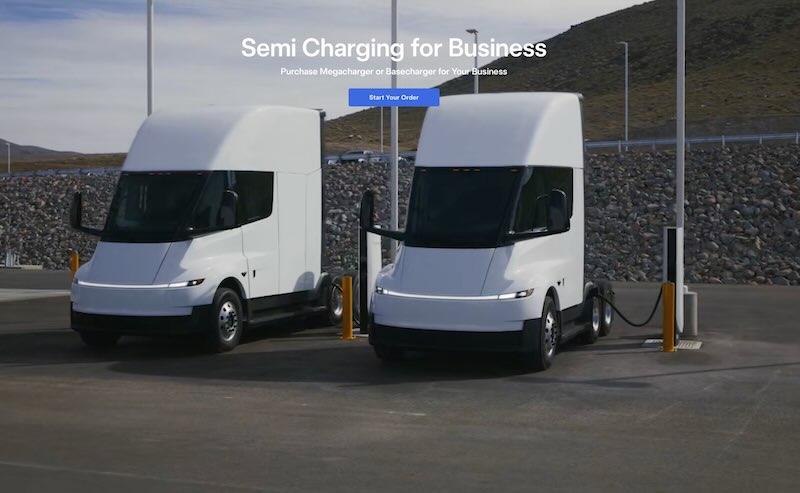
Tesla’s commercial charging ambitions just got a lot more concrete. The company has officially launched Tesla Semi Charging for Businesses, a structured infrastructure program targeting fleet operators and third-party site hosts. It’s not a pilot. It’s not a soft launch. It’s a full product offering — complete with hardware tiers, network services, and a pricing model that’ll make CFOs do the math twice.
Starting at $40,000 for two Basechargers and scaling up to $188,000 for a Megacharger cabinet with two posts, this is Tesla making a serious play for the commercial heavy-duty charging market. And the scope here is broader than just selling hardware.
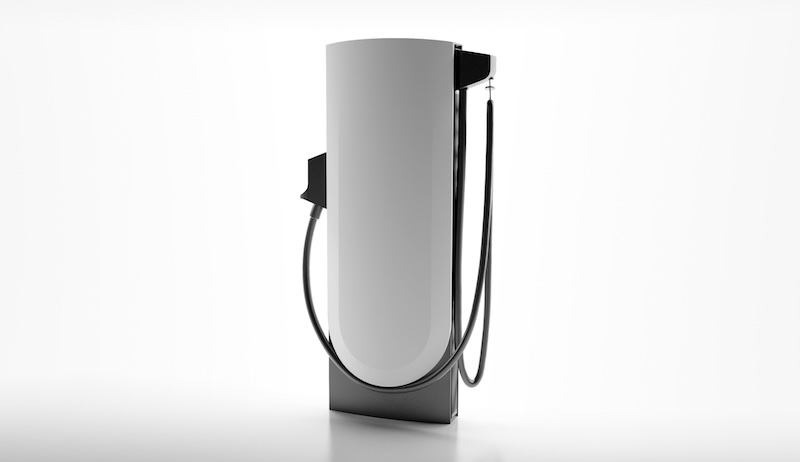
Tesla Semi Charging for Businesses ships in two configurations, each targeting a distinct operational need.
The Basecharger is positioned as the “home charging” solution for heavy-duty fleets, a depot-first unit designed for overnight or shift-end top-ups. At 125 kW and a continuous output of 150 A, it’s not fast, but it’s steady. Tesla says it can add up to 60% of range in four hours, which works well for predictable routes with fixed return schedules.
Physically, it’s a fully integrated unit — no separate AC-to-DC cabinet required — measuring 340 × 1200 × 2000 mm and weighing just 100 kg. It supports MCS 3.2, ISO 15118-2, and is OCPI capable, meaning it plays well with third-party fleet management systems. Two units ship for $31,000, with services and shipping pushing the subtotal to $40,000. Need scale? Tesla will sell up to 100 Basechargers for $2 million. Deliveries begin in early 2027.
For operators running public-facing or high-utilization sites, Megacharger is the heavy hitter. A single cabinet paired with two posts delivers up to 1,200 kW of shared DC output across a voltage range of 180–1,000 VDC. The cabinet-to-post cable distance extends up to 100 meters, offering real flexibility in site layout.
It’s large — 1,175 × 1,390 × 1,925 mm, weighing 1,100 kg — but efficiency sits above 96%, and the cooling system is engineered for low noise without requiring dedicated ventilation. One cabinet, two posts, and the associated services and shipping come to $188,000. At scale, 100 Megacharger posts will run $9.4 million.
Here’s where Tesla Semi Charging for Businesses shifts from hardware sale to ongoing service relationship. At revenue-generating sites, Tesla charges $0.08 per kWh — and that fee comes bundled with a notably broad service stack.
Package covers annual preventative maintenance, Tesla-certified technician visits, a 97% uptime guarantee, and a 10-plus-year equipment service agreement inclusive of parts and labor. On the software side, operators get access to Tesla for Business, a management dashboard with session data, monthly usage reports, and pricing controls — alongside OCPI-based live data sharing and automatic revenue payouts on a set schedule, net of Tesla’s fee.
Trip planning and dynamic rerouting are also included. Tesla’s routing engine factors in state of charge, site availability, weather, and efficiency to push drivers toward host-owned sites. Those sites get listed in Tesla’s Trip Planner and in-vehicle navigation.
Driver-facing support runs 24/7/365 through Tesla’s Network Operations Center, covering both Tesla and non-Tesla Semi operators. Remote diagnostics, automatic triage, and routine firmware updates are all part of the agreement. Utility rate optimization and internet connectivity management round out the offering.
Ongoing software improvements — forecasted stall availability, dynamic pricing tools, plug-and-charge resilience, and in-app driver feedback — are positioned as evolving features, not one-time deliverables.
Tesla isn’t just selling chargers here — it’s selling a managed infrastructure ecosystem. Whether the $0.08/kWh network fee proves competitive will depend heavily on site utilization rates and energy costs. But for fleet operators weighing the operational overhead of running their own charging infrastructure, the bundled service model may be exactly the kind of offer that makes the math work.
For businesses ready to go electric with their heavy-duty fleets, Tesla Semi Charging might just be the amp-up they’ve been waiting for.
Related Post
Jay Leno Drives the Redesigned Tesla Semi — Here’s What He Found
Tesla Semi Production Specs Released: Standard vs Long Range Trims Detailed
Tesla Semi Refresh: New Design, Same Range Before 2026 Launch