
SpaceX has officially moved Starlink Residential pricing into dynamic territory, and depending on where you live, your next bill could look very different from the one before it. The company has started notifying customers via email that Starlink Residential plan pricing will shift based on local network capacity and subscriber demand, a model more familiar to airline ticketing than home internet service.
For some customers, that’s good news. For others, not so much.
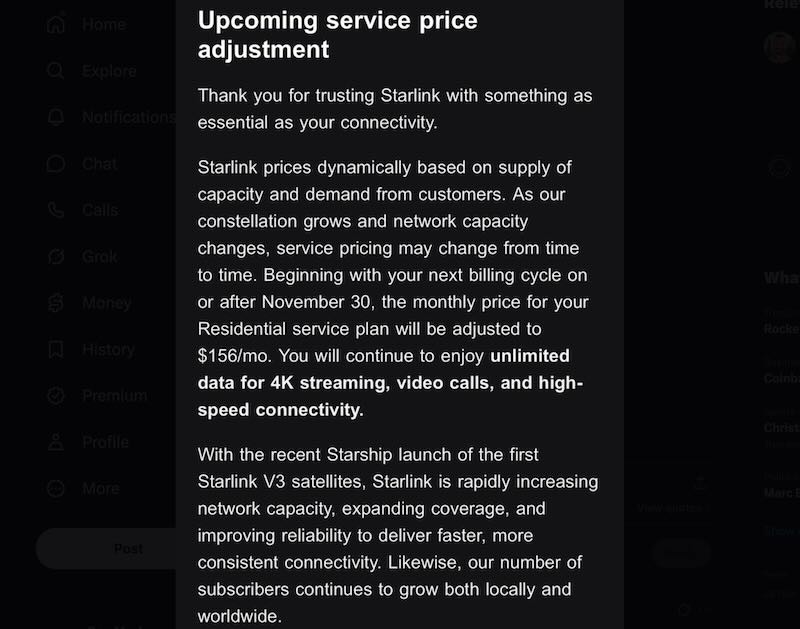
SpaceX’s message is straightforward: as the constellation expands and demand shifts, pricing will move with it. The company confirmed it’s deploying additional capacity through new V3 satellites, but subscriber growth, both locally and globally, continues to put pressure on available bandwidth.
The pricing window, at least for now, appears capped at a 20% increase or decrease from current rates. That’s a meaningful range. A Missouri user reported their Residential 100 Mbps plan climbing from $50 to $60.50 per month, effective with their next billing cycle on or after November 30. Meanwhile, a Facebook user in the same state confirmed their Starlink Residential plan, specifically the Max tier, jumping from $130 to $156 per month.
That’s a $26 monthly increase, which adds up to over $300 annually for the same service.
Not everyone is on the wrong side of this equation. In Kansas City, Missouri, all Residential tiers are getting cheaper: 100 Mbps plan drops to $49.50, the 200 Mbps option comes in at $76.50, and the Max plan falls to $117 per month. Further west in Marysville, Kansas, the discounts run even deeper — $44, $68, and $104 per month, respectively.
So the same product, delivered by the same satellites, can carry meaningfully different price tags depending on which side of a state line you’re on. That’s the reality of demand-based pricing, and it’s worth understanding before your next billing cycle arrives.
SpaceX isn’t hiding the ball here. The company stated plainly that it intends to review pricing on a “regular basis, roughly quarterly,” and acknowledged customers may see more frequent changes than they’ve experienced historically or compared to competing providers.
Here’s where things get operationally tricky for households budgeting around a fixed internet bill. Quarterly reviews mean your rate could, in theory, shift four times a year. That’s a new planning consideration for anyone running a small business from home, managing a rural property, or simply trying to hold a predictable monthly budget.
SpaceX did offer a counterweight to that concern: “as we expand capacity, service pricing in your area may be lowered.” Implication is that the V3 satellite rollout should eventually relieve congestion in high-demand areas, which could translate into price reductions down the road. Whether that timeline aligns with subscriber patience is a separate question.
Worth noting, dynamic model does carry a degree of internal logic. Rural and underserved markets have long paid flat rates that didn’t account for infrastructure investment cycles. If SpaceX can actually lower prices in areas where capacity improves, that’s a more honest pricing structure than the static models most ISPs use. Problem is execution and communication, both of which are still being tested here.
If you’re a current Starlink subscriber, check your email inbox. The notification about pricing changes is being sent directly, and it includes the specific dollar amount your plan will adjust to along with the effective date. Don’t wait for the billing statement to surface the number.
For those evaluating whether Starlink Residential still makes financial sense, answer depends heavily on your alternatives. In areas where traditional broadband remains unavailable or unreliable, a $156 monthly bill for Max-tier service may still be the most competitive option on the table. In denser suburban markets with fiber competition, that calculus shifts quickly.
SpaceX has positioned this as a feature rather than a liability, flexible pricing that responds to real-world capacity. That framing will hold up only if the downward adjustments materialize as promised and customers don’t find themselves perpetually on the wrong end of quarterly reviews.
Satellite internet market is maturing fast, and SpaceX is clearly treating its pricing infrastructure as a growth lever. Whether that works in subscribers’ favor or against them may ultimately come down to how aggressively those V3 satellites can expand available capacity.
In the meantime, budgeting for Starlink just got a little less… static.
Related Post
Starlink Standard 4 vs Standard 4 X: SpaceX New Dish & Router Bundles Explained
SpaceX Revamps Starlink Residential Plans With New Pricing, Residential 100/200Mbps and Max