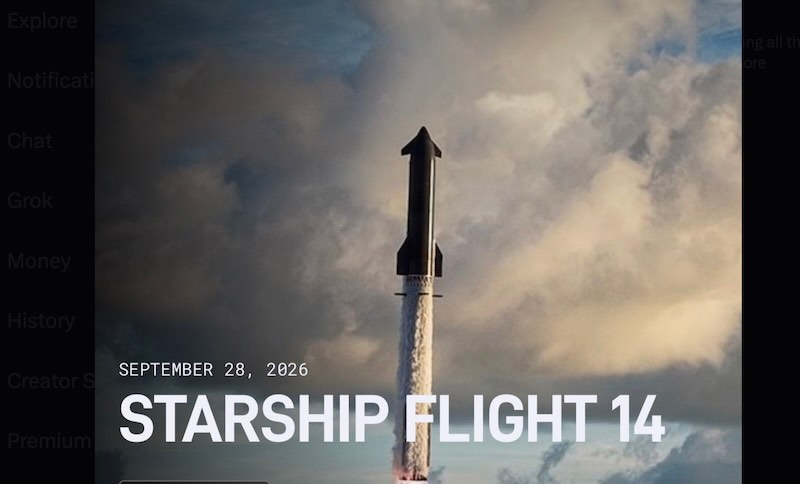
SpaceX’s Starship reached orbit for the first time on its 14th flight and deployed 26 Starlink V3 satellites, which makes the mission the program’s first revenue-generating flight. Starship’s first orbital flight didn’t follow the plan exactly, though. One Raptor vacuum engine shut down during ascent, and the remaining five engines burned longer to compensate. Well, the failure didn’t stop the ship from releasing every satellite. Business questions come next: what those satellites add to Starlink, and when they start producing revenue.
SpaceX’s post-flight blog update lays out the mission in order. It shows a flight team that kept orbit as the goal despite the engine problem, then cut the time on orbit after deployment.
During the ascent burn, one Raptor vacuum engine stopped early. After losing that engine, the flight profile still held, because the other five engines burned longer to offset the missing thrust. Starship reached its planned suborbital trajectory, a path SpaceX describes as passively safe. Flight controllers then assessed the vehicle, confirmed that the three sea-level Raptors needed for later burns were healthy, and gave a go for orbital operations. Every later burn relied on sea-level engines, which made that check the decision point for the rest of the flight.
Next, the ship reignited one sea-level Raptor for an orbit insertion burn and entered orbit around Earth. After a short coast, it released all 26 satellites. SpaceX says it made contact with every satellite over laser links, ground stations, and Starlink user terminals. Contact across all three paths indicates that the communications hardware works after deployment. Satellites will now run on-orbit checkouts and raise their orbits before they begin serving customers.
Because of the engine problem, the flight team limited the time on orbit and started the return sooner. That choice favored risk control over mission length. The ship fired a single sea-level Raptor for its first deorbit burn, then passed through reentry and descent toward a splashdown zone in the northern Pacific Ocean. SpaceX had coordinated two landing zones before launch, and this one was clear of sea and air traffic. In the last phase, all three sea-level Raptors relit for the landing burn and flip maneuver, and the ship splashed down at the intended point.
For context, Starlink has roughly 11,100 satellites in orbit today, and most are V2 Minis. One estimate holds that each V3 satellite raises the bandwidth capacity of the entire constellation by about 0.11%. Nobody can measure that figure yet, because the new satellites haven’t started service.
How much capacity do 26 satellites add? An average satellite represents roughly 0.009% of the fleet, so the 0.11% figure implies that one V3 unit carries about 12 times that capacity. Across 26 units, the gain totals nearly 3% once service starts, equal to roughly 300 average satellites. One scenario imagines hundreds of launches that each carry 60 V3 satellites, more than double the payload of this flight. Elon says it’s increasingly probable that Starlink will carry most of Earth’s IP traffic over the long term. Still, that’s a forecast, and one flight can’t validate it.
Having reached orbit, the mission’s commercial value now depends on service entry. Yes, the flight counts as revenue-generating, but checkouts and orbit raises come first. As a result, the label describes the payload’s purpose more than current income. Service start date is the next metric to watch, and launch cadence then sets how quickly capacity grows.
SpaceX has now shown that Starship can reach orbit, release satellites, deorbit, and splash down in one mission. Two questions remain. What caused the vacuum engine shutdown, and how will SpaceX prevent a repeat? Starship compensated this time, but a commercial payload increases the cost of another failure. Can the company also fly the same profile with more satellites per launch? This mission carried 26, while the scenario above assumes 60.
Related Post
SpaceX Starship Flight 13: V3 Starlink Satellites Take Flight
Starship Flight 14: SpaceX Targets First Orbital Test And Starlink V3 Launch
Starlink V3 Satellites Could Push SpaceX Toward a Multi-Trillion Future