
Tesla’s newly disclosed patent for “Manufacturing Paint-Free Vehicle Body Panels” represents a paradigmatic shift in automotive production methodology, 5-second cybercab production. Promises to dramatically reduce manufacturing costs while simplifying repair processes, particularly for the upcoming Cybercab autonomous vehicle.
The paint-free vehicle body panels patent introduces multi-cavity reactive injection molding architecture that eliminates traditional painting operations entirely. Tesla’s WO2025151308A1 patent addresses the fundamental constraint wherein conventional vehicle panels require complex spray painting in capital-intensive facilities.
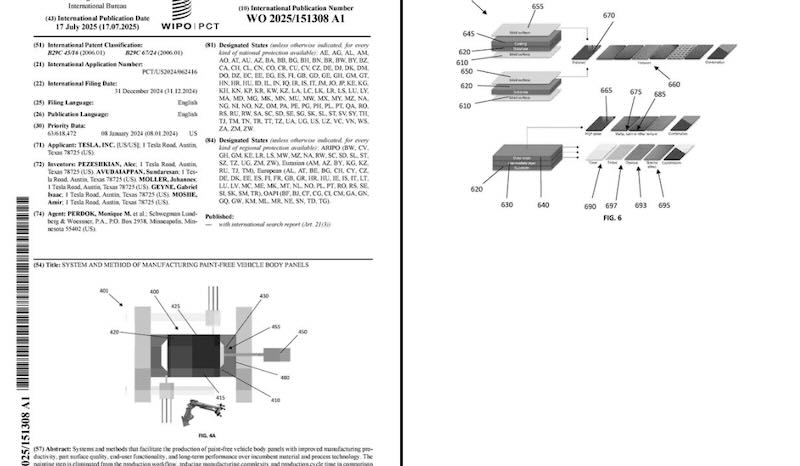
Tesla’s paint-free vehicle body panels technology implements tetrahedral mold rotation kinematics enabling parallel execution of substrate formation, surface activation, reactive coating deposition, and demolding operations. Approach achieves temporal optimization where cycle time equals the maximum individual process duration rather than their summation.
VP Vehicle Engineering Lars Moravy explained the process: “You inject the polyurethane paint at the same time that you make the plastic panels. There’s no paint shop with that vehicle. We put the colors in when we make the panels. That’s it. If you want to repair it, it’s just basically paint.”
Technological breakthrough extends RIM methodology—historically confined to small automotive parts—to large-scale body panel production through innovations in multi-gate rheological distribution, perimeter venting topology, and in-mold surface texture transfer.
The paint-free vehicle body panels system delivers manufacturing consolidation by eliminating multi-stage painting processes and reducing production operations to a single integrated sequence. Consolidation removes the requirement for elaborate paint shop facilities traditionally associated with automotive manufacturing.
Surface quality determinism is achieved through mold surface engineering without reformulation requirements, while coating thickness precision provides direct control via cavity spacing that surpasses spray application variability. Process also eliminates volatile organic compound emissions inherent in spray painting operations.
Tesla’s paint-free vehicle body panels innovation directly parallels the transformation in premium optical lens manufacturing, where traditional multi-stage coating processes have been superseded by integrated in-mold technologies. Consider conventional prescription lens production: optical blanks undergo grinding, polishing, cleaning, primer application, dip coating in hardcoat solutions, UV curing, anti-reflective coating application, and final curing.
Modern lens manufacturing has evolved to integrate scratch-resistant coatings during the molding process itself. Specialized molds simultaneously form the optical substrate while reactive siloxane chemistry creates the hardcoat layer through in-mold polymerization. Mold’s optical surface quality transfers directly to both substrate and coating, eliminating post-molding polishing operations.
Tesla’s tetrahedral mold rotation parallels multi-station lens production where different stations handle injection, plasma surface activation, reactive coating deposition, and demolding operations. Parallel processing achieves cycle times determined by the longest individual operation rather than their sum.
The critical innovation in Tesla’s paint-free vehicle body panels lies in exploiting reactive chemistry’s ability to form permanent chemical bonds during the manufacturing process. Just as modern lenses achieve delamination-proof hardcoats through siloxane-substrate covalent bonding during cure, Tesla’s polyurethane/polyurea systems create molecular-level integration with activated thermoplastic substrates.
Surface quality transfer from mold to product eliminates variability inherent in post-applied coatings, whether optical clarity in lenses or aesthetic finish in automotive panels. Transformation from sequential post-processing to integrated in-mold finishing represents a fundamental manufacturing philosophy shift.
Paint-free vehicle body panels technology will make Cybercab production significantly cheaper while simplifying repair processes. In a self-driving world where accidents become increasingly rare, this repair simplification addresses a diminishing but still important concern for fleet operators and individual owners.
Enables functional integration platforms that allow in-mold electronics embedding during primary manufacture, opening possibilities for integrated sensors and communication systems essential for autonomous vehicle operation.
Related Post
Tesla First CyberCab Castings Spotted: Autonomous Taxi Production Underway at Giga Texas
Tesla Cybercab: 300-Mile Range from Sub-50kWh Battery Promises Industry-Leading Efficiency
Tesla Cybercab New Powertrain with an Estimated 5.5 Miles/kWh, Huge Improvement Over Model 3/Y