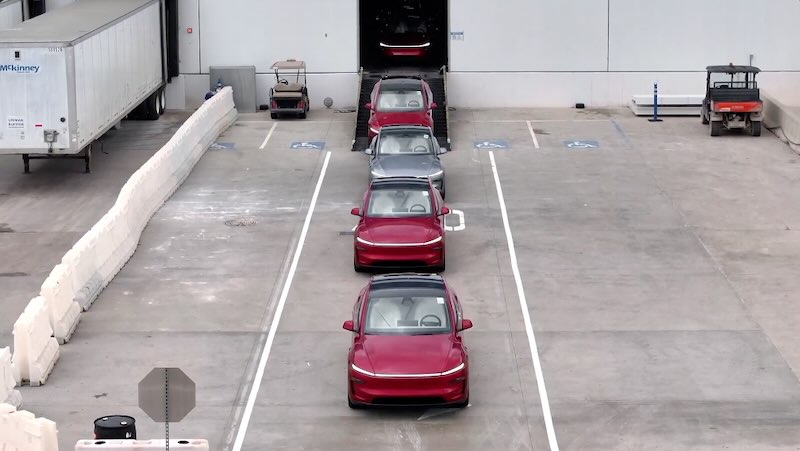
Tesla has officially terminated its millimeter-wave radar program, marking the end of a five-year technological experiment that once promised to enhance the company’s FSD capabilities. This decision, while surprising to some industry observers, actually represents the culmination of a strategic pivot that began three years ago when the automaker first started removing radar from its vehicle lineup.
Automotive industry’s approach to autonomous driving has traditionally relied on sensor fusion — combining multiple data streams from different hardware components to create a comprehensive understanding of the vehicle’s surroundings. However, Tesla’s latest move signals a radical departure from this consensus, placing the company firmly in opposition to competitors who continue to advocate for multi-sensor redundancy.
XPeng Motors CEO He Xiaopeng isn’t mincing words about autonomous driving’s future. In a candid industry discussion, the executive laid out his company’s ambitious timeline—claiming vision-based systems will definitively outperform LiDAR technology within three years.
When Tesla initially integrated radar technology into its vehicles, the decision aligned with standard industry practice. Millimeter-wave radar offered theoretical advantages: it could penetrate adverse weather conditions and provide velocity measurements that cameras alone couldn’t match. Yet, as the company’s engineers worked to refine the FSD system, they discovered that these benefits came with significant trade-offs.
Primary issue emerged in 2021 when Tesla’s engineering team identified a critical problem with sensor fusion. Rather than enhancing perception capabilities, combination of radar and camera data actually decreased the signal-to-noise ratio. Counterintuitive finding meant that adding more sensors didn’t necessarily translate to better performance — in fact, it often made the system less reliable.
Tesla’s analysis revealed that radar sensors would require dramatic improvements in resolution to remain viable alongside high-definition cameras. Since optical sensors generate exponentially richer data streams, any radar system would need revolutionary advances to justify its inclusion in the perception stack. Realization prompted the company to develop proprietary high-resolution radar technology, an effort that would ultimately prove unsuccessful.
Transition to a camera-based FSD system didn’t happen overnight. Starting with the Model 3/Y in 2021, Tesla systematically removed radar from its vehicles, even retrofitting older cars through software updates when FSD Beta v9 launched.
Interestingly, Tesla’s commitment to innovation led to a peculiar situation with its premium vehicles. Updated Model S/X actually shipped with the company’s custom-designed high-resolution radar hardware in 2023. However, despite the physical presence of these sensors, Tesla has now confirmed that they remain inactive — a testament to how thoroughly the vision-only approach has proven itself superior in real-world testing.
Cybertruck’s complete omission of radar for assisted driving features further reinforces this strategic direction. By designing its newest vehicle platform without any radar integration, Tesla has effectively burned the bridges back to multi-sensor fusion.
Elon’s statements provide insight into the technical reasoning behind abandoning both radar and lidar technologies. His comparison to military stealth systems highlights a fundamental weakness: modern AI processors can extract meaningful information from passive optical sensors that active systems like radar cannot match. Elon specifically noted that thermal signatures remain visible to infrared-equipped cameras even in darkness, rendering traditional radar advantages obsolete.
Critics often point to adverse weather conditions as a weakness of camera-based systems, liDAR weather performance: rain and fog challenges for autonomous vehicles. However, Elon countered this argument by highlighting lidar’s own limitations in precipitation, dust, and snow due to reflection scatter. He specifically referenced competitor Waymo’s operational restrictions during heavy weather events as evidence that alternative sensor technologies don’t necessarily solve these challenges.
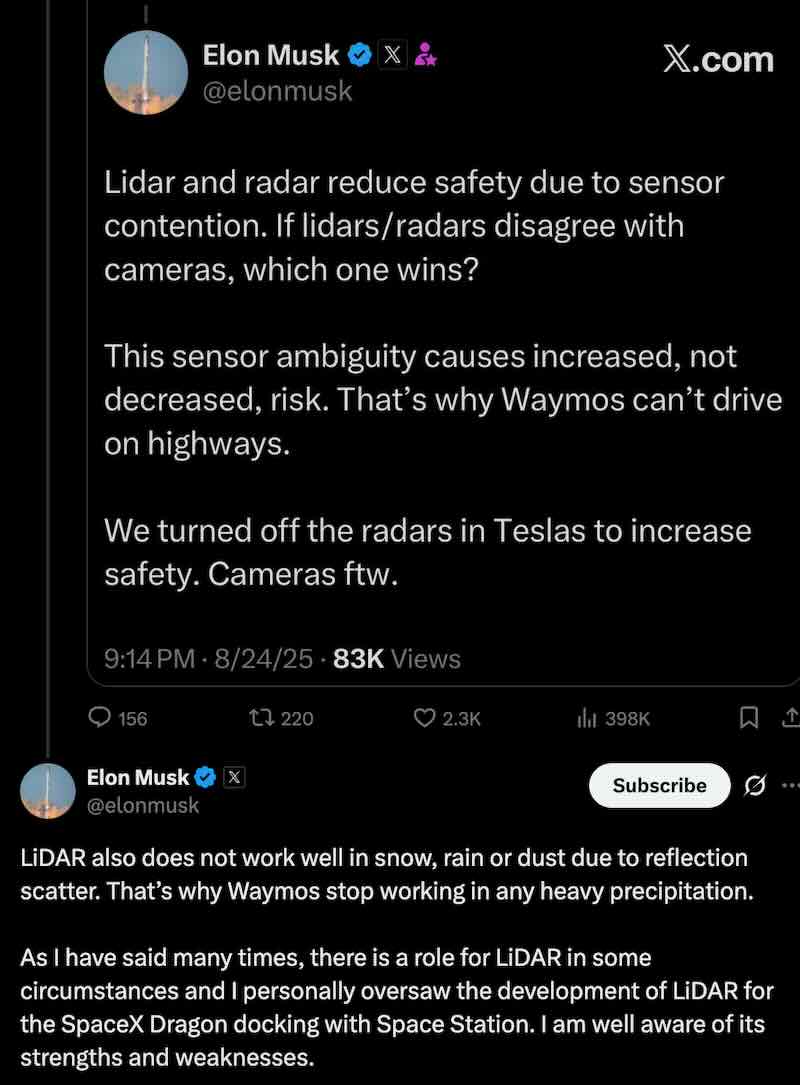
SpaceX connection adds credibility to these assessments. Musk’s direct involvement in developing lidar systems for Dragon spacecraft docking procedures demonstrates firsthand experience with the technology’s capabilities and constraints. This aerospace application, while successful in its specific context, apparently reinforced his conviction that terrestrial autonomous driving requires different solutions.
Tesla’s decision to abandon radar while competitors double down on sensor redundancy creates a stark divide in autonomous vehicle development philosophy. Companies like Waymo continue investing heavily in lidar-equipped vehicles, arguing that safety-critical systems require multiple independent verification methods.
By eliminating expensive sensor hardware, Tesla potentially gains significant advantages in both manufacturing costs and system complexity. Fewer components mean fewer points of failure, simplified calibration procedures, and reduced computational overhead for sensor fusion algorithms. Efficiencies could translate to faster deployment timelines and lower production costs as FSD technology scales.
Software-centric approach also enables more rapid iteration cycles. Without hardware dependencies, Tesla can push updates to its entire fleet simultaneously, testing and refining algorithms across millions of vehicles rather than waiting for new sensor generations to reach production.
Initial market reaction to Tesla’s radar removal has been mixed, with some safety advocates expressing concern about reduced redundancy while technology enthusiasts praise the bold simplification. Real-world performance data from Tesla’s vision-only fleet will ultimately determine whether this gamble pays off.
As Tesla pushes toward higher levels of autonomy using only cameras, regulatory bodies worldwide will scrutinize the safety implications. Tesla must demonstrate that its vision-only FSD system meets or exceeds the reliability standards achieved by multi-sensor approaches. Burden of proof could influence timelines for broader autonomous driving deployment.
Tesla’s complete commitment to optical perception represents more than a technical decision — it’s a statement about the future of autonomous driving. While competitors hedge their bets with multiple sensor modalities, Tesla has chosen to perfect a single approach. Time will tell whether this focus on vision proves to be FSD’s perfect sight or a blind spot in the company’s autonomous ambitions.
Related Post
Tesla Raw Vision Gambit: Vision-Only Active Safety, Pure Vision and Sensor Fusion
Tesla Robotaxi Review: FSD v13+ with Remote Intervention – Real Test Results
Tesla Model Y Completes First Fully Autonomous Vehicle Delivery from Factory to Customer Home