
Tesla has secured a significant patent that could transform how electric vehicles are built. “True Unboxed Process 2.0” (US12420879B1) represents a major advancement in automotive manufacturing technology, potentially enabling Tesla to produce vehicles like the upcoming Cybercab with unprecedented efficiency.
Newly granted patent describes an automated assembly system that fundamentally changes how exterior vehicle parts connect to the main structure. It’s a technical achievement that could help Tesla maintain its manufacturing edge as competition in the EV space intensifies.
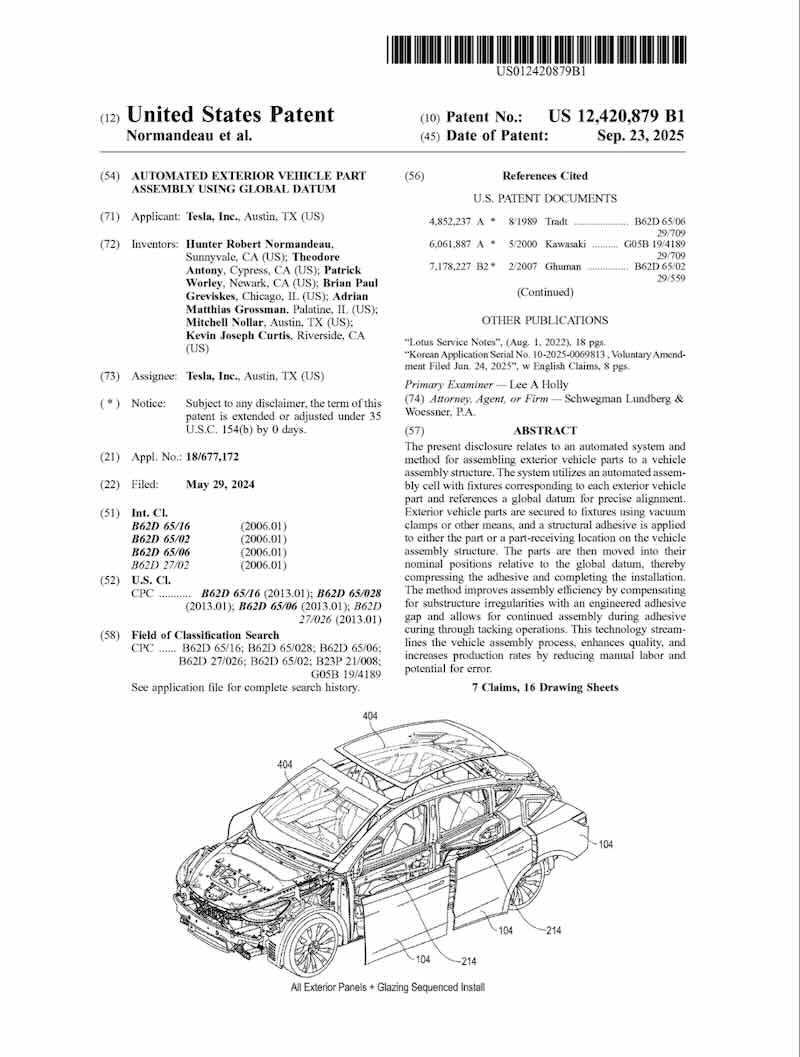
How the True Unboxed Process Works
At its core, Tesla’s true unboxed process employs robotic stations equipped with specialized fixtures for each vehicle component. Parts are secured using vacuum clamps while a robotic adhesive arm applies structural adhesive either to the part itself or to its destination on the vehicle frame.
What makes this system particularly innovative is its use of a global datum — a fixed reference point that ensures precise alignment throughout assembly. Robotic part positioner moves components into their exact positions relative to this datum, compressing the adhesive to create strong bonds.
Traditional manufacturing processes often struggle with small variations in parts and structures. True unboxed process addresses this challenge by incorporating an engineered adhesive gap that compensates for irregularities in vehicle parts or substructures.
Allows for greater tolerance in manufacturing while maintaining strict quality standards, adhesive fills small gaps and inconsistencies, creating a stronger, more uniform connection between components.
Perhaps the most efficiency-boosting aspect of Tesla’s patent is the tacking operation that occurs simultaneously with adhesive application. Feature enables assembly to continue while the structural adhesive cures—effectively eliminating a significant bottleneck in production.
Patent mentions that tacking can be accomplished through self-piercing datums or hot melt adhesive, securing parts temporarily until the main structural adhesive fully cures.
Upcoming Cybercab, scheduled for production in 2026, will reportedly be the first vehicle to leverage this innovative assembly method. True unboxed process seems particularly well-suited for Tesla’s futuristic autonomous taxi, which likely features unconventional materials and design elements.
By implementing this system, Tesla could potentially assemble the Cybercab with fewer workers, greater consistency, and faster production rates than would be possible with traditional methods.
Elon has once again shocked the automotive world with a claim that seems to defy physics: upcoming Cybercab production line will churn out one vehicle every 5 seconds. Ambitious target—revealed during all-hands meeting—would represent a manufacturing breakthrough so significant that even veteran automotive engineers are struggling to comprehend how it could be possible.
Patented process represents a significant step toward Tesla’s goal of building a “machine that builds the machine.” By reducing reliance on manual labor and minimizing potential errors, true unboxed process could help Tesla scale production while maintaining quality.
System’s ability to handle differential heating and varying material properties also suggests it could facilitate the use of more diverse materials in vehicle construction, potentially leading to lighter, stronger, and more efficient designs.
Related Post
Tesla First CyberCab Castings Spotted: Autonomous Taxi Production Underway at Giga Texas
Tesla Cybercab New Powertrain with an Estimated 5.5 Miles/kWh, Huge Improvement Over Model 3/Y
Tesla Cybercab: 300-Mile Range from Sub-50kWh Battery Promises Industry-Leading Efficiency