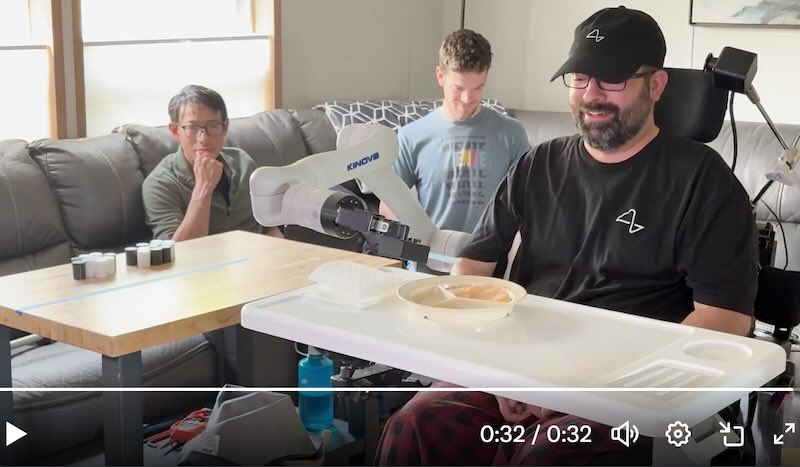
Neuralink has achieved a significant milestone in brain-computer interface technology. Nick Wray, an ALS patient who lost arm mobility, now operates a robotic arm using only his thoughts through the company’s neural implant device. Development represents a tangible step forward in assistive technology for individuals with severe motor impairments.
What happens when you combine neural implants with robotics? For Nick, the answer came during three consecutive eight-hour workdays—something he hadn’t experienced in years. Working alongside Neuralink’s Assistive Robotic Arm team, he demonstrated unprecedented control over the ARA system through his brain-computer interface.
Achievements weren’t merely technical demonstrations. Nick performed everyday tasks that most take for granted: putting on a hat independently, microwaving chicken nuggets, and feeding himself. He also mastered opening his refrigerator and manipulating jar lids—activities requiring precise motor control that the Neuralink device translated from neural signals to robotic movements.
The trial produced measurable results. Nick set records by moving 39 cylinders across a table in five minutes and flipping five pegs during a standard dexterity test typically administered to stroke patients. Benchmarks provide concrete data points for evaluating brain-computer interface performance in real-world applications.
Beyond metrics, Nick operated his wheelchair indoors using the system, demonstrating potential mobility applications. Combination of The Buoniconti Fund and Neuralink resources enabled this collaborative research effort.
Implications extend beyond individual achievement. Successful integration of neural implants with robotic systems opens pathways for others facing similar challenges. Technology moves from theoretical possibility to practical application, though questions remain about scalability and accessibility.
Nick’s experience illustrates how brain-computer interfaces can restore functional independence. His ability to control complex robotic systems through thought alone suggests we’re witnessing the early stages of a significant shift in assistive technology. Next phase will determine whether Neuralink can replicate these results across broader patient populations and diverse use cases.
Related Post
Neuralink Summer Demos Robot Hands Control via Brain Interface, Plans Million-Bit Communication
Neuralink Implants Telepathy Chip in 6th Patient, Enables Mind-Controlled Computing
Neuralink Raises $650M Series E, Expands Brain-Computer Interface Trials Globally