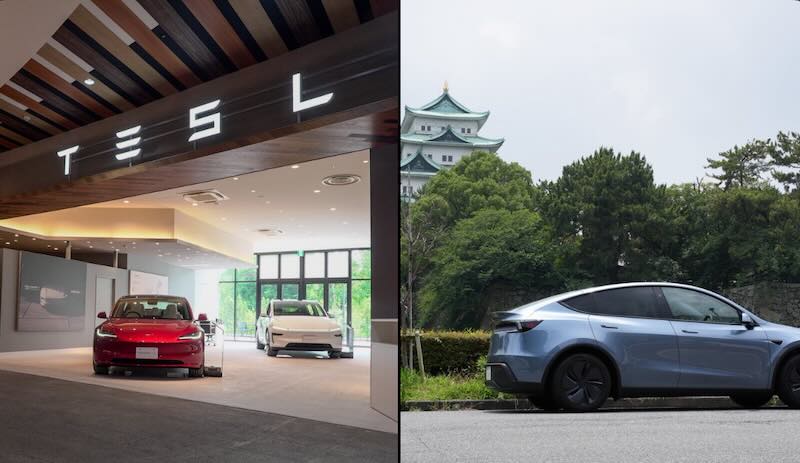
Japan is advancing toward allowing Tesla to deploy its FSD system within the country. The Ministry of Land, Infrastructure, Transport and Tourism has greenlit software updates that enable Tesla vehicles to enhance their autonomous driving capabilities.Updates will reach existing vehicle owners through over-the-air distribution methods.
The ministry’s decision represents a shift in how autonomous driving technology receives authorization in Japan. Rather than requiring hardware modifications or lengthy approval processes for each iteration, the regulatory body has acknowledged that Tesla’s FSD can meet existing safety standards through software improvements alone. Approach contrasts with traditional automotive approval frameworks that often mandate physical inspections and component-level certifications.
Tesla Japan has already initiated public road testing of the system, with company employees operating the vehicles. Tesla intends to launch the feature for consumers once it fulfills all local safety requirements and regulatory benchmarks.
Former Tesla board member Hiro Mizuno characterized the ministry’s stance on retrofitting autonomous driving software as significant for the industry. He noted that the Ministry of Land, Infrastructure, Transport and Tourism’s decision eliminates a major bottleneck. “Currently, Tesla is the only manufacturer actively pursuing this, but I had thought that if actual autonomous driving were to begin, it would be impossible to keep up if the approval process had to be repeated for every software update,” Mizuno stated.
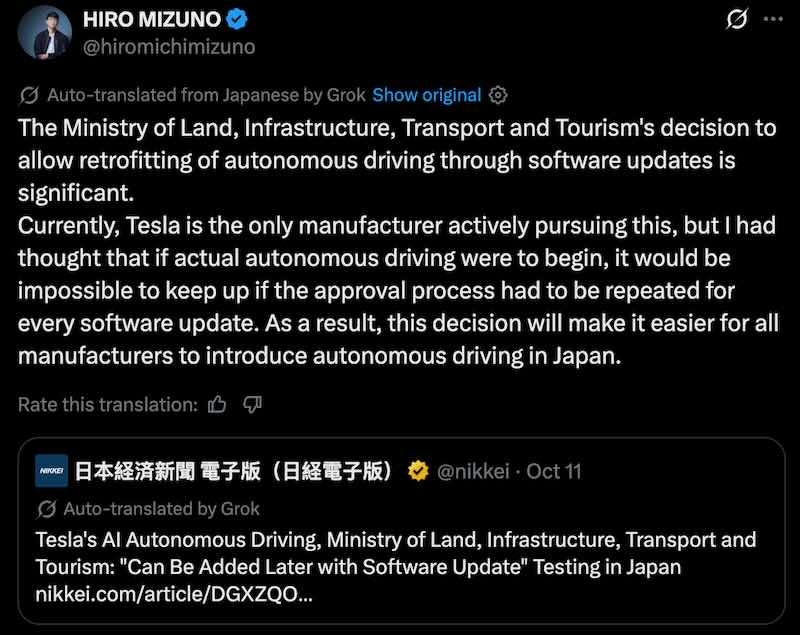
The regulatory framework now accommodates Tesla’s end-to-end AI approach without imposing rigid hardware prerequisites upfront. Methodology allows manufacturers to deploy autonomous features retroactively through over-the-air updates—a practice already established for other vehicle systems.
Mizuno suggested that Japan’s move could accelerate similar regulatory changes in neighboring markets. Korea, in particular, may expedite its own approval processes as public sentiment shifts and political pressure mounts. Observation reflects how regulatory decisions in one market can influence regional adoption patterns for emerging technologies.
For Tesla’s FSD system, Japanese approval streamlines deployment to existing vehicle fleets without requiring expensive retrofits. It also validates the software-centric development model on an international scale, potentially setting precedents for other markets evaluating autonomous driving systems.
Related Post
Tesla Plans to Double Japan Retail Stores by 2026 – EV Market Expansion Strategy
Uber Teams Up With Tesla to Launch EV Taxi Service in Japan
Tesla FSD V14.1 Finally Arrives: Emergency Vehicle Detection, New Speed Profiles & Arrival Options