Tesla’s semiconductor roadmap just got more concrete. CEO Elon Musk confirmed the company’s next-gen AI5 chip won’t reach high-volume production until 2027, though a limited batch should arrive in 2026. Announcement clarifies Tesla’s ambitious timeline for in-house chip development—a strategy that’s positioning the automaker as a serious player in AI hardware.
AI5 represents a significant technical advancement over current hardware. According to specifications shared by industry observers, the chip delivers 40× faster processing speeds, 8× more compute power, and 9× additional memory capacity compared to its predecessor. Bandwidth improvements of 5× and streamlined code paths—reduced to approximately five — should translate into meaningful real-world performance gains.
What’s particularly noteworthy is the cost efficiency. Tesla claims AI5 chip will be 10× cheaper per inference than comparable Nvidia solutions while consuming 3× less power per watt. For a company deploying AI at scale across vehicles and robotics, these economics matter considerably.
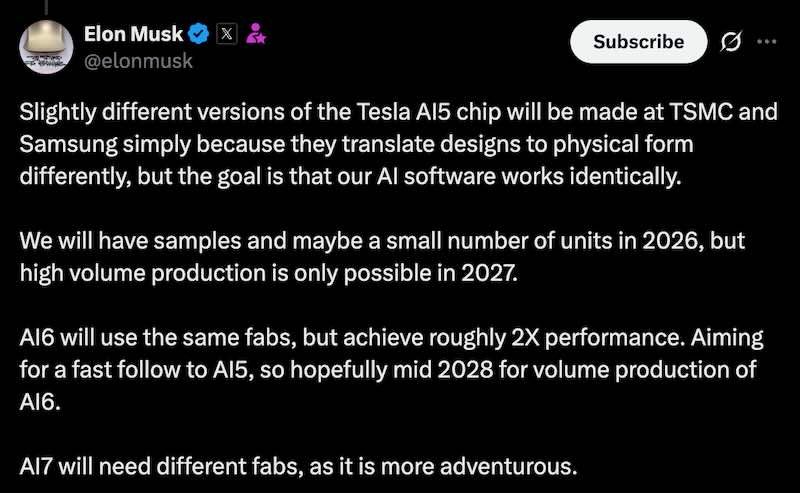
Manufacturing will involve both Samsung and TSMC, with work performed in Texas and Arizona facilities. Elon clarified that “slightly different versions of the Tesla AI5 chip will be made at TSMC and Samsung simply because they translate designs to physical form differently.” However, Tesla’s AI software should function identically across both variants.
AI6 chip is already in planning stages, targeting roughly 2× performance improvements over AI5 using the same fabrication facilities. Volume production is expected by mid-2028. Meanwhile, AI7 will require entirely new manufacturing infrastructure, suggesting more significant architectural changes ahead.
The question isn’t whether Tesla can build advanced chips—it’s whether competitors can match this level of vertical integration. Most automakers remain dependent on third-party semiconductor suppliers, while Tesla’s controlling its entire stack from silicon to software. Advantage compounds with each generation, making it increasingly difficult for rivals to close the gap. Looks like Tesla’s betting everything on AI5.
Related Post
Tesla Q3 2025: Record Revenue and AI5 Chip Breakthrough with 40× Performance
Tesla Renamed AI5 from HW5: The Brain Behind More Than Just Self-Driving Cars
Tesla FSD V14.1 Finally Arrives: Emergency Vehicle Detection, New Speed Profiles & Arrival Options