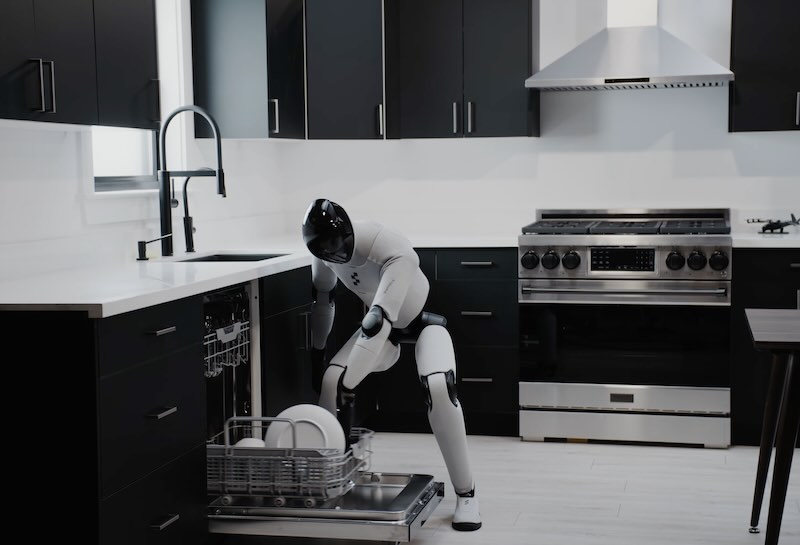
Figure has unveiled Helix 02, marking what the humanoid robotics company describes as a significant advancement in autonomous robot capabilities. The system operates through a unified neural network that processes sensory input and controls the entire body directly from visual data, no traditional programming scaffolding required.
Robot completed a dishwasher loading and unloading sequence across a full kitchen space, operating autonomously for four minutes. Runtime represents what Figure calls the longest continuous task performed by a humanoid robot without resets or human intervention. Sequence required the robot to navigate the space, manipulate objects, and maintain balance throughout.
Unlike previous systems that relied on separate modules for movement and object handling, this approach integrates every onboard sensor—vision systems, tactile feedback, and proprioceptive awareness—with every actuator through a single visuomotor neural network.
System 0, the underlying controller powering Helix 02, was trained on over 1,000 hours of human motion data combined with simulation-to-real reinforcement learning. Learned approach replaced 109,504 lines of hand-coded C++ that previous generations required for stable movement patterns.
Training process yields what Figure terms a “neural prior” for natural motion—essentially, the robot learned movement fundamentals from observing human behavior rather than following explicitly programmed rules.
Figure 03’s hardware includes tactile sensing and palm-mounted cameras, enabling Helix 02 to handle tasks that previous models couldn’t manage. The robot can extract individual pills from containers, dispense precise syringe volumes, and separate small irregular objects from cluttered environments, even when its own body blocks its main vision system.
Capabilities emerge from the integration of touch, vision, and proprioception into the decision-making process. Rather than treating manipulation as a separate problem from navigation or balance, the system processes all inputs simultaneously.
Can humanoid robots match human versatility in real-world environments? Figure’s Helix 02 suggests that end-to-end learning approaches might accelerate progress faster than modular systems. The company hasn’t disclosed deployment timelines or commercial applications, but the technology demonstrates that robots are figuring out how to handle complex spaces.
Related Post
Figure 02 Humanoid Robot Sorts Packages for Full Hour: 95% Barcode Accuracy in New Demo
BMW Robotic Revolution: Figure 001 Humanoid Shifts Gears in Automotive Manufacturing
Can Robots Be Mass-Produced Like Phones? Figure’s CEO Brett Adcock Weighs In