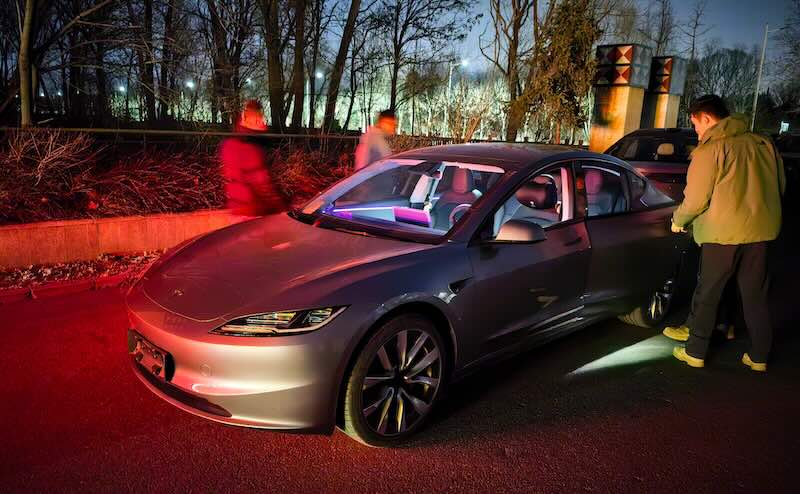
Tesla has once again confirmed its commitment to early FSD buyers. CEO Elon Musk addressed mounting concerns from HW3 owners, reiterating that those who purchased FSD will receive full autonomous capability, even if that requires a free computer upgrade.
Timing isn’t coincidental. Tesla recently announced it will discontinue one-time FSD purchases after February 14, transitioning entirely to subscriptions. That policy change sparked immediate backlash from customers who invested thousands in the technology years ago, many of whom now drive HW3-equipped vehicles.
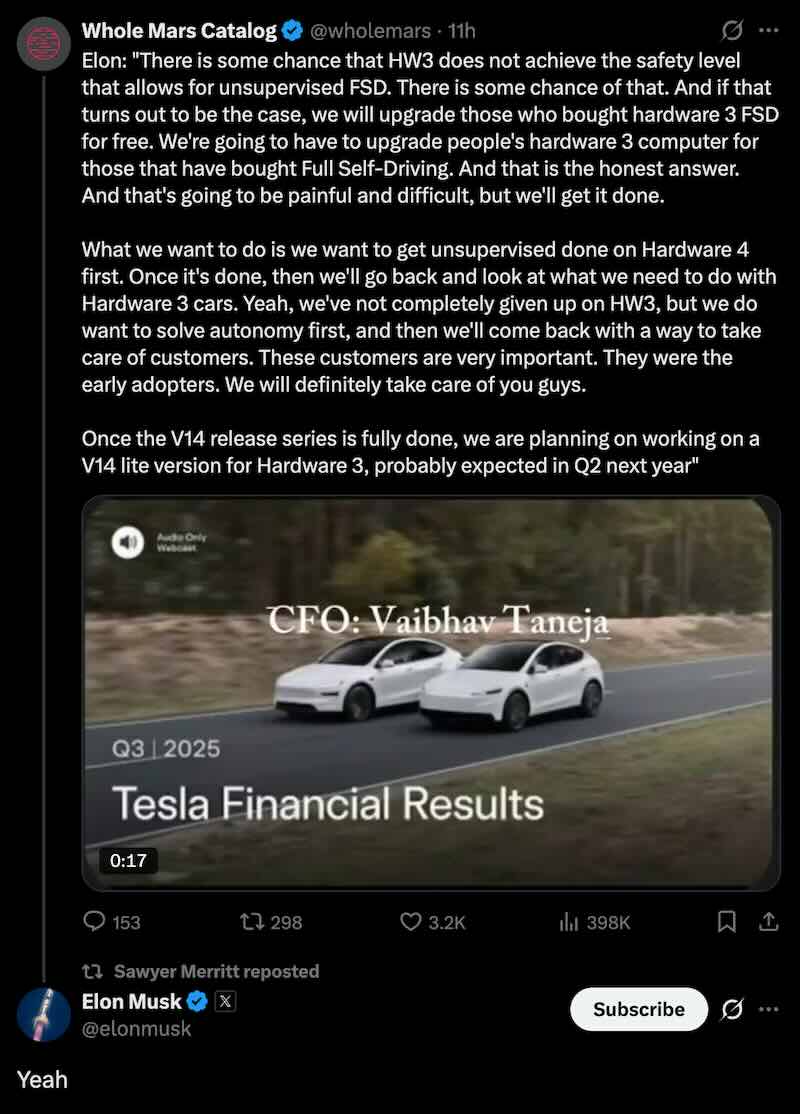
Elon didn’t sugarcoat the situation during Tesla’s Q3 2025 earnings call. “There is some chance that HW3 does not achieve the safety level that allows for unsupervised FSD,” he acknowledged. “And if that turns out to be the case, we will upgrade those who bought HW3 FSD for free.”
He continued: “That is going to be painful and difficult, but we’ll get it done.”
Tesla’s current strategy prioritizes HW4 development first. According to Elon, the company wants to “solve autonomy first” on newer hardware before circling back to address HW3 limitations. Once unsupervised driving works reliably on HW4, engineers will determine what modifications, or full replacements—older vehicles need.
Ashok Elluswamy, Tesla’s VP of AI, previously outlined the technical roadmap. After completing the FSD v14 rollout on HW4, developers plan to create a streamlined version specifically for HW3 vehicles. Internally, this iteration carries the designation FSD v14 Lite.
Tesla expects that lighter version to arrive in Q2 this year. However, the timeline remains uncertain, FSD v14.3 hasn’t launched yet, which could push subsequent releases further out.
Renewed commitment arrives at a critical juncture. Early adopters purchased FSD based on explicit promises about future capability. Many paid $5,000 to $15,000 upfront, trusting Tesla would deliver regardless of how long development took.
When Tesla announced the end of one-time purchases, suspicion emerged that the company might quietly abandon HW3 obligations. After all, subscription revenue generates ongoing income—honoring old commitments doesn’t.
Elon’s response targets those concerns directly. “These customers are very important,” he said. “They were the early adopters. We will definitely take care of you guys.”
From a business perspective, the challenge is substantial. Replacing computer hardware across thousands of vehicles carries significant costs. But from a trust perspective, the obligation is straightforward, Tesla sold Full Self-Driving, not “Full Self-Driving Unless Your Hardware Gets Outdated.”
Whether the company delivers on schedule remains to be seen. What’s clear is that early buyers aren’t letting Tesla forget what FSD actually meant when they purchased it.
Related Post
Tesla FSD v14 Already Has Reasoning Features, Says VP Ashok Elluswamy
Tesla Restarts Dojo 3 Supercomputer After AI5 Chip Breakthrough
Tesla FSD v12.6 Brings Major Autopilot Upgrades to AI3(HW3) Vehicles