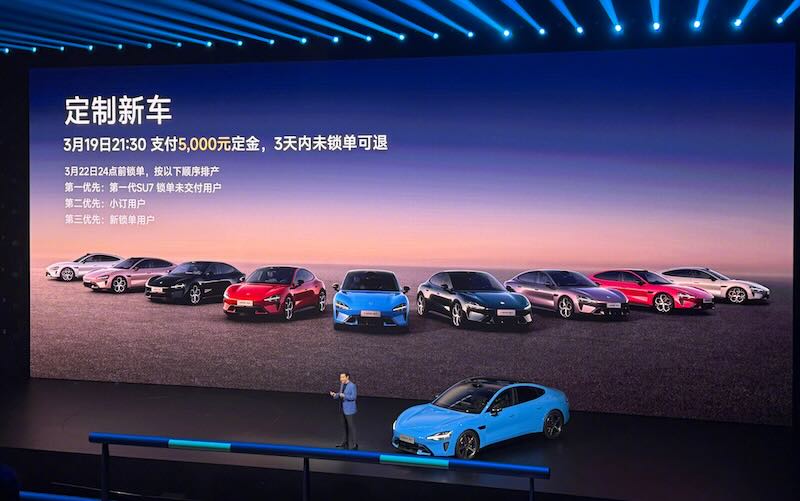
Xiaomi didn’t just refresh the SU7. The company rebuilt it from the inside out, and the result is a vehicle that’s far more difficult to dismiss as a tech-company novelty. Starting at 219,900 yuan for the base trim, 249,900 yuan for the Pro, and 303,900 yuan for the Max, new-gen SU7 arrives with sharper pricing and a spec sheet that demands attention from legacy automakers.
Cabin alone signals a shift in priorities. A multi-layer wraparound ambient lighting system syncs with music and driving modes, while Nappa leather wraps the sport steering wheel at key contact points. Every high-touch surface uses soft materials, details that suggest Xiaomi has been listening closely to criticism about the original.

Here’s where things get interesting. Onboard smart refrigerator now runs on an independent compressor, supporting a cooling range of -6 to 15°C and heating up to 50°C. It holds six standard cans — small, yes, but executed properly this time.
Audio varies by trim. Standard and Pro models ship with a 14-speaker system and a dedicated subwoofer that reaches below 30Hz. Max steps up to 25 speakers with Dolby Atmos support. That’s a meaningful gap between configurations, and buyers will want to factor it in.
Seating has received a thorough rethink. Driver’s seat offers 18-way adjustability with massage and active side bolstering across all trims. Front passengers get a zero-gravity seat with ventilation, heating, and massage. Rear seats now recline to 121° — a number that matters for longer journeys. Laminated acoustic glass comes standard on all four doors, and the Max adds an optional ultra-quiet package with over 110 acoustic treatments throughout the cabin.
The V6s Plus motor now runs across the entire lineup. Max hits 100 km/h in 3.08 seconds and tops out at 265 km/h. Range ratings land at 720 km for the base, 902 km for the Pro, and 835 km for the Max under CLTC testing — a sequence worth noting, since the Pro actually outranges the Max.
All three variants operate on a silicon carbide high-voltage platform. Max model supports peak charging at 5.2C, getting from 10% to 80% in as little as 12 minutes. That kind of charging speed starts to erode one of the last remaining objections to EV ownership.
Chassis-wise, the “Jiaolong” platform brings a front double-wishbone and rear five-link independent suspension layout, 265mm rear tires across the range, and upgraded brake pedal tuning. Model Pro and Max add dual-chamber air suspension with CDC adaptive dampers. To demonstrate braking confidence, Xiaomi ran 40 consecutive 100-to-0 km/h stops without measurable performance degradation.
Xiaomi SU7’s door handle system deserves its own section, not because it’s flashy, but because it’s genuinely thoughtful engineering. Handles comply with China’s 2027 safety standard today, ahead of the mandate.
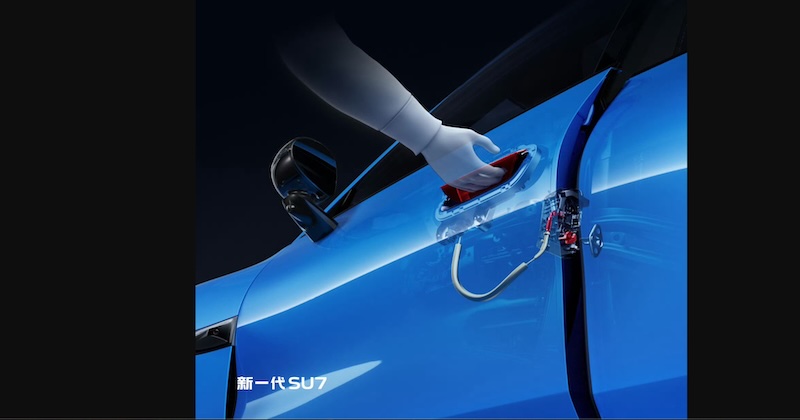
In normal operation, they’re semi-hidden and electrically actuated. After a collision, they switch to mechanical mode automatically. Locking system draws from three independent power sources: the main battery via DC-DC converter, a 12V low-voltage battery, and a dedicated backup unit positioned under the second-row seats — a location statistically less likely to sustain damage in severe crashes.
If all power fails, a mechanical cable still allows external door access. Inside, each door carries its own independent mechanical emergency release requiring no electricity whatsoever.
On the technology side, the four-in-one domain controller, dual 5G dual-SIM, Wi-Fi 7, UWB proximity control, and a 700 TOPS driver-assistance chip round out a connected vehicle that’s built to automotive-grade validation standards. HAD system handles complex navigation, large obstacle avoidance, and natural voice commands without requiring structured input.
The Xiaomi SU7 started as a statement. Now, it’s starting to look like a standard.
Related Post
Xiaomi Next-Gen SU7 Pre-Orders Open: 900km Range, LiDAR Standard, Starting at RMB 229,900
Xiaomi Vision GT Supercar Debuts at MWC Barcelona
Xiaomi YU7 Electric SUV Gets 200K Orders in Three Minutes at Launch