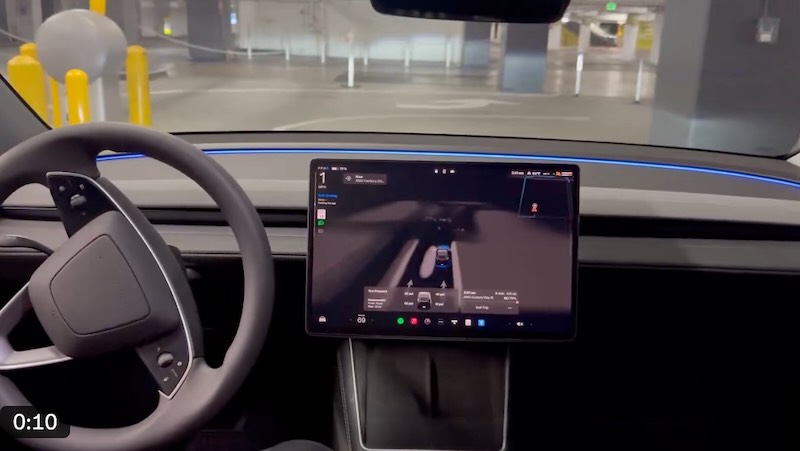
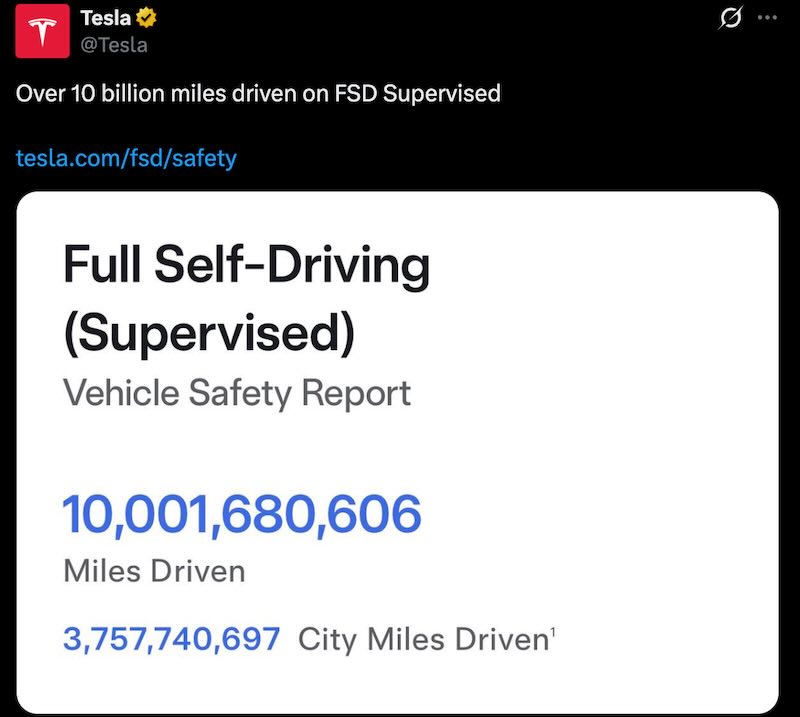
Tesla’s FSD system has officially crossed 10 billion cumulative miles — roughly 16 billion kilometers, a milestone that signals the technology’s rapid maturation rather than its arrival. And if the current trajectory holds, the next 10 billion miles may come faster than anyone expected.
With 1.3 million active FSD users as of Q1 2026, and subscriber momentum that defies conventional adoption curves, Tesla isn’t just collecting data. It’s building a compounding advantage that competitors can’t easily replicate.
Tesla sold approximately 358k vehicles globally in Q1 2026, yet added 180,000 new FSD subscribers during the same period. In North America specifically, the company sold 117k vehicles but still added 180k subscriptions — a notional take rate exceeding 154%.
That figure exceeding 100% shouldn’t raise eyebrows. It reflects a large cohort of existing owners finally opting in, many of them prompted by meaningful capability improvements in recent FSD iterations. When you stack that against Tesla’s 9.26 million vehicles sold globally — implying a cumulative FSD adoption rate near 14%, there’s still a substantial pool of potential subscribers yet to convert.
Tesla’s FSD improvements haven’t gone unnoticed. Each software release is narrowing the gap between driver hesitation and driver trust.
Beyond the headline numbers, Tesla has been unusually candid about how it refines FSD’s behavior in the field. Beyond using cabin-facing cameras for driver monitoring, the system also factors in seatback angle as an attention proxy — a heavily reclined position may indicate fatigue or disengagement.
Every disengagement gets reviewed internally, though data captured within 200 meters of a user’s home is excluded by default. Users can opt in to share that proximity data, which could enable Tesla to improve home-zone and parking-specific behavior.
After any disengagement event, the system prompts drivers to record a voice note — capped at 30 seconds — explaining what happened. More than 100 engineers review selected cases manually, while AI handles the rest. Notably, Tesla recommends English for these recordings, since translations from other languages may introduce errors.
Tesla’s FSD global rollout is accelerating. Regulatory approval in the Netherlands represents the first meaningful European foothold for the technology. To secure it, Tesla engineers submitted over 4k pages of documentation to Dutch regulators and completed 1.6 million kilometers of testing across an 18-month period.
That’s not a token compliance effort — it’s an institutional commitment to market-by-market approval. Still, timeline for broader European availability remains measured. After FSD v14 Lite reaches HW3.0 vehicles in the U.S., European regulatory clearance could take an additional 6–12 months.
The pace of accumulation is accelerating. At the current subscriber base and usage rates, Tesla’s internal teams project the 20-billion-mile milestone could arrive within three quarters. That’s a compounding effect: more subscribers, more miles per subscriber, and more software updates that encourage greater reliance on the system.
Whether regulators in new markets can keep pace with that deployment velocity remains the key variable — and arguably the most consequential one.
Tesla’s FSD may have taken years to reach its first 10 billion miles, but the road to the next 10 billion is paved with better data, better software, and an installed base that’s only getting fuller on self-driving.
Related Post
Tesla AI Engineer Yun-Ta Tsai Explains Why More Sensors Could Actually Hurt Autonomous Driving
Tesla FSD V14.3 Released: Faster Reactions, Smarter Vision and Major RL Upgrades
Tesla FSD Insurance Savings: Autopilot More, Pay Less | 2026 Guide