
Tesla Cybercab has cleared one of its most critical regulatory hurdles — and the paperwork came with a treasure trove of specs Tesla hadn’t voluntarily disclosed. Vehicle has officially secured an EPA Certificate of Conformity for the 2026 Cybercab, classifying it as a battery-electric Zero Emission Vehicle and confirming compliance with federal Clean Air Act emission standards. What makes this particularly significant isn’t just the certification itself — it’s what the filing reveals about a vehicle Tesla’s been strategically tight-lipped on.
Publicly accessible certification documents have officially dropped, giving us our first real look at the specs for the Cybercab. EPA documents aren’t posted daily — they’re uploaded in 14-day increments, refreshed every other Monday, which explains why this batch landed alongside filings from other manufacturers.
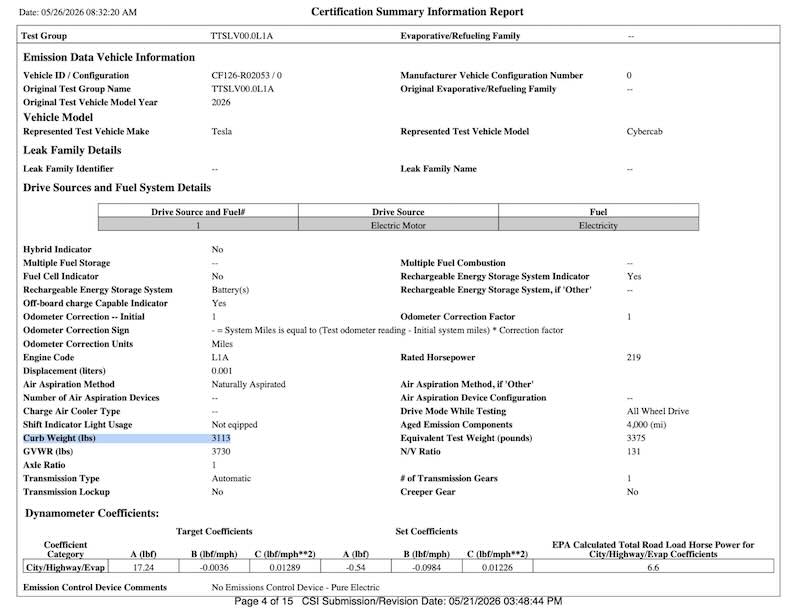
Official filings reveal a front-wheel drive configuration, marking a rare departure from Tesla’s usual rear-wheel or all-wheel drive architecture. That’s not the only surprise. Cybercab is powered by a single 163 kW (219 horsepower) AC permanent magnet motor, operating on a 326-volt electrical architecture with a compact ~48 kWh lithium-ion battery pack.
Weight-wise, it tips the scales at just 3,113 pounds with a GVWR of 3,730 pounds — making it the lightest vehicle Tesla has ever built. That lean curb weight matters enormously for efficiency, and the numbers back it up: documents filed with the EPA show the vehicle is certified at 165 Wh/mi, placing it among the most efficient electric vehicles on the road.
Range figures in EPA documents aren’t the same as what ends up on a window sticker, and that distinction matters here. “Equivalent All-Electric Range” is listed at 418 miles, alongside 375 miles of highway range — but these raw lab numbers don’t translate directly to a real-world EPA rating.
EPA requires manufacturers to adjust their range figures from lab conditions, with the most common approach applying a factor of 0.7 to all test parameters, including range. Run that math — 418 multiplied by 0.7 lands at roughly 293 miles, which aligns precisely with what Tesla had previously communicated. Despite the small battery, Tesla is targeting approximately 300 miles of range per charge.
EPA certification was issued for test group TTSLV00.0L1A on May 26, 2026, with an introduction-into-commerce date of May 29, 2026. That said, the EPA certificate is a significant step, but Tesla still requires separate autonomous vehicle permits from individual states before it can operate the Cybercab as a public rideshare service.
Production, meanwhile, isn’t waiting. Over the weekend, 102 units were spotted in the outbound lot at Gigafactory Texas, and vehicles are already appearing in cities for real-world testing. Cybercab is expected to expand into Orlando, Tampa, Miami, Las Vegas, and additional markets before year’s end.
Regulatory process is moving. The factory’s moving. The only thing left? Getting this cab to move paying passengers — legally.
Related Post
Tesla 2025 Recap, Confirms Cybercab Real Production Ramp Starts in April
Tesla Cybercab Production Starts April 2026: No Steering Wheel, No Pedals