
Tesla has initiated production of the Cybercab at its Texas facility, marking a transition from prototype demonstrations to manufacturing scale. The company disclosed during its Q1 2026 earnings report that paid robotaxi miles nearly doubled quarter-over-quarter, crossing 1.7 million cumulative miles. Production units now feature a glossy exterior finish, departing from the matte surfaces seen on earlier demonstration vehicles.
CEO Elon Musk acknowledged during the earnings call that initial Cybercab production will proceed slowly before accelerating toward year-end. “Whenever you have a new product with completely new everything, you should expect initial production will be slow, then going exponential towards the end of this year,” Elon stated.
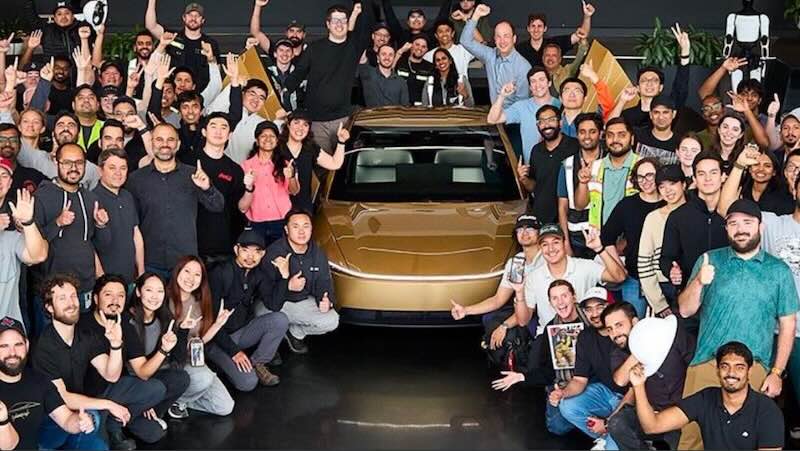
The production Cybercab showcases design refinements beyond surface treatment. Gold color option appears richer and more saturated compared to prototype versions. These manufacturing units represent Tesla’s first purpose-built robotaxi vehicles designed without traditional driver controls.
Lars Moravy, VP of Vehicle Engineering, confirmed the Cybercab will not face the 2,500-unit annual cap that typically restricts autonomous vehicle deployment. This exemption removes production constraints tied to federal safety standards for vehicles lacking steering wheels and pedals. Tesla’s deployment timeline will depend entirely on internal manufacturing capacity and regulatory approvals in target markets.
Tesla indicated the Cybercab will eventually supersede the Model Y as the primary robotaxi vehicle. “Once in production, we expect that Cybercab will begin to replace the existing Model Y fleet and will be the largest volume vehicle in the fleet over time,” the company stated in its earnings materials.
Tesla has expanded unsupervised operations in Austin while launching services in Dallas and Houston during April. Preparation work continues for entry into additional major metropolitan areas, including testing and permit acquisition.
Elon projected robotaxi expansion to approximately twelve states by year-end, emphasizing a cautious rollout strategy. “We haven’t had any injuries. We want to keep it that way,” he noted. Revenue from unsupervised operations will likely remain modest through 2026, with material contributions expected in 2027.
The company prioritizes safety metrics as operations scale. With paid Tesla robotaxi miles doubling quarterly, the service continues expanding its operational footprint while maintaining injury-free performance.
Related Post
Tesla Cybercab Production Starts April 2026: No Steering Wheel, No Pedals
Tesla True Unboxed Process Patent Could Transform EV Manufacturing for CyberCab Production
Tesla Cybercab New Powertrain with an Estimated 5.5 Miles/kWh, Huge Improvement Over Model 3/Y