
Tesla has officially published its First Responders Guide for the Cybercab, and it’s arguably the clearest signal yet that public Robotaxi rides aren’t far off. Documentation isn’t a flashy product announcement — it’s the kind of procedural, by-the-book technical release that tends to precede real-world deployment. What it describes is a vehicle that’s been engineered, quite deliberately, to operate without a human at the wheel.
The Cybercab, Tesla confirms, runs on an SAE L4 automated driving system. In autonomous mode, vehicle is designed to handle the entire dynamic driving task without any input from a human driver. That’s a meaningful distinction from L2 driver-assistance systems Tesla has shipped for years. A Cybercab fitted with a steering wheel, brake pedal, and acceleration pedal is explicitly classified as an engineering or test vehicle — a workaround, not the intended product.
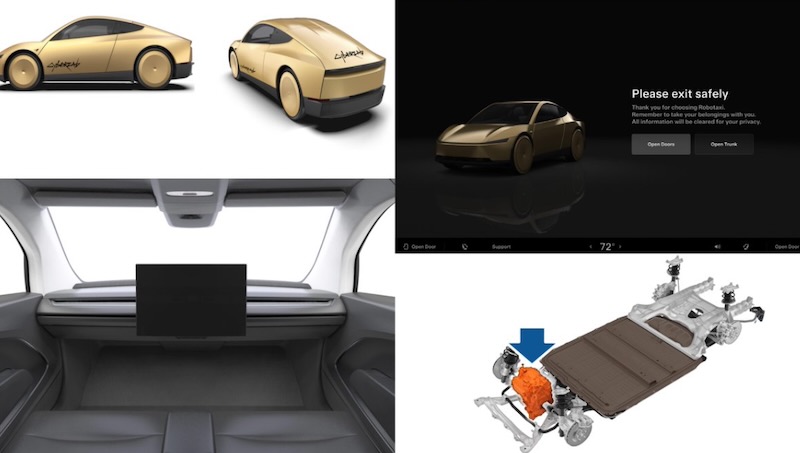
Operationally, Cybercab design domain covers a broad range of environments — public freeways, city streets, rural roads, parking lots, car washes, charging stations, and pick-up and drop-off zones. It’s also designed to operate around the clock, including during light to moderate precipitation. That said, if extreme weather is forecast, it won’t accept new rides. If it’s already out and conditions deteriorate unexpectedly, it’s programmed to pull over at the nearest safe location, park, and alert Tesla Robotaxi Support.
Between rides, the vehicle doesn’t just sit idle. It roams its operational area or routes itself to a charging station or parking lot. If the battery is too low to complete another trip, it heads to charge before picking up any new bookings. It’s a closed operational loop — efficient by design.
First Responders documentation reveals a surprisingly thorough safety stack built into the Cybercab. There are at least ten airbags across the cabin — front, knee, side-mounted, inner and outer seat-mounted, and curtain. Vehicle also includes an active hood that rises during certain pedestrian impacts to reduce injuries, and exterior microphones and speakers that enable two-way communication with Tesla Robotaxi Support.
For emergency scenarios, Cybercab includes two First Responder Loops, one under the hood and one behind the passenger-side B-pillar — for redundancy. Opening a door or unbuckling a passenger’s seatbelt automatically disengages the Robotaxi and triggers a park. Vehicle is also designed to respond to visible hand signals from first responders and can follow pathways marked with cones. In the event of connectivity or hardware failure, the hazard lights flash rapidly and the system attempts to pull over safely.
A few hardware notes stand out: charge port is centered below the trunk, not on the rear fender; there’s a manual emergency charge cable release hidden behind the rear wheel liner; and the vehicle runs on both a 400V high-voltage battery and a 48V low-voltage battery, with orange-colored coolant in the battery pack.
Tesla recommends that first responders unfamiliar with its vehicles take time to familiarize themselves with the controls before attempting manual operation — a reasonable ask given how differently Cybercab is configured from conventional vehicles. Window switches sit underneath the touchscreen. Interior door handles have two detents, with the second acting as a mechanical emergency release.
None of this reads like speculative hardware. It reads like a vehicle that’s been engineered, tested, and documented for real-world use at scale. When it comes to the Cybercab’s readiness for the road, the question isn’t really if anymore — it’s when the Robotaxi rolls out for everyone.
Related Post
Tesla Cybercab EPA Certificate Reveals Specs: Range, HP & Battery
Tesla Cybercab Production Begins: Robotaxi Miles Double in Q1 2026
Tesla Cybercab New Powertrain with an Estimated 5.5 Miles/kWh, Huge Improvement Over Model 3/Y