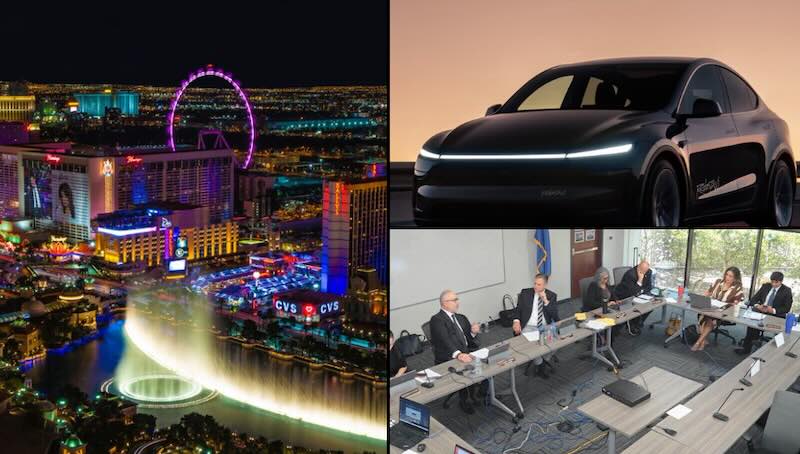
Nevada’s Transportation Authority voted to grant Tesla its full Autonomous Vehicle Network Company (AVNC) permit on August 20th, clearing the path for a paid public robotaxi service across the entire state. Approval came after the commission’s four-hour General Session, meeting that had Tesla representatives in attendance and the autonomous vehicle industry watching closely.
This isn’t the limited, 10-vehicle interim order Tesla had been operating under. This is the real thing.
Tesla’s road to this moment didn’t start yesterday. Regulatory progression in Nevada began in late 2025, when Tesla submitted its Testing Registry certification to the Nevada DMV in September 2025 and received approval just seven days later — though that certification explicitly prohibited carrying paying passengers. By November 2025, Tesla completed Nevada’s self-certification process for autonomous vehicle operations, and then filed for the AVNC permit on June 3, 2026.
The commission’s August 20th vote replaces the previous interim operating order, which capped Tesla’s fleet at just 10 vehicles, with a far more expansive authorization covering up to 5,000 fully autonomous robotaxis deployable over the next 12 months.
Approval covers all of Clark County, which includes Las Vegas, but its reach doesn’t stop there. According to the commission, Tesla can expand operations to the rest of the state as long as it notifies regulators when it intends to extend its geofence. That’s a significant amount of operational flexibility for a company that’s still building out its autonomous fleet nationwide.
Tesla representatives at the meeting were clear: they won’t deploy all 5,000 vehicles at once. They’ll start small, prove out safety and operations, and scale from there. Before commercial service officially begins, Tesla must complete a few administrative requirements — vehicle inspections, insurance filings, and submitting its fare rates to the authority. That process is expected to wrap up within 30 days.
Tesla’s robotaxi scaling also depends on how quickly it can move to FSD v15, a software rewrite currently targeted for late 2026 or early 2027. So while the permit authorizes 5,000 vehicles, the real fleet ramp will likely track that software milestone.
Tesla has bet heavily on autonomy, robots, and AI, Nevada just gave that bet a lot more room to run. With Las Vegas as its launchpad, Tesla’s robotaxi ambitions now have a very clear next move: put the pedal to the metal, one permit at a time.
Related Post
Tesla Cybercab EPA Certificate Reveals Specs: Range, HP & Battery
Tesla CyberCab Launches in Austin: Public Robotaxi Rides Expected by Late August
Tesla Cybercab Robotaxi First Responders Guide: What the Docs Reveal