It started as a family group text. It ended up in front of Tesla’s VP of AI.
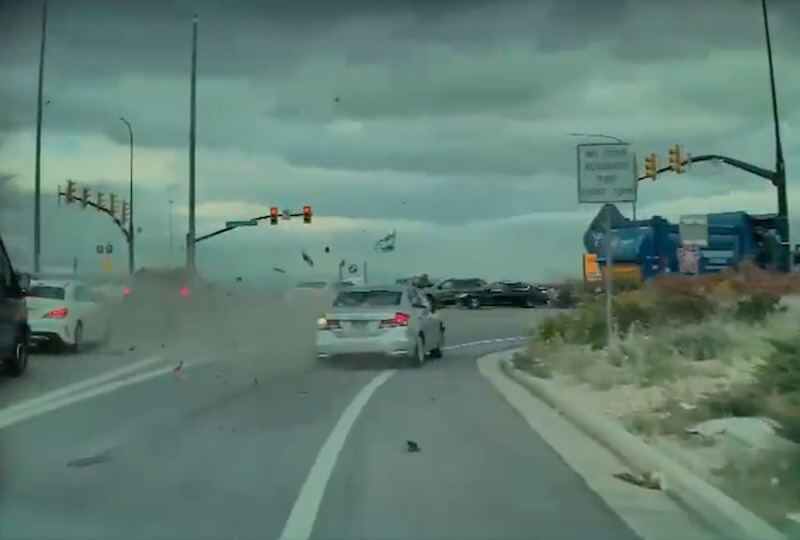
On November 12, 2026, Kathleen Anderson posting on X as @RepubliKate shared three dashcam videos of an incident involving her brother’s friend’s Tesla. Operating in self-driving mode, detected an approaching vehicle coming from behind at excessive speed and moved out of the way. Driver of the speeding car was killed. Within hours, the post had drawn a direct response from Tesla’s VP of AI and was circulating across automotive communities globally.
What initially looked like a compelling but anecdotal moment has since connected to a much larger story about where Tesla’s autonomous driving stack actually stands right now.
The crash is believed to have occurred on the PG Blvd offramp in Utah County. Based on a Korean-language breakdown that circulated alongside the original post, the Tesla’s FSD display was active when the system made an unusual deceleration before moving toward the shoulder. Moments later, a white sedan approached at high speed, passed the Tesla on the left, and collided with another vehicle at an intersection. Tesla avoided involvement entirely.
Anderson later added context in a follow-up: her brother mentioned in a family text that there was speculation the speeding driver may have experienced a medical issue before the crash, and may have already been deceased at the moment of impact. News reports at that time only confirmed that a West Jordan man died and three others were hospitalized in a Midvale crash. The official cause remained under investigation.
Post didn’t stay in the Tesla enthusiast echo chamber for long. Ashok Elluswamy, Tesla’s VP of AI, replied directly—stating that Tesla’s self-driving simultaneously monitors all 360 degrees around the car and takes the vehicle out of danger from any direction.
That’s not just executive messaging. It maps precisely to a feature Tesla has been rolling out since September 2026. Tesla introduced Automatic Collision Evasion, a new safety feature that can activate FSD Supervised to avoid a collision and continue driving, as part of software update 2026.27.5 alongside FSD v14.3.9.
Rather than only braking in a straight line like standard Automatic Emergency Braking, the system determines whether swerving around a hazard offers a better chance of avoiding a crash. It’s described as a last-resort maneuver when the vehicle detects an emergency event.
Mechanics matter here—especially for anyone trying to understand what may have happened on that Utah County offramp.
Maneuver can include changing lanes or moving onto the shoulder, with braking or accelerating as needed, then continuing to drive. While the evasion is running, the accelerator is muted and pressing the brake slows the car without canceling the maneuver; canceling requires firm, deliberate steering with more force than a normal FSD cancel.
Tesla’s release materials cite a roughly 20% faster reaction time versus the prior stack, a meaningful margin when the feature’s whole job is avoiding a crash a driver is already too late to prevent.
FSD is already executing a safety maneuver in as little as 0.17 to 0.20 seconds at the outer limit of human perception. That reaction window is what separates a near-miss from a fatality.
There’s a catch, though. Feature is currently limited to vehicles with the AI4 hardware platform. Owners on older hardware won’t have access, feature is also paywalled behind an FSD subscription and is currently inaccessible to Tesla owners outside North America, even those who have paid for FSD.
This incident didn’t happen in a vacuum. Tesla has faced sustained NHTSA scrutiny throughout 2026. Office of Defects Investigation opened an Engineering Analysis to evaluate Tesla’s FSD degradation detection system, specifically focusing on its ability to detect system degradation in reduced roadway visibility conditions and alert the driver with sufficient time to respond.
California even ruled that Tesla’s “Full Self-Driving” branding constituted false advertising, and earlier this year a separate incident made headlines when a Tesla was pulled over in August 2026 for going 64 miles per hour in a 45 mph zone while operating in FSD mode.
Against that backdrop, a dashcam video showing FSD actively steering a vehicle away from a potentially fatal collision carries real narrative weight for Tesla regardless of whether the company officially claims credit for the maneuver.
Questions remain. Owner has not publicly confirmed which FSD version was running. Utah County crash investigation hasn’t closed. And the precise mechanism whether this was Automatic Collision Evasion, standard FSD lateral avoidance, or coincidental driver input, hasn’t been confirmed by Tesla’s telemetry data.
During an ACE intervention, accelerator pedal is muted, while pressing the brake might slow vehicle but doesn’t cancel the maneuver. Even if the system leaves you as a passenger, you are still liable for anything that goes wrong. That liability question will follow the technology wherever it goes next.
What’s clear is that Tesla’s self-driving simultaneously monitors all 360 degrees, for at least one driver on a Utah freeway off-ramp, that may have made all the difference.
If this is what FSD looks like when it’s driving its case forward, Tesla’s critics may need to steer around a few of their own assumptions.
Related Post
Tesla FSD V14.3.9 Automatic Collision Evasion: What Drivers Need to Know
Tesla FSD Pothole Avoidance Is Coming — Here’s What Elon Musk Confirmed
Tesla FSD Subscriptions Surge 56% to 1.48M in Q2 2026 — Here’s What the Data Shows